
Non-FictionInformativeEducational
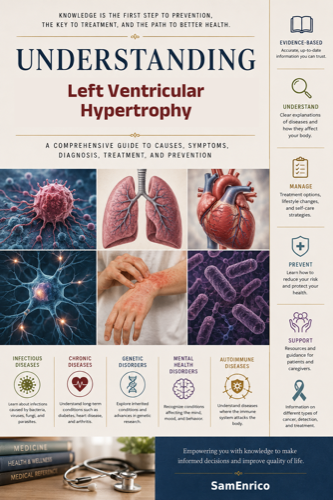
Understanding Left Ventricular Hypertrophy eBook
This disease publication, published by SamEnrico,
by Shank Eilene
This disease publication, published by SamEnrico, covers Understanding Left Ventricular Hypertrophy
Formats
Free sample
Chapter 1: The Silent Earthquake–- The morning of March 14th started like any other for Maria Figueroa, a 52-year-old third-grade teacher in El Paso, Texas. She packed her husband’s lunch, kissed her teenage son goodbye, and drove through the familiar desert dawn to Jack Lowe Elementary School. She had no chest pain. No shortness of breath. No palpitations.
By most medical definitions, she felt “perfectly healthy.” But at 10:37 AM, while helping a student sound out the word “beautiful,” Maria collapsed face-first onto her classroom rug. A colleague started CPR. Paramedics arrived within eight minutes. An automated external defibrillator shocked her heart twice. None of it worked.
Maria Figueroa died from sudden cardiac arrest at the age of fifty-two. The autopsy report listed the cause of death as “arrhythmia in the setting of hypertensive left ventricular hypertrophy.” Her heart weighed 520 grams—nearly twice the normal weight of 250-300 grams. Her left ventricular wall measured 2.1 centimeters thick, more than double the upper limit of normal. Her coronary arteries showed mild plaque but no catastrophic blockages. Maria did not have a heart attack in the traditional sense.
She had a heart that had been silently remodeling itself for decades, and one day, without warning, its electrical system failed. The tragedy of Maria’s death is not that it was inevitable. It is that it was entirely predictable—and entirely preventable.The Hidden Epidemic You’ve Never Heard Of Left Ventricular Hypertrophy—LVH for short—is one of the most common abnormal heart conditions in the world, yet most people have never heard of it. This is not because it is rare or benign. It is because LVH has no publicist.
Unlike heart attacks, which arrive with dramatic chest-clutching agony, or strokes, which announce themselves with sudden paralysis, LVH operates in complete silence. It is the medical equivalent of a building foundation slowly cracking under the weight of an unsupported roof. The cracks spread for years, even decades, invisible to the building’s occupants, until one ordinary Tuesday the entire structure collapses without warning.Here is what you need to know immediately: LVH is not a disease in itself. It is a phenotype—a visible or measurable characteristic—that results from the heart adapting to stress. Think of it as a callus on your hand.
If you start lifting heavy weights without gloves, your skin thickens to protect itself. That callus is adaptive, even helpful, up to a point. But if the callus grows too thick, it can crack, bleed, or restrict movement. Your heart works exactly the same way. When faced with chronic stress—most commonly high blood pressure—the left ventricle, which pumps oxygenated blood to your entire body, responds by thickening its muscular walls.
This thickening reduces the tension on each individual muscle fiber, temporarily normalizing the workload. For a while, this adaptation works beautifully. The heart continues pumping, ejection fractions remain normal, and the patient feels fine.But the adaptation comes at a steep price. A thickened heart is a stiff heart. A stiff heart does not relax properly between beats, so it cannot fill with enough blood before the next contraction.
This leads to diastolic dysfunction, then heart failure with preserved ejection fraction (HFp EF), then atrial fibrillation, then stroke, then sudden death. The progression can take ten, twenty, or thirty years, but for millions of people worldwide, it is happening right now, one heartbeat at a time, entirely unnoticed.The Numbers That Should Terrify You Let us look at the mathematics of this hidden epidemic. Hypertension—chronic high blood pressure—affects approximately 1.28 billion adults worldwide, according to the World Health Organization. Of those, roughly 600 million do not know they have it. Among those with diagnosed hypertension, only about 50 percent have their blood pressure adequately controlled.
Now consider this: among people with uncontrolled hypertension, the prevalence of LVH ranges from 20 to 40 percent, depending on the population studied and the diagnostic criteria used. In severe or long-standing hypertension, the prevalence climbs above 60 percent.Do the multiplication. Of the 1.28 billion hypertensive adults worldwide, at least 250 million have LVH by echocardiographic criteria. That is 250 million people walking around with a thickened, stiffening, arrhythmia-prone heart, most of whom have no idea. In the United States alone, an estimated 15 to 20 million adults have LVH.
The condition is more common than atrial fibrillation, more common than heart failure, more common than all cancers except breast and prostate. Yet ask your friends and family what LVH means, and you will likely receive blank stares.The demographic patterns are striking and revealing. LVH is more common in older adults, affecting up to 60 percent of people over 70 with hypertension. It is more common in Black populations, who have higher rates of hypertension and more pronounced cardiac remodeling in response to blood pressure elevation. It is more common in obese individuals, for whom the heart must work harder to perfuse a larger body mass.
And it is increasingly common in younger people, driven by the epidemic of obesity and sedentary lifestyle that has pushed hypertension into the third and fourth decades of life.But prevalence alone does not make LVH dangerous. What makes it dangerous is what it does to outcomes. LVH is not merely a marker of hypertension—it is a powerful, independent predictor of cardiovascular events. A landmark analysis from the Framingham Heart Study found that individuals with ECG-diagnosed LVH had a four- to six-fold increased risk of sudden death compared to those without LVH, even after adjusting for blood pressure levels. The Losartan Intervention For Endpoint Reduction (LIFE) study, which followed more than 9,000 hypertensive patients with LVH, found that every 1-gram increase in left ventricular mass was associated with a 4 percent increase in the risk of cardiovascular death.
Let that sink in. A single gram of additional heart muscle—about the weight of a paperclip—raises your risk of dying from a cardiovascular cause by 4 percent.A Brief History of a Silent Killer The recognition of LVH as a clinical entity has a surprisingly recent history. Before the advent of modern imaging, pathologists in the 19th century noticed that the hearts of patients who died from “dropsy” (what we now call heart failure) were often enlarged, thickened, and heavy. The great Victorian pathologist Sir Samuel Wilks wrote in 1862 about “a peculiar condition of the heart in which the walls are thickened without dilation of the cavities,” noting that this condition seemed to accompany chronic kidney disease and what was then called “apoplexy” (stroke). But these were autopsy findings, relevant only after the patient had died.The first major breakthrough came in 1908, when Dutch physiologist Willem Einthoven (who later won the Nobel Prize for inventing the electrocardiogram) described voltage criteria for what he called “left ventricular preponderance.” Einthoven noticed that the electrical signals recorded from the chest differed in patients with enlarged hearts.
His criteria were crude, but they established a principle that remains clinically useful more than a century later: electrical changes on the ECG can reflect structural changes in the heart.The second breakthrough came from the Framingham Heart Study, which began enrolling residents of Framingham, Massachusetts in 1948. When researchers analyzed the data decades later, they found something unexpected: participants whose ECGs showed LVH…
This is the end of the free sample. Get the eBook to keep going. Buy now
About this book
Details
- Author
- Shank Eilene
- Publisher
- SamEnrico
- Language
- English
- Genre
- Non-Fiction, Informative, Educational
- Released
- 2026-05-11
- Pages (approx.)
- 148
- Available as
- eBook, Audiobook

Read better in the ZLOADR app
Your eBooks on your phone or tablet. Sign in with your SamEnrico account and start reading.
More by Shank Eilene
 Drone Pilot Training BreakShank Eilene$11.99
 Gambling Cue Exposure TherapyShank Eilene$11.99
 Disappointment in Publish BookShank Eilene$11.99
 Emotional Inheritance Healing WorkbookShank Eilene$11.99
 Work Addiction Among Teachers GuideShank Eilene$11.99
 The Last Words of Hypatia: A Scholar’s Final Stand Against the DarkShank Eilene$11.99
 Clerk Meat PTShank Eilene$11.99
 Zero Subscriber Newsletter Launch GuideShank Eilene$12.99
 Parcel Carrier Rate NegotiationShank Eilene$12.99
 How to Start a Burger Stand Business (Beginners Guide)Shank Eilene$11.99
You may also like
 Hong Kong Handover 1997Dunn Johnnie$11.99
 Zumba For Postnatal Recovery CourseNeal Christian$11.99
 Zumba for BeginnersLadner Nikia$11.99
 YouTube Comment Mining GuideHumes Pandora$12.99
 Worry Box MeditationCarlin Rudy$11.99
 Workplace Stress MeditationNguyen Lynn$11.99
 Workplace Stress and Sleep RepairHawley Ivory$11.99
 Workplace Perfectionism CureDelaney Jeffry$11.99
 Workplace Injustice Anger GuideWallen Isabelle$11.99
 Work Addiction and Burnout LinkGreenwood Ester$11.99
 Women in Yoga and WellnessBeattie Galina$11.99
 Women in Stand Up ComedyChun Evangeline$11.99