
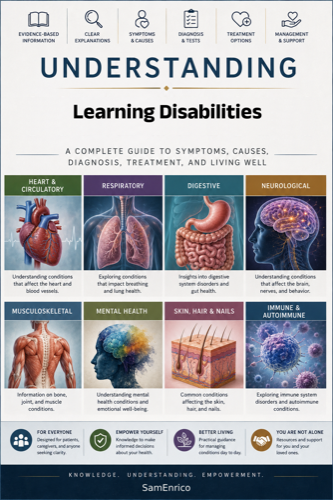
Non-FictionInformativeEducational
Understanding Learning Disabilities eBook
This condition publication, published by SamEnrico
This condition publication, published by SamEnrico, covers Understanding Learning Disabilities
Formats
Free sample
Chapter 1: The Phone Call--–- The phone rang at 2:47 on a Tuesday afternoon. Sarah remembered the time because she had just sat down with her first cup of coffee since 6:00 AM, a cold brew she had microwaved twice already. Her son, Lucas, was in fourth grade. He had been struggling with reading since kindergarten, but every parent-teacher conference brought the same reassurances: “He’s a bright boy. He’ll catch up.
Some kids just take longer.” She had believed them. She had believed them for four years.On the other end of the line was the school psychologist, a woman Sarah had met only once, briefly, during a orientation night. “Mrs. Thompson,” the psychologist said, her voice measured and professional, “we’ve completed the evaluation we discussed. I’m calling to share the results.
Do you have a few minutes?”Sarah didn’t know what “a few minutes” meant in this context. Was this a five-minute conversation or a life-changing one? She said yes anyway, because that is what parents do. They say yes to phone calls from schools, even when their hands are shaking.“Lucas meets the criteria for a specific learning disability in reading,” the psychologist continued. “More specifically, dyslexia.
I want to emphasize that this does not mean he is less intelligent than his peers. In fact, his cognitive testing showed above-average abilities in several areas. But his brain processes written language differently, and that difference requires specialized instruction.”Sarah heard the words. She understood each one individually. But strung together, they felt like a foreign language.
Dyslexia. Learning disability. Different brain processing. She had heard those terms before, of course. She knew there were children who had trouble reading.
But those were other people’s children. Not Lucas. Not her Lucas, who could build intricate Lego structures without instructions, who could remember every single player on his favorite baseball team including their batting averages, who could tell a story with such vivid detail that you felt like you had been there. That Lucas. How could that Lucas have a disability?The psychologist was still talking.
Something about an IEP meeting, about accommodations, about specialized reading instruction. Sarah nodded along, making sounds of acknowledgment, but her mind had split in two. One half was still on the phone, nodding. The other half was already grieving.This chapter is about that moment. The phone call.
The conference room. The moment a parent hears the words “learning disability” for the first time. It is about the cascade of emotions that follows—the fear, the guilt, the relief, the anger, the hope—and about what those emotions mean. It is about the difference between a label that traps and a label that liberates. And it is about the first steps of a journey that no parent expected to take but that millions of parents walk every year.The Weight of the Words There is no neutral way to hear the phrase “learning disability.” The word “disability” carries centuries of cultural baggage.
It evokes images of lack, of deficit, of something missing or broken. Even for parents who have worked in special education themselves, even for parents who have advocated for disability rights, the word lands differently when it is attached to their own child.This is not a failure of character. It is a feature of human psychology. We are wired to want our children to be safe, successful, and accepted by the tribe. A diagnosis that suggests difficulty—especially difficulty in school, which is the primary arena where children are measured and compared—triggers a primal fear response.
The amygdala, the brain’s threat-detection system, lights up. Cortisol floods the system. The parent goes into fight-or-flight mode, even while sitting calmly in a conference room chair.What makes this moment particularly painful is that it often follows years of smaller, quieter struggles. The parent has already watched their child fall behind. They have already seen the frustration in their child’s eyes when the other kids read aloud effortlessly.
They have already heard the teacher say, “He just needs to try harder,” or “She’s so smart, I don’t understand why she can’t get this.” They have already wondered, in the darkest hours of the night, whether they are doing something wrong. Whether they should read more. Whether they should push harder. Whether they have failed their child.The diagnosis does not create the pain. It names it.
And naming is both a wound and a healing.The Five Emotions of Diagnosis Over decades of research and clinical practice, psychologists have identified a predictable emotional trajectory that parents follow after a learning disability diagnosis. This is not a straight line. Parents do not move cleanly from one emotion to the next like checking boxes on a form. They cycle back and forth. They feel two or three emotions at once.
They wake up in acceptance and go to bed in denial. But understanding the pattern—seeing that your feelings have been felt by thousands of parents before you—can be profoundly comforting.1. Denial: “They Must Be Wrong”Denial is the brain’s shock absorber. It does not allow the full weight of the news to land all at once. When the psychologist says “dyslexia” or “learning disability,” the parent’s first response is often to find reasons to disbelieve it.“She reads at home sometimes.”“He’s so smart in other ways.”“Maybe the test was wrong.
Maybe he was tired that day.”“My brother struggled with reading too, and he turned out fine.”These are not excuses. These are survival mechanisms. The parent is not being unreasonable; they are being human. Denial buys time. It allows the psyche to process the information in smaller pieces, rather than all at once.The danger of denial is not that it exists—it is necessary—but that it can calcify into refusal.
Some parents stay in denial for months or years. They reject services. They blame the school. They blame the other parent. They blame the child.
They insist that more practice, more discipline, more “trying harder” will solve the problem. And while they wait, the child falls further behind.The way out of denial is not to eliminate it but to gently, persistently add evidence. The school evaluation. A private evaluation. The reading specialist’s assessment.
The parent’s own observations written down in a notebook. Eventually, the weight of evidence becomes too heavy for denial to carry.2. Guilt: “What Did I Do Wrong?”If denial is the first response, guilt is the second—and for many parents, the most enduring. The guilt takes many forms, but they all circle back to the same terrifying question: Did I cause this?“I didn’t read to him enough when he was little.”“I let her watch too much television.”“I should have pushed the school harder.”“I should have known something was wrong earlier.”“It must be genetic. This is my fault.
This came from me.”This last form of guilt—the genetic guilt—is particularly corrosive. When a parent recognizes their own struggles in their child’s evaluation, they face a double burden: they grieve for their child’s difficulty, and they grieve…
This is the end of the free sample. Get the eBook to keep going. Buy now
About this book
Details
- Author
- Navarrete Mitzie
- Publisher
- SamEnrico
- Language
- English
- Genre
- Non-Fiction, Informative, Educational
- Released
- 2026-06-02
- Pages (approx.)
- 160
- Available as
- eBook, Audiobook

Read better in the ZLOADR app
Your eBooks on your phone or tablet. Sign in with your SamEnrico account and start reading.
More by Navarrete Mitzie
 Women's Refugee MovementNavarrete Mitzie$11.99
 The Attention Compounding PrincipleNavarrete Mitzie$11.99
 Step Eight Harm ListNavarrete Mitzie$11.99
 Treating Psychopathy FailureNavarrete Mitzie$11.99
 Language Of Growth GuideNavarrete Mitzie$11.99
 Habit for Depression GuideNavarrete Mitzie$11.99
 Medical School Anki GuideNavarrete Mitzie$11.99
 The Tongues of the Nile: The Polyglot Scholars of Ancient EgyptNavarrete Mitzie$11.99
 Scharnhorst: The Architect of Prussian Military MightNavarrete Mitzie$11.99
 How to Produce a GalvanizerNavarrete Mitzie$11.99
 How to Become a Maple-syrup MakerNavarrete Mitzie$11.99
 Process Flow Prompt Engineering GuideNavarrete Mitzie$12.99
You may also like
 Hong Kong Handover 1997Dunn Johnnie$11.99
 Zumba For Postnatal Recovery CourseNeal Christian$11.99
 Zumba for BeginnersLadner Nikia$11.99
 YouTube Comment Mining GuideHumes Pandora$12.99
 Worry Box MeditationCarlin Rudy$11.99
 Workplace Stress MeditationNguyen Lynn$11.99
 Workplace Stress and Sleep RepairHawley Ivory$11.99
 Workplace Perfectionism CureDelaney Jeffry$11.99
 Workplace Injustice Anger GuideWallen Isabelle$11.99
 Work Addiction and Burnout LinkGreenwood Ester$11.99
 Women in Yoga and WellnessBeattie Galina$11.99
 Women in Stand Up ComedyChun Evangeline$11.99