
Non-FictionInformativeEducational
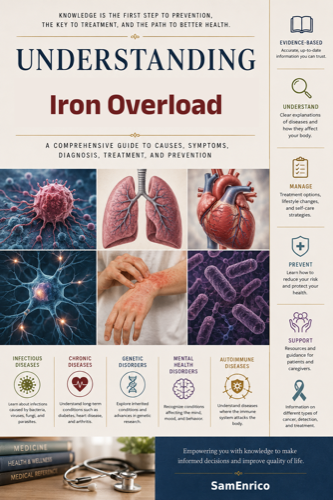
Understanding Iron Overload eBook
This disease publication, published by SamEnrico,
This disease publication, published by SamEnrico, covers Understanding Iron Overload
Formats
Free sample
Chapter 1: The Great Pretender...--–- Three doctors in three years. That was the average. Three separate physicians, three different waiting rooms, three sets of puzzled expressions. Fatigue, they said. Probably just stress.
Maybe early arthritis. Could be a touch of depression. Here, try this anti-inflammatory. Get more sleep. Cut back on the coffee.
Come back in six months if you're still not feeling right.But the fatigue wasn't the kind that resolved with a good night's rest. It was the bone-deep exhaustion that made climbing a single flight of stairs feel like a marathon. The joint pain wasn't the predictable ache of aging; it was a peculiar stiffness concentrated in the knuckles, specifically the second and third fingers of each hand, as if someone had placed small stones inside the joints. And the depression—if that's what it even was—felt less like sadness and more like a fog that settled over the brain, making simple decisions feel overwhelming and conversations difficult to follow.What these patients didn't know, and what their doctors had failed to consider, was that a single underlying condition was responsible for all of it. A condition that affects an estimated one in every 200 to 300 people of Northern European descent, making it more common than cystic fibrosis, muscular dystrophy, and phenylketonuria combined.
A condition that, when caught early, is remarkably easy to treat and completely manageable. Yet a condition that remains profoundly underdiagnosed, often until irreversible damage has already occurred.This is the paradox of iron overload, specifically hereditary hemochromatosis. It is simultaneously one of the most common genetic disorders in the Western world and one of the most frequently missed diagnoses in clinical practice. The symptoms are nonspecific. The early warning signs are easy to dismiss.
And the consequences of that dismissal—cirrhosis, cardiomyopathy, diabetes, debilitating arthritis, and early death—are entirely preventable.This chapter is about recognition. It is about understanding why iron overload has earned its reputation as "The Great Pretender," how it came to be misunderstood for centuries, and most importantly, how you can determine whether you or someone you love might be among the millions walking around with undiagnosed iron accumulation. The journey from patient to diagnosis is often long and frustrating, but it does not have to be. By the end of this chapter, you will have the knowledge and tools to advocate for the simple blood tests that could change everything.A History of Misunderstanding: From Bronze Cadavers to Genetic Discovery The story of iron overload is, in many ways, a story of missed connections. Physicians had been describing the constellation of symptoms for more than a century before anyone realized they were looking at a single disease process.The earliest known description dates to 1865, when the French physician Armand Trousseau—himself a renowned clinician who would later have his name attached to the sign of latent tetany—presented a peculiar case before the Société Médicale des Hôpitaux de Paris.
His patient was a middle-aged man with diabetes, cirrhosis of the liver, and a striking bronze discoloration of the skin. Trousseau called it "bronze diabetes" and considered it a rare variant of ordinary diabetes mellitus. He had no way of knowing that the bronze color came from iron, because the connection between iron and these clinical findings had not yet been made.Over the following decades, similar cases appeared sporadically in the medical literature. Patients presented with the triad of diabetes, liver disease, and skin pigmentation. Some also had heart failure, arthritis, or testicular atrophy.
Pathologists performing autopsies on these patients noticed something unusual: the liver, pancreas, heart, and other organs were stained a deep rust-brown color. Under the microscope, this staining corresponded to massive deposits of a granular pigment. But what was this pigment? Early investigators assumed it was a form of melanin or lipofuscin, both normal byproducts of cellular aging. The correct identification would have to wait for advances in chemical histology.In 1889, the German pathologist Friedrich Daniel von Recklinghausen (remembered today for neurofibromatosis) made the critical observation.
Using a potassium ferrocyanide stain that specifically detects iron, he demonstrated that the mysterious brown pigment was, in fact, hemosiderin—an iron-storage compound. He named the condition "hemochromatosis," from the Greek words haima (blood) and chroma (color), referring to the iron staining of the tissues. Yet even with this discovery, the fundamental question remained: why were these patients accumulating iron in the first place? Was it a primary disorder of iron metabolism, or was the iron accumulation secondary to something else, such as chronic alcohol use or dietary factors?For the next half-century, the medical community remained divided. The prevailing theory held that hemochromatosis was "exogenous"—caused by excessive dietary iron intake, often in combination with alcohol, which was thought to increase iron absorption.
This theory had the virtue of being intuitive, but it failed to explain why hemochromatosis tended to run in families. Case reports from the 1920s and 1930s described siblings with the disease, as well as parent-child clusters, suggesting a heritable component.The definitive breakthrough came in 1935, when the British pathologist J.H. Sheldon published his landmark monograph, Haemochromatosis. Sheldon systematically reviewed all reported cases and performed meticulous family studies. He concluded that the disease was almost certainly "a congenital inborn error of metabolism," transmitted as a mendelian recessive trait.
This was a radical claim at the time, but Sheldon's data were compelling. He noted that the disease was much more common in men than women (a clue that menstruation and pregnancy were protective, as they cause iron loss), that symptoms typically appeared in middle age (allowing years of iron accumulation before clinical expression), and that family members of affected individuals were at substantially increased risk.Sheldon's work laid the foundation, but the molecular revolution was still decades away. It would take another six decades before the specific gene responsible for the most common form of hemochromatosis was identified. In 1996, a team led by John Feder at the biotechnology company Mercator Genetics announced the discovery of the HFE gene on the short arm of chromosome 6. The mutation they identified—a single nucleotide change from guanine to adenine at position 845 of the gene, resulting in the substitution of tyrosine for cysteine at amino acid 282 (hence the name C282Y)—was found in nearly 90% of patients with clinically diagnosed hereditary hemochromatosis.This discovery transformed hemochromatosis from a mysterious wasting disease into a predictable genetic condition.
It also revealed the astonishing prevalence of the disorder. Subsequent population studies showed that approximately one in eight to ten individuals of Northern European descent carries a single copy of the C282Y mutation, and approximately one in 200 to 300 inherits two copies (one from each parent) and is therefore at risk for developing clinical iron overload. Among certain populations, such as the Irish, the carrier frequency approaches one in five.Yet despite this knowledge, despite the existence of a simple genetic test and a safe, effective treatment, hereditary hemochromatosis remains profoundly underdiagnosed. A landmark study from the Centers for Disease Control and Prevention (CDC) found that the average patient sees three or more physicians over a period of several years before receiving a correct diagnosis. Many patients are told…
This is the end of the free sample. Get the eBook to keep going. Buy now
About this book
Details
- Author
- Haller Kallie
- Publisher
- SamEnrico
- Language
- English
- Genre
- Non-Fiction, Informative, Educational
- Released
- 2026-06-02
- Pages (approx.)
- 153
- Available as
- eBook, Audiobook

Read better in the ZLOADR app
Your eBooks on your phone or tablet. Sign in with your SamEnrico account and start reading.
More by Haller Kallie
 The Senior Real Estate Specialist GuideHaller Kallie$11.99
 Consistency Influence TechniquesHaller Kallie$11.99
 First Black Mayor StoryHaller Kallie$11.99
 Influencer Disclosure In PodcastsHaller Kallie$11.99
 Goal Setting for Grief GuideHaller Kallie$11.99
 Neon Shadows: The Forgotten DJs of Cold War BerlinHaller Kallie$11.99
 Focused Ion Beam TechnicianHaller Kallie$11.99
 Green Procurement Mandates GuideHaller Kallie$12.99
 African Mental Health ToolkitHaller Kallie$12.99
 How to Start a Baler Twine Business (Beginners Guide)Haller Kallie$11.99
You may also like
 Hong Kong Handover 1997Dunn Johnnie$11.99
 Zumba For Postnatal Recovery CourseNeal Christian$11.99
 Zumba for BeginnersLadner Nikia$11.99
 YouTube Comment Mining GuideHumes Pandora$12.99
 Worry Box MeditationCarlin Rudy$11.99
 Workplace Stress MeditationNguyen Lynn$11.99
 Workplace Stress and Sleep RepairHawley Ivory$11.99
 Workplace Perfectionism CureDelaney Jeffry$11.99
 Workplace Injustice Anger GuideWallen Isabelle$11.99
 Work Addiction and Burnout LinkGreenwood Ester$11.99
 Women in Yoga and WellnessBeattie Galina$11.99
 Women in Stand Up ComedyChun Evangeline$11.99