
Non-FictionInformativeEducational
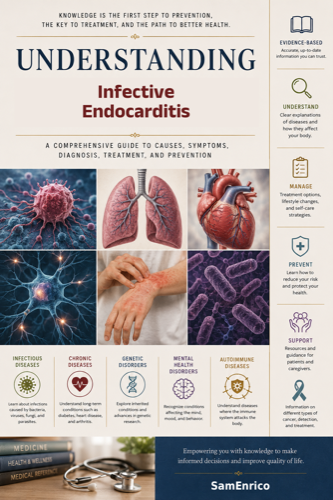
Understanding Infective Endocarditis eBook
This disease publication, published by SamEnrico,
by Ledesma Chi
This disease publication, published by SamEnrico, covers Understanding Infective Endocarditis
Formats
Free sample
Chapter 1: The Heart Eater...--–- The first time Maria held her grandson, she thought she had the flu. Three weeks earlier, the 68-year-old retired teacher had undergone a routine dental cleaning – nothing more than a scaling and polishing. Two days before that, she had flossed aggressively, as she always did, and noticed her gums bled a little. She thought nothing of it. Then came the low-grade fever: 99.8°F, never higher.
Night sweats soaked her sheets. Her joints ached, and she found herself napping twice a day. Her primary care physician ran a CBC, a metabolic panel, a chest X-ray. Normal, normal, normal. "Viral syndrome," the doctor said.
"Rest and hydrate." Maria rested. Ten days later, she woke up unable to move her left arm. The stroke team at the hospital called a code. The CT angiogram showed no large vessel occlusion, but something else caught the radiologist's eye: the mitral valve had a peculiar, shaggy appearance on the non-contrast images. A transthoracic echocardiogram followed, then a transesophageal echo.
The diagnosis landed like a hammer: Staphylococcus aureus infective endocarditis with a 14-millimeter vegetation on the anterior mitral leaflet, complicated by septic emboli to the middle cerebral artery territory. Maria had never injected drugs. She had no prosthetic valve. She had no known heart murmur. But she was 68, with mild degenerative calcific aortic stenosis – a condition she didn't even know she had.
The bacteria had entered her bloodstream through those bleeding gums, traveled to her heart, and settled on a valve that had been subtly damaged by decades of turbulent flow. Within 48 hours of her stroke, the vegetation fragmented again, showering her kidneys and spleen. Maria survived after emergency mitral valve replacement and six weeks of intravenous nafcillin, but she never regained full use of her left hand. Her grandson learned to walk while she learned to live with a mechanical valve and the ever-present fear that the heart eater might return.–- That is the face of infective endocarditis in the 21st century. Not the rheumatic fever of the 1950s.
Not the heroin addict's tricuspid valve infection of the 1980s. Not the uniformly fatal disease of the pre-antibiotic era. Maria's story – subtle onset, missed diagnosis, catastrophic embolic stroke, emergency surgery, and a lifetime of vigilance – represents the new epidemiology of a very old disease. Infective endocarditis (IE) has shape-shifted across generations, adapting to the very medical advances that were supposed to conquer it. This chapter establishes the evolving landscape of IE: where it came from, where it stands today, who gets it, why it is increasing in some populations, and how understanding these epidemiological shifts is the first and most essential step toward beating it.The Disease That Would Not Die–- Before penicillin, a diagnosis of IE was a death sentence.
In 1920, the physician Emanuel Libman famously described the condition as "the most hopeless of all cardiac affections." Patients lingered for weeks or months with undulating fevers, wasting away as vegetation after vegetation embolized to their brains, kidneys, and spleens. Autopsy series from that era show that IE accounted for approximately 10-15% of all cardiac deaths, and the average time from first symptom to death was six to ten months. The mortality rate approached 100%. The only interventions were supportive: bed rest, blood transfusions, and the futile hope that the body's own immune system might clear the infection. It never did.–- The arrival of penicillin in the 1940s transformed everything.
For the first time, physicians could kill the bacteria inside the heart. The landmark 1948 study by Dr. C. Sidney Burwell at Johns Hopkins reported that 70% of patients with streptococcal IE treated with penicillin survived. The medical world rejoiced.
But the celebration was premature. Within a decade, penicillin-resistant staphylococci emerged. By the 1960s, methicillin-resistant Staphylococcus aureus (MRSA) appeared in hospitals. The bacterium that had once been a nuisance became a killer. Meanwhile, the very technologies that extended human life – prosthetic heart valves, pacemakers, hemodialysis catheters, central venous lines – created new niches for bacteria to colonize.
IE did not disappear. It migrated.–- Today, IE affects approximately 13 to 15 cases per 100,000 person-years in developed nations – a rate that has remained stubbornly stable or even slightly increased over the past three decades. The global burden is estimated at 1.5 million cases annually, with a mortality rate of 15-30% despite modern antibiotics and advanced surgical techniques. To put that in perspective: more people die from IE each year than from Hodgkin lymphoma or testicular cancer. And unlike those diseases, IE disproportionately strikes the elderly, the chronically ill, and the socially marginalized – populations that have seen fewer therapeutic advances.The Two Faces of Modern IE–- To understand IE today, you must first recognize that it presents as two distinct epidemiological profiles, often described as the "two faces" of the disease.
The first face – the one Maria wore – is the face of modern healthcare itself: an aging population with degenerative valve disease, increasingly reliant on prosthetic devices, and vulnerable to healthcare-associated infections. The second face is the face of the opioid epidemic: young IV drug users presenting with right-sided S. aureus IE, often repeatedly, and often with devastating social and medical consequences.–- Face One: The Aging Heart. In the pre-antibiotic era, the most common predisposing condition for IE was rheumatic heart disease – a consequence of untreated group A streptococcal pharyngitis that left permanent valve scarring, typically affecting the mitral valve. As antibiotics conquered rheumatic fever in developed nations, the epidemiology shifted.
Today, the most common predisposing condition in patients over 65 is degenerative calcific aortic stenosis – the hardening and narrowing of the aortic valve that occurs naturally with age. Approximately 2-3% of people over 65 have significant aortic stenosis, and each of those patients carries a 5-10 fold increased risk of developing IE compared to the general population. Why? Because turbulent blood flow across a calcified valve damages the endothelial lining, creating the perfect nidus for NBTE (non-bacterial thrombotic endocarditis) formation – a process detailed in Chapter 2. Maria's mild aortic stenosis, unknown to her, was the silent invitation for S.
aureus to settle in.–- Face Two: The Opioid Epidemic. Between 2000 and 2015, hospitalizations for IE among people aged 18-35 increased by 300% in the United States – a rise almost perfectly correlated with the increase in IV heroin and prescription opioid misuse. Unlike Maria's left-sided IE, these young patients typically present with right-sided IE, overwhelmingly involving the tricuspid valve. The microbiology is almost always S. aureus, often MRSA.
The clinical presentation differs dramatically: rather than stroke and systemic emboli, these patients develop septic pulmonary emboli – bacteria traveling from the tricuspid valve to the lungs, causing multiple cavitary nodules, cough, hemoptysis, and pleuritic chest pain. The mortality is lower than left-sided IE (approximately 5-10%) because the right ventricle tolerates regurgitation well and because the lungs filter emboli before they reach the systemic circulation. But the recurrence rate is devastating: up to 30% of IV drug users discharged after IE will be readmitted with a second episode within one year, often requiring repeated valve surgeries, draining healthcare resources, and testing the limits of medical ethics (see Chapter 9).–- The coexistence of these two faces creates a unique challenge for clinicians. A 72-year-old with a prosthetic valve and a 28-year-old with a…
This is the end of the free sample. Get the eBook to keep going. Buy now
About this book
Details
- Author
- Ledesma Chi
- Publisher
- SamEnrico
- Language
- English
- Genre
- Non-Fiction, Informative, Educational
- Released
- 2026-05-07
- Pages (approx.)
- 160
- Available as
- eBook, Audiobook

Read better in the ZLOADR app
Your eBooks on your phone or tablet. Sign in with your SamEnrico account and start reading.
More by Ledesma Chi
 Operation Car Wash Refinery OverpricingLedesma Chi$11.99
 Blood Phobia Applied TensionLedesma Chi$11.99
 Assertiveness for Sensitive PeopleLedesma Chi$11.99
 The Recovery Journaling Prompts GuideLedesma Chi$11.99
 The Great Coin Heist: How a Band of Thieves Stole Millions in Rare PenniesLedesma Chi$11.99
 How to Become a Mud-mixer HelperLedesma Chi$11.99
 Chain Sales ManagerLedesma Chi$11.99
 Baby Child Products SpendingLedesma Chi$12.99
 Grant Writing Portfolio ManualLedesma Chi$12.99
You may also like
 Hong Kong Handover 1997Dunn Johnnie$11.99
 Zumba For Postnatal Recovery CourseNeal Christian$11.99
 Zumba for BeginnersLadner Nikia$11.99
 YouTube Comment Mining GuideHumes Pandora$12.99
 Worry Box MeditationCarlin Rudy$11.99
 Workplace Stress MeditationNguyen Lynn$11.99
 Workplace Stress and Sleep RepairHawley Ivory$11.99
 Workplace Perfectionism CureDelaney Jeffry$11.99
 Workplace Injustice Anger GuideWallen Isabelle$11.99
 Work Addiction and Burnout LinkGreenwood Ester$11.99
 Women in Yoga and WellnessBeattie Galina$11.99
 Women in Stand Up ComedyChun Evangeline$11.99