

Non-FictionInformativeEducational
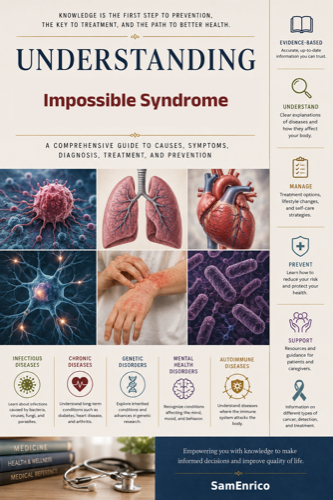
Understanding Impossible Syndrome eBook
This disease publication, published by SamEnrico,
by Laird Lawana
This disease publication, published by SamEnrico, covers Understanding Impossible Syndrome
Formats
Free sample
Chapter 1: The Uncounted Millions...--You have been told, probably more than once, that what you have is “too rare to matter.” Perhaps a well-intentioned family physician said it while glancing at your chart. Perhaps an insurance denial letter implied it in sterile, impersonal language. Perhaps you have whispered it to yourself at three in the morning, after yet another sleepless night spent wondering if you are slowly going crazy.The truth is the opposite of everything you have been led to believe.Rare is not rare. Rare is everywhere. And the fact that you have been made to feel like a medical anomaly — a fascinating puzzle, a collection of symptoms that no textbook can explain — is not a reflection of anything broken inside your body.
It is a reflection of a system that was never designed to see you, to hear you, or to heal you.Let us begin with a number that will fundamentally change how you understand your own journey. A number that should be printed on the wall of every medical school, every hospital waiting room, every insurance executive’s office.Thirty million.That is how many people in the United States alone live with a rare disease. Not thirty thousand. Not three million. Thirty million.
One out of every ten Americans. If every person with a rare disease lived in a single state, that state would be the third most populous in the country — larger than Texas, larger than Florida, larger than New York. Globally, the estimate exceeds three hundred million. That is more people than the entire population of the United States.Three hundred million human beings, scattered across every country, every time zone, every hospital corridor — each of them told at some point that what they have is “impossible.”This is the first and most damaging lie the medical system tells without ever meaning to: that rare diseases are rare in the sense of “almost never happens.” They are not. They are rare only in the technical, legal sense.
In the United States, a disease is officially designated as “rare” if it affects fewer than two hundred thousand people. But there are more than seven thousand known rare diseases. Seven thousand distinct ways that the human body can deviate from the expected blueprint. Each one is a different genetic typo, a different metabolic glitch, a different inflammatory misfire. And when you add them all together, they are not rare at all.
They are astonishingly common. They are woven into the fabric of human existence. They are, in all probability, you.The question that haunts every person reading this book is the same: If there are so many of us, why does it feel so impossibly lonely?The answer is not located anywhere in your body. It will not be found in your blood work, your imaging studies, or your genetic sequencing report. The answer is located in the architecture of modern medicine itself — in the way doctors are trained, in the way research is funded, in the way insurance companies decide what they will and will not pay for.
You have been made invisible not because you are insignificant, but because the system has a blind spot the size of a continent, and you happen to be standing right in the middle of it.The Training Gap That Left You Behind Let us talk about what your doctors were never taught.A standard four-year medical school curriculum in the United States devotes approximately eleven hours to the entire field of rare disease education. Eleven hours spread across more than seven thousand conditions. That is less than one second of instruction time per disease. And those eleven hours are not distributed evenly across the rare disease spectrum. They focus almost exclusively on a handful of conditions that can kill quickly if missed — malignant hyperthermia, acute porphyria, a few others that appear on board exams and in emergency room nightmares.
The slow-burn conditions, the ones that erode your joints over decades, that exhaust your mitochondria one cell at a time, that twist your connective tissue until everything feels loose and wrong? Those receive minutes of attention. Or none at all.This is not because doctors are lazy, cruel, or incompetent. Most physicians entered medicine because they genuinely wanted to help people. The problem is structural, not personal.
Medical education is optimized for what is common — heart disease, diabetes, asthma, urinary tract infections, the predictable rhythms of primary care. And that optimization makes perfect sense if you are designing a healthcare system for the statistically average patient. The average patient walks into a clinic with chest pain, gets an electrocardiogram, and either is having a heart attack or is not. The average patient with a sore throat gets a strep test, takes antibiotics, and returns to work in three days. The average patient fits neatly into the algorithms that populate every electronic health record system, every clinical practice guideline, every insurance company’s prior authorization form.You have never been the average patient.Your blood work comes back normal, but you cannot get out of bed before noon.
Your magnetic resonance imaging is clean, but your joints slide out of place when you reach for a coffee cup. Your comprehensive metabolic panel is “unremarkable,” but your brain feels like it is wrapped in wet wool. And because you do not fit into any of the standard boxes, the system does not know what to do with you. So it does what all large systems do when confronted with something they cannot process: it tries to make you fit anyway.It labels you with “anxiety.” It writes “somatic symptom disorder” in your chart — a diagnosis that translates from medical jargon as “we believe you are genuinely suffering, but we believe the source of your suffering is your mind rather than your body.” It refers you to psychiatry. It sends you home with a prescription for an antidepressant and a referral to a cognitive behavioral therapist.
It closes your case file and moves on to the next patient.None of this is your fault. None of this means your symptoms are not real. It means you have encountered a system with a gaping hole in its knowledge base, and you have fallen through that hole along with thirty million other Americans.The Historical Shift That Changed Everything Medicine has not always been this ineffective at diagnosing people like you. To understand why the current system fails so spectacularly, you need to understand how it was built and how it is currently being rebuilt.For most of human history, doctors diagnosed by looking, listening, and touching. They grouped patients by their visible symptoms: the ones with fever and productive cough went into one bucket; the ones with jaundice and right upper quadrant pain went into another; the ones with joint swelling and morning stiffness went into a third.
This symptom-based approach worked reasonably well for infectious diseases, for acute injuries, for the kinds of medical problems that have plagued humanity for millennia. But it was utterly inadequate for rare genetic conditions — which often disguise themselves as common problems, hiding in plain sight behind familiar symptoms that never quite add…
This is the end of the free sample. Get the eBook to keep going. Buy now
About this book
Details
- Author
- Laird Lawana
- Publisher
- SamEnrico
- Language
- English
- Genre
- Non-Fiction, Informative, Educational
- Released
- 2026-05-07
- Pages (approx.)
- 137
- Available as
- eBook, Audiobook

Read better in the ZLOADR app
Your eBooks on your phone or tablet. Sign in with your SamEnrico account and start reading.
More by Laird Lawana
 DaVinci Resolve AI Tools GuideLaird Lawana$11.99
 Mirror Dream Symbols GuideLaird Lawana$11.99
 Understanding Alcohol Related Brain DamageLaird Lawana$11.99
 Social Phobia Treatment PlanLaird Lawana$11.99
 Opioid Chronic Pain Alternative GuideLaird Lawana$11.99
 The Last Telegram: A Love Lost in the BlitzLaird Lawana$11.99
 Route Diversion Recovery HandbookLaird Lawana$12.99
 Agricultural Robotics Long RangeLaird Lawana$12.99
 How to Start a Bridle Cutting Business (Beginners Guide)Laird Lawana$11.99
 Warehouse Forklift OperatorLaird Lawana$11.99
You may also like
 Hong Kong Handover 1997Dunn Johnnie$11.99
 Zumba For Postnatal Recovery CourseNeal Christian$11.99
 Zumba for BeginnersLadner Nikia$11.99
 YouTube Comment Mining GuideHumes Pandora$12.99
 Worry Box MeditationCarlin Rudy$11.99
 Workplace Stress MeditationNguyen Lynn$11.99
 Workplace Stress and Sleep RepairHawley Ivory$11.99
 Workplace Perfectionism CureDelaney Jeffry$11.99
 Workplace Injustice Anger GuideWallen Isabelle$11.99
 Work Addiction and Burnout LinkGreenwood Ester$11.99
 Women in Yoga and WellnessBeattie Galina$11.99
 Women in Stand Up ComedyChun Evangeline$11.99