
Non-FictionInformativeEducational
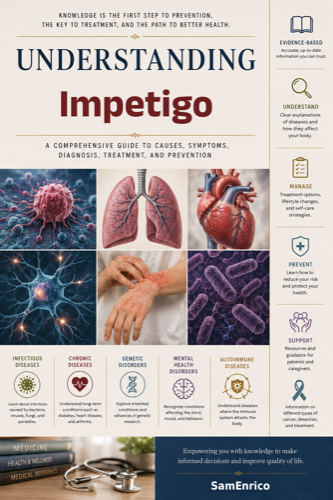
Understanding Impetigo eBook
This disease publication, published by SamEnrico,
This disease publication, published by SamEnrico, covers Understanding Impetigo
Formats
Free sample
Chapter 1: Beyond the Rash--–- The first time Sarah noticed the tiny red bump on her two-year-old son’s cheek, she assumed it was a mosquito bite. It was August, after all. By the following morning, that single bump had transformed into a cluster of blister-like lesions, oozing a thick, amber fluid that dried into a crust resembling crystallized honey. Within forty-eight hours, despite her best efforts with over-the-counter antibiotic cream, the infection had spread to his chin, his left nostril, and the backs of his hands. Her son, once a happy toddler exploring his world with curious fingers, was now inconsolable, scratching relentlessly, and barred from daycare.
Sarah was exhausted, confused, and terrified. She had never heard the word “impetigo” before the pediatrician uttered it that frantic Tuesday afternoon.This scenario unfolds in thousands of homes every single day. Impetigo is the most common bacterial skin infection in children worldwide, yet it remains shrouded in misunderstanding, stigma, and surprisingly outdated medical folklore. Parents like Sarah often waste precious time—and money—treating the wrong condition, applying ineffective home remedies, or unknowingly spreading the infection to every family member. The purpose of this chapter is to ensure that never happens to you.Before we can discuss treatment, prevention, or the psychological toll of chronic skin infections, we must first establish a rock-solid foundation.
What exactly is impetigo? Why does it target some children more aggressively than others? And critically, how do you tell the difference between this bacterial invader and the dozen other childhood rashes that look confusingly similar? By the time you finish this chapter, you will possess a dermatologist-level understanding of the disease’s origins, its bacterial culprits, and the surprising ways it infiltrates both broken and seemingly healthy skin. You will never mistake impetigo for a simple rash again.The Bacterial Culprits: A Tale of Two Pathogens Impetigo is not a virus, like chickenpox or herpes.
It is not a fungus, like ringworm. It is not an allergic reaction or an autoimmune condition. Impetigo is, at its core, a superficial bacterial infection of the epidermis—the outermost layer of the skin. Think of it as an unintended bacterial colonization of the skin’s surface, where the bacteria multiply rapidly, trigger an inflammatory response from the body, and produce the characteristic sores, blisters, and crusts that define the disease.Two primary bacterial species are responsible for virtually every case of impetigo. The first is Staphylococcus aureus, often abbreviated simply as S.
aureus or referred to colloquially as “staph.” The second is Streptococcus pyogenes, also known as Group A Streptococcus or “strep.” Understanding the distinct personalities of these two bacteria is not merely an academic exercise; it directly influences which treatments will work, which complications may arise, and how aggressively you need to pursue medical intervention.Staphylococcus aureus has, over the past several decades, become the dominant player in impetigo. Current epidemiological data suggests that this single bacterium is responsible for approximately seventy to eighty percent of all impetigo cases, either alone or in combination with strep. S. aureus is a remarkably adaptable organism. It colonizes the skin and nasal passages of roughly thirty percent of healthy individuals without causing any symptoms at all—a state medical professionals call “asymptomatic carriage.” These carriers unknowingly shed bacteria into their environment, making them unwitting vectors for transmission.
When S. aureus does breach the skin barrier through a cut, scrape, insect bite, or even microscopic abrasions invisible to the naked eye, it can rapidly establish an infection. The bacteria produce a suite of virulence factors—molecular weapons that destroy skin cells, evade the immune system, and create the conditions for rampant multiplication.One of the most clinically relevant features of S. aureus is its ability to produce exfoliative toxins. These are specialized proteins that specifically target desmoglein-1, a protein that acts as the “glue” holding skin cells together in the outer layers.
When these toxins are present, the skin cells detach from one another, leading to the formation of large, flaccid blisters that easily rupture. This toxin-driven presentation is what we call bullous impetigo, which we will explore in greater depth in Chapter 2. Not all strains of S. aureus carry the genes for exfoliative toxins, which is why some staph infections present as the more common crusted, non-bullous form.Streptococcus pyogenes, the second bacterial culprit, operates somewhat differently. Unlike the toxin-producing strains of staph, strep tends to provoke a more intense inflammatory response.
The classic “honey-crusted” sores of impetigo, particularly around the nose and mouth, were historically attributed primarily to strep. Today, we understand that many of these cases are actually caused by staph or mixed infections involving both bacteria. However, strep remains a significant concern for one critical reason: its propensity to trigger autoimmune complications. When the immune system mounts a response against strep bacteria on the skin, it sometimes mistakenly attacks the body’s own tissues. This cross-reactivity can lead to post-streptococcal glomerulonephritis, an inflammatory condition affecting the kidneys that we will examine thoroughly in Chapter 10.
Importantly, strep does not cause rheumatic fever when it infects the skin—only when it infects the throat—a fact that surprises many clinicians and parents alike.The distinction between staph and strep as causative agents matters. It matters for antibiotic selection, as some medications cover one bacterium but not the other. It matters for prognosis, as strep carries unique long-term risks. And it matters for understanding why some children experience recurrent impetigo while others clear a single infection and never look back. Throughout this book, we will return to these two bacterial protagonists, dissecting their behaviors and vulnerabilities so that you can outsmart them at every turn.The Broken Skin Myth: How Bacteria Invade Healthy Epidermis One of the most persistent misconceptions about impetigo—a myth perpetuated even by some medical textbooks—is that it requires a pre-existing break in the skin.
You have likely heard some version of this statement: “Impetigo only occurs when bacteria enter through a cut, scratch, or insect bite.” This is what medical professionals call secondary impetigo, and it certainly does occur. Children with eczema, for example, have a compromised skin barrier that allows bacteria to penetrate easily. Similarly, a scraped knee from playground fall can become secondarily infected with impetigo. In these scenarios, the timeline is clear: first there was an injury, then the bacteria colonized that injury, then the characteristic sores appeared.But here is the truth that challenges decades of conventional wisdom: Primary impetigo—infection of completely intact, healthy-appearing skin—is not only possible but exceedingly common. How does this happen?
The answer lies in the microscopic landscape of human skin.When you look at your child’s skin with the naked eye, it appears smooth and continuous, a seamless barrier protecting the internal organs from the external world. Under a microscope, however, that same skin reveals a complex topography of crevices, furrows, hair follicles, and sweat gland ducts. The outermost layer of the skin, the stratum corneum, consists of fifteen to twenty layers of flattened, dead keratinocytes—skin cells that have completed their lifecycle and are now essentially proteinaceous bricks in a protective wall. Between these bricks lies a lipid matrix, a sort of mortar that holds…
This is the end of the free sample. Get the eBook to keep going. Buy now
About this book
Details
- Author
- Valenzuela Sanjuana
- Publisher
- SamEnrico
- Language
- English
- Genre
- Non-Fiction, Informative, Educational
- Released
- 2026-06-03
- Pages (approx.)
- 160
- Available as
- eBook, Audiobook

Read better in the ZLOADR app
Your eBooks on your phone or tablet. Sign in with your SamEnrico account and start reading.
More by Valenzuela Sanjuana
 Car Wash Operation Prison InterviewsValenzuela Sanjuana$11.99
 Wondershare Filmora AI GuideValenzuela Sanjuana$11.99
 The Sober Creative Unblocking ManualValenzuela Sanjuana$11.99
 Benzo Parenting Recovery GuideValenzuela Sanjuana$11.99
 The Claustrophobia Exposure GuideValenzuela Sanjuana$11.99
 The Serpent’s Gambit: A Spy Among the NagasValenzuela Sanjuana$11.99
 How to Start a Briefs for Men and Boys Business (Beginners Guide)Valenzuela Sanjuana$11.99
 Virtual Cooking Class HostValenzuela Sanjuana$11.99
 Inventory Buffer Activation GuideValenzuela Sanjuana$12.99
 Farm Vehicle Autonomy GuideValenzuela Sanjuana$12.99
You may also like
 Hong Kong Handover 1997Dunn Johnnie$11.99
 Zumba For Postnatal Recovery CourseNeal Christian$11.99
 Zumba for BeginnersLadner Nikia$11.99
 YouTube Comment Mining GuideHumes Pandora$12.99
 Worry Box MeditationCarlin Rudy$11.99
 Workplace Stress MeditationNguyen Lynn$11.99
 Workplace Stress and Sleep RepairHawley Ivory$11.99
 Workplace Perfectionism CureDelaney Jeffry$11.99
 Workplace Injustice Anger GuideWallen Isabelle$11.99
 Work Addiction and Burnout LinkGreenwood Ester$11.99
 Women in Yoga and WellnessBeattie Galina$11.99
 Women in Stand Up ComedyChun Evangeline$11.99