
Non-FictionInformativeEducational
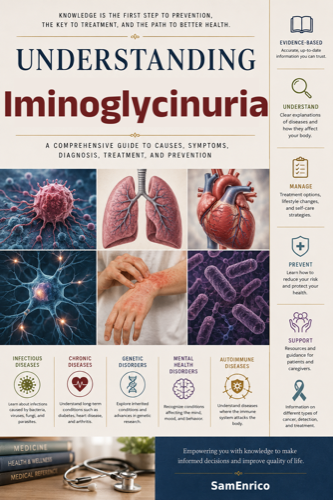
Understanding Iminoglycinuria eBook
This disease publication, published by SamEnrico,
This disease publication, published by SamEnrico, covers Understanding Iminoglycinuria
Formats
Free sample
Chapter 1: The Benign Paradox...--The email arrived on a Tuesday, buried between a pharmacy coupon and a credit card offer. For the Santos family in Omaha, Nebraska, it was the kind of message that changes everything without changing anything at all. The subject line read: "Your child's newborn screening results – follow-up required." Inside, a single line sent them spiraling through medical websites, late-night Google searches, and sleepless hours: "Abnormal aminoaciduria pattern suggestive of Iminoglycinuria. Clinical correlation advised."Luis and Maria Santos had never heard of Iminoglycinuria. Neither had their pediatrician.
Neither, for that matter, had the first three specialists they called. Yet here it was—a genetic condition, a kidney disorder, a metabolic puzzle—attached to their perfectly healthy, seven-pound, three-ounce daughter who nursed contentedly as they read the words. The lab report said "abnormal." Their eyes said "healthy." Their hearts said "cancer." Their heads said "what is this?"This is the Benign Paradox of Iminoglycinuria (IG): a genetic condition that sounds terrifying, looks complicated, is genomically fascinating, yet for the vast majority of those who carry it, produces absolutely no symptoms whatsoever. It is a disorder defined by what it does not do. It is a diagnosis that often leads to more anxiety than the condition itself warrants.
It is, in the words of one genetic counselor who has delivered this news hundreds of times, "the medical equivalent of being told you have blue eyes—except the lab report uses words like 'pathogenic variant' and 'renal transport defect.'"The Discovery of a Medical Mystery The story of Iminoglycinuria begins not with a patient who was sick, but with a researcher who was curious. In the mid-20th century, a generation of physician-scientists armed with newly developed amino acid analyzers began systematically cataloging what came out in human urine. Among them were two giants of metabolic medicine: Dr. Charles Scriver at Mc Gill University and Dr. Leon Rosenberg at Yale (later at Princeton).
Working independently and then collaboratively, they noticed something peculiar.When they ran urine samples from healthy individuals through their machines, most people showed trace amounts of amino acids—the kidneys are efficient reclamation machines. But a small subset showed something different: persistently elevated levels of three specific compounds: proline, hydroxyproline, and glycine. Not just slightly elevated, but dramatically so—sometimes fifty times the normal concentration.Scriver and Rosenberg published their findings in the 1960s, coining the term "Iminoglycinuria" to describe the pattern. "Imino" referred to the unique chemical structure of proline and hydroxyproline (which are technically imino acids, not amino acids). "Glycinuria" captured the accompanying glycine spillage.
And the condition entered the medical lexicon as a curiosity—a genetic footnote with no apparent consequence.But here is where the story takes its first unexpected turn. For decades, Iminoglycinuria was classified as an "inborn error of metabolism" alongside devastating conditions like phenylketonuria (PKU), which causes profound intellectual disability if untreated, and maple syrup urine disease, which can kill newborns within weeks. The name alone—inborn error of metabolism—sounds catastrophic. It conjures images of specialized diets, developmental delays, and lifelong medical management.Yet unlike PKU, where a missing enzyme allows toxic byproducts to accumulate and destroy the developing brain, Iminoglycinuria involves a completely different mechanism: the kidneys, not the liver; transport, not metabolism; wasting, not accumulation. And most critically, no toxicity.
The proline, hydroxyproline, and glycine that spill into the urine of someone with IG are not harmful. They are simply...excreted. The body makes more. Life continues uninterrupted.This distinction—between a metabolic storage disorder and a renal transport disorder—is the single most important concept for any patient or parent to understand. You cannot store up toxicity from Iminoglycinuria.
You cannot poison your brain or your organs by eating the wrong foods. The worst thing that happens is that your urine contains slightly more of certain protein building blocks than average. In the vast majority of cases, that is the beginning and the end of the story.Defining the Undefinable: What IG Actually Is Let us be precise. Iminoglycinuria is a genetic condition affecting the proximal tubule of the kidney—the part of the nephron responsible for reclaiming filtered nutrients back into the bloodstream. In a person with IG, specific transport proteins on the surface of kidney cells do not function properly.
As a result, three specific compounds—proline, hydroxyproline, and glycine—pass through the kidney and exit the body in urine rather than returning to circulation.The diagnostic threshold, for those who appreciate numbers, is a urinary excretion of proline and hydroxyproline exceeding 0.2 mmol per gram of creatinine (a measure that normalizes for urine concentration) with accompanying glycine elevation. But what matters clinically is not the number but the pattern. A child with IG will show this pattern consistently, on every urine amino acid analysis, from infancy through adulthood, regardless of diet or hydration status.It is essential to distinguish Iminoglycinuria from several related but distinct conditions that are often confused with it, both in medical literature and in clinical practice.Isolated Hyperglycinuria occurs when glycine alone appears in the urine at elevated levels, without accompanying proline or hydroxyproline. This can be caused by mutations in the same SLC36A2 gene implicated in IG, but without the modifier gene mutation (SLC6A20) that completes the digenic picture. Isolated hyperglycinuria is even more common than IG and even more benign.Hartnup Disorder involves the urinary loss of neutral amino acids (a different chemical category that includes tryptophan, alanine, and others).
Unlike IG, Hartnup can produce symptoms—specifically pellagra-like findings including skin rashes and neurological issues—because tryptophan is a precursor to niacin. But even Hartnup is usually benign with adequate nutrition. The critical point is that Hartnup and IG are genetically and chemically distinct, involving different transporters (SLC6A19 for Hartnup versus SLC36A2/SLC6A20 for IG).Fanconi Syndrome is a generalized dysfunction of the proximal tubule that causes wasting of virtually all amino acids, plus glucose, phosphate, and bicarbonate. Fanconi is never benign. It causes rickets in children, osteomalacia in adults, growth failure, and metabolic acidosis.
The presence of normal glomerular filtration rate and normal reabsorption of other solutes distinguishes IG from Fanconi definitively.Cystinuria involves the urinary loss of cystine and the dibasic amino acids (lysine, arginine, ornithine). Its clinical significance comes from cystine stones, which can form large, painful, recurrent kidney stones. IG does not cause cystine stones, though as we will see in later chapters, there may be a modest increase in calcium oxalate stone risk in a subset of IG patients with concurrent hypercalciuria.These distinctions matter because misdiagnosis happens. In one published case series, several adults carried a diagnosis of "possible Hartnup disorder" for years before urine amino acid analysis revealed the pattern of Iminoglycinuria. They had been advised to restrict certain foods, take niacin supplements, and undergo annual neurological exams—none of which were necessary.
The Benign Paradox had led them down a path of unnecessary medicalization.The Epidemiology: How Rare Is Rare?Determining the true prevalence of Iminoglycinuria is surprisingly difficult, and the reasons illuminate how rare disease epidemiology works—and fails to work.Newborn screening programs in most countries do not test for Iminoglycinuria. They test for a panel…
This is the end of the free sample. Get the eBook to keep going. Buy now
About this book
Details
- Author
- Mcdonough Tasia
- Publisher
- SamEnrico
- Language
- English
- Genre
- Non-Fiction, Informative, Educational
- Released
- 2026-05-07
- Pages (approx.)
- 153
- Available as
- eBook, Audiobook

Read better in the ZLOADR app
Your eBooks on your phone or tablet. Sign in with your SamEnrico account and start reading.
More by Mcdonough Tasia
 Rask AI Translation WorkflowMcdonough Tasia$11.99
 Understanding Kindling Effect in AlcoholismMcdonough Tasia$11.99
 Test Exam Dream Symbols GuideMcdonough Tasia$11.99
 Step Parent Self Worth GuideMcdonough Tasia$11.99
 OKRs for Board Game GroupMcdonough Tasia$11.99
 Billionaire Buccaneers: The Secret Wars of the Super-Rich on the High SeasMcdonough Tasia$11.99
 Hazard Communication GHS Update HandbookMcdonough Tasia$12.99
 Agricultural Edge ComputingMcdonough Tasia$12.99
 How to Start a British Airports Authority Business (Beginners Guide)Mcdonough Tasia$11.99
 Table Tennis - Ping PongMcdonough Tasia$11.99
You may also like
 Hong Kong Handover 1997Dunn Johnnie$11.99
 Zumba For Postnatal Recovery CourseNeal Christian$11.99
 Zumba for BeginnersLadner Nikia$11.99
 YouTube Comment Mining GuideHumes Pandora$12.99
 Worry Box MeditationCarlin Rudy$11.99
 Workplace Stress MeditationNguyen Lynn$11.99
 Workplace Stress and Sleep RepairHawley Ivory$11.99
 Workplace Perfectionism CureDelaney Jeffry$11.99
 Workplace Injustice Anger GuideWallen Isabelle$11.99
 Work Addiction and Burnout LinkGreenwood Ester$11.99
 Women in Yoga and WellnessBeattie Galina$11.99
 Women in Stand Up ComedyChun Evangeline$11.99