
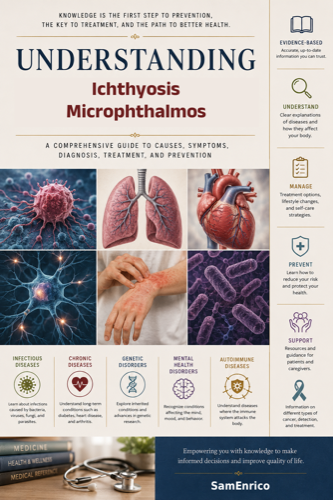
Non-FictionInformativeEducational
Understanding Ichthyosis Microphthalmos eBook
This disease publication, published by SamEnrico,
by Boss Chantel
This disease publication, published by SamEnrico, covers Understanding Ichthyosis Microphthalmos
Formats
Free sample
Chapter 1: The Fish Scale...–- The first time a parent sees the words “ichthyosis microphthalmos” on a medical report, the brain performs a strange sort of triage. It recognizes “ichthyosis” as something vaguely familiar—perhaps a memory of a television medical drama, or a distant cousin’s dry skin condition. It stumbles over “microphthalmos,” a word that sounds like something from a Greek myth rather than a human diagnosis. And then it tries to put them together, and fails. The two halves do not seem to belong to the same sentence, let alone the same child.
A skin condition and an eye condition? What do scales have to do with smallness? How can one diagnosis explain both the visible landscape of the skin and the hidden architecture of the eye?This chapter exists to answer that question. It will take you on a journey from the surface of the body to its deepest genetic codes, from the first bewildering moments after diagnosis to a clear, organized understanding of what this condition actually is. By the time you finish these pages, you will no longer be a passive recipient of medical information.
You will be an informed partner in your child’s care, equipped with the vocabulary, conceptual framework, and historical context that turn fear into knowledge and knowledge into action.The Anatomy of a Name Every medical term tells a story, and “ichthyosis microphthalmos” tells two stories that converge. Let us begin with the first character in this drama: ichthyosis. The word comes from the ancient Greek “ichthys,” meaning fish. Walk through any fish market in the world, and you will see the inspiration: the overlapping, plate-like scales that cover a fish’s body, shimmering and protective but also distinct from mammalian skin. In the medical imagination of the nineteenth century, physicians saw something similar on the skin of certain patients—not true scales, of course, but thickened, dry, adherent plates of keratin that resembled a fish’s exterior more than a human’s.
The name stuck, even as our understanding of the underlying biology has transformed completely.Ichthyosis is not a single disease but a family of disorders united by a common problem: the skin’s inability to properly regulate its own turnover. In normal skin, the epidermis renews itself approximately every twenty-eight days. New cells are born in the deepest layer, the stratum basale, and then begin a slow migration toward the surface. As they rise, they flatten, lose their nuclei, and fill with keratin proteins, eventually becoming the tough, waterproof squames that form our barrier against the outside world. When these cells reach the surface, they are shed imperceptibly—a process we call desquamation—and replaced by the next wave from below.
The entire system operates with remarkable precision, maintaining a barrier that is thick enough to protect but thin enough to flex, breathe, and sense.In ichthyosis, that precision breaks down. The rate of new cell production may accelerate, flooding the surface faster than it can shed. Or the shedding process itself may slow, causing old cells to accumulate like autumn leaves that no one rakes. Or both mechanisms may operate simultaneously, creating a backlog of keratin that mounts day after day, week after week, forming visible scale that ranges from fine and powdery to thick and plate-like. The skin becomes rough, dry, and often darkly pigmented in the creases and folds where scale accumulates most densely.The second character in our drama is microphthalmos, from the Greek “mikros” (small) and “ophthalmos” (eye).
Here the story is not about turnover but about growth. The human eye begins as a pair of outpouchings from the developing forebrain, called optic vesicles, which form in the fourth week of gestation. These vesicles invaginate to become the optic cups, which will give rise to the retina, and the lens placodes, which will form the lens. The entire process is a ballet of genetic signals, with molecules like PAX6, SHH, and RA (retinoic acid) directing cells to divide, migrate, differentiate, and stop. When this ballet goes wrong, the eye does not achieve its full size.
It remains small—sometimes mildly so, sometimes profoundly—and with that smallness often come associated malformations: colobomas (gaps in the retina or iris), cataracts, microcornea (a small cornea), and persistent fetal vasculature (remnants of the embryonic blood supply that should have regressed).The marriage of ichthyosis and microphthalmos into a single diagnostic term reflects a clinical observation that dates back more than a century: these two features appear together in certain patients more often than would be expected by chance. They are not independent misfortunes but linked manifestations of a deeper developmental disruption. And that disruption, we now know, lies in the genes that control the embryonic formation of both skin and eyes—and often other organs as well.A Deeper Look at the Ichthyosis of This Condition Not all ichthyosis is created equal, and the ichthyosis of Ichthyosis Microphthalmos has its own distinctive features. To understand what makes it different, we must first understand the structure of normal skin at the microscopic level.The epidermis, the outermost layer of the skin, is a stratified squamous epithelium composed primarily of keratinocytes. These cells exist in various states of differentiation depending on how far they have traveled from the basement membrane.
The deepest layer, the stratum basale, contains the stem cells and transit-amplifying cells that divide to produce new keratinocytes. As these cells move upward, they enter the stratum spinosum, named for the spiny appearance of their intercellular bridges. Next comes the stratum granulosum, where keratinocytes begin to produce keratohyalin granules filled with proteins like filaggrin and loricrin that are essential for barrier function. Finally, they reach the stratum corneum, the outermost layer of dead, flattened squames that are constantly being shed and replaced.In the ichthyosis associated with Ichthyosis Microphthalmos, the pathology varies depending on the underlying genetic subtype. In STRA6-related disease, the granular layer is often thickened or abnormally organized, and the stratum corneum shows compact hyperkeratosis (excessive thickening) with retention of nuclei, a finding called parakeratosis that indicates accelerated turnover.
In FREM1-related disease, the pathology is different: the granular layer may be normal or even thinned, but the stratum corneum shows lamellar hyperkeratosis with an abnormal lipid composition, reflecting the role of FREM1 in anchoring the epidermis to the underlying dermis and in regulating lipid metabolism.The clinical appearance of the ichthyosis also varies. Some newborns are born encased in a collodion membrane—a tight, translucent, varnish-like film that covers the entire body, restricting movement and breathing, and often cracking within the first twenty-four to forty-eight hours to reveal deep fissures that weep serous fluid. The collodion membrane is not specific to Ichthyosis Microphthalmos; it can occur in several forms of congenital ichthyosis. But when it does occur in a child with microphthalmos, it strongly suggests one of the genetic subtypes covered in this book. The membrane typically peels off over two to four weeks, leaving behind red, scaly skin that may be more or less severe than the membrane suggested.Other newborns present without a collodion membrane but with generalized scaling that is present at birth or appears within the first few weeks.…
This is the end of the free sample. Get the eBook to keep going. Buy now
About this book
Details
- Author
- Boss Chantel
- Publisher
- SamEnrico
- Language
- English
- Genre
- Non-Fiction, Informative, Educational
- Released
- 2026-06-03
- Pages (approx.)
- 158
- Available as
- eBook, Audiobook

Read better in the ZLOADR app
Your eBooks on your phone or tablet. Sign in with your SamEnrico account and start reading.
More by Boss Chantel
 OKRs for Financial IndependenceBoss Chantel$11.99
 Car Wash Operation Family StyleBoss Chantel$11.99
 Russian Energy Efficiency CreditsBoss Chantel$11.99
 Body Image In Romantic RelationshipBoss Chantel$11.99
 The Silk Road's Shadow War: The CIA's Secret Spies in the Mountains of AfghanistanBoss Chantel$11.99
 The Vanishing Act: The Last Days of the Great Library of AlexandriaBoss Chantel$11.99
 How to Become a JewelerBoss Chantel$11.99
 Mixed Reality Lab SimulationsBoss Chantel$12.99
 Employer Visa Compliance HandbookBoss Chantel$12.99
 Orange Juice TradingBoss Chantel$11.99
You may also like
 Hong Kong Handover 1997Dunn Johnnie$11.99
 Zumba For Postnatal Recovery CourseNeal Christian$11.99
 Zumba for BeginnersLadner Nikia$11.99
 YouTube Comment Mining GuideHumes Pandora$12.99
 Worry Box MeditationCarlin Rudy$11.99
 Workplace Stress MeditationNguyen Lynn$11.99
 Workplace Stress and Sleep RepairHawley Ivory$11.99
 Workplace Perfectionism CureDelaney Jeffry$11.99
 Workplace Injustice Anger GuideWallen Isabelle$11.99
 Work Addiction and Burnout LinkGreenwood Ester$11.99
 Women in Yoga and WellnessBeattie Galina$11.99
 Women in Stand Up ComedyChun Evangeline$11.99