

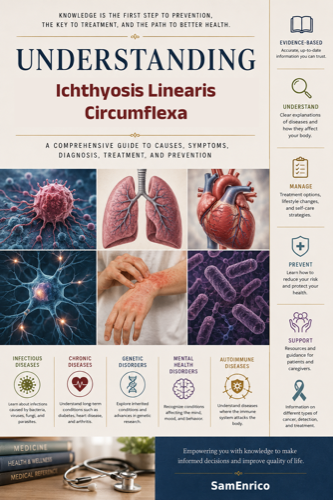
Non-FictionInformativeEducational
Understanding Ichthyosis Linearis Circumflexa eBook
This disease publication, published by SamEnrico,
by Gough Kyoko
This disease publication, published by SamEnrico, covers Understanding Ichthyosis Linearis Circumflexa
Formats
Free sample
Chapter 1: The Migratory Map...--Imagine waking up one morning to find that the rash on your arm has vanished overnight—only to reappear on your ribs by lunchtime. Now imagine that this wandering pattern of redness and scaling continues for weeks, months, or even years, with no clear trigger and no reliable explanation from doctors who seem puzzled by what they see. This is the daily reality for individuals living with Ichthyosis Linearis Circumflexa (ILC), a condition so rare that most dermatologists will never encounter a single case in their entire careers.The name itself sounds intimidating, but it describes something surprisingly straightforward. "Ichthyosis" comes from the Greek word for fish, referring to the scale-like appearance of affected skin. "Linearis" describes the lined or striped pattern of the rash.
"Circumflexa" indicates the curved, wandering borders that give the condition its most distinctive feature: lesions that seem to move across the body like weather systems on a radar map. Put together, these words paint a picture of a skin condition unlike any other—one defined not by stability but by constant, unpredictable motion.For those living with ILC, this migration is not merely a clinical curiosity. It is a source of frustration, embarrassment, and physical discomfort. The rash may appear on the face during an important job interview, then relocate to the back just in time for a wedding. It might flare severely during vacation when sun exposure and heat become unavoidable, then retreat mysteriously when cooler weather arrives.
No two weeks look exactly the same, and no treatment seems to work consistently because the underlying process never truly stops.This chapter serves as your first clear, compassionate introduction to a disease you may never have heard of before. Whether you are a parent whose child has just received this diagnosis, an adult who has struggled for years with unexplained rashes, or a medical professional seeking to understand a rare condition, this chapter will give you the foundational knowledge you need to navigate everything that follows. By the time you finish reading, you will understand what ILC is, what it is not, why it has remained hidden from mainstream medical publishing, and why this book exists as the definitive guide for patients, families, and clinicians.The Signature Appearance: Reading the Skin The most remarkable feature of ILC is its visual appearance. Unlike the static plaques of psoriasis or the diffuse redness of eczema, ILC creates lesions that actively change from day to day. The classic description in medical textbooks is "serpiginous borders"—a term derived from the Latin word for snake, capturing the winding, sinuous quality of the rash edges.
These borders are often described as having a "double-edged scale," meaning two parallel ridges of dead skin cells with a central groove between them, resembling a tiny train track running along the edge of the rash.Inside these serpentine borders, the skin may appear relatively normal or show mild redness. Outside the borders, the skin is typically unaffected. The center of older lesions often heals completely, leaving behind only a temporary change in skin color that fades over weeks or months. New lesions appear elsewhere on the body, creating a shifting mosaic that has been compared to a topographical map, a jigsaw puzzle, or even the patterns of a giraffe's coat.The migratory nature of ILC is not random, though it often appears that way to the untrained eye. Individual lesions typically expand outward at a rate of a few millimeters per day, healing in the center as they grow at the edges.
A single ring may persist for one to three weeks before fading entirely, but during that time, new rings are forming elsewhere. The overall effect is that the rash appears to wander—disappearing from one location while simultaneously appearing in another.This movement explains why patients often feel like they are chasing an invisible enemy. A topical cream applied to the rash on Monday may be treating completely different skin by Thursday. A phototherapy session targeting the back may find that the rash has relocated to the chest by the next appointment. Understanding this migratory pattern is the first step toward accepting that ILC requires a different management approach than static skin conditions.
You are not failing at treatment; the disease is simply behaving exactly as it is supposed to.The Netherton Connection: One Disease, Multiple Names A point of confusion that has frustrated countless patients and families is the relationship between ILC and a condition called Netherton Syndrome. Many people receive one diagnosis, then later hear the other name and wonder if they have two separate diseases or if one diagnosis was wrong. The truth is simpler and more reassuring: ILC is almost always the skin manifestation of Netherton Syndrome.Netherton Syndrome is a broader genetic condition that affects three main systems of the body: the skin, the hair, and the immune system. The skin manifestation of Netherton Syndrome often takes the specific form of Ichthyosis Linearis Circumflexa—the migratory, ring-shaped rash described in this chapter. Not every person with Netherton Syndrome develops the classic ILC rash; some have more generalized scaling or redness.
However, when a doctor sees the characteristic migrating rings of ILC, it is considered highly suggestive of underlying Netherton Syndrome.For simplicity and readability, this book will use "ILC" to refer to the full spectrum of Netherton Syndrome as it presents with skin findings. When we discuss the hair abnormalities (bamboo hair) or immune features (high Ig E, allergies, asthma), we will specify those separately. But the shorthand of "ILC" acknowledges that for most patients, the skin is the most visible and bothersome part of the condition. This terminology choice is made purely for practical reasons; it does not imply that ILC is a separate disease from Netherton Syndrome.To put it another way: think of Netherton Syndrome as the name of the house, and ILC as the name of the front door. You can enter through the door and explore the entire house, but the door is not the house itself.
Similarly, you can have ILC without yet knowing about the hair and immune features, but those features are almost always present to some degree if you look carefully enough. Throughout this book, when we say "ILC," we are standing at that front door—but we will open it fully in later chapters to reveal the complete picture.How Rare Is Ultra-Rare?The word "rare" gets thrown around casually in medicine, but ILC belongs to a category that researchers call "ultra-rare." The estimated prevalence is fewer than one person in every 200,000. To put that number in perspective: in a city the size of Chicago (approximately 2.7 million people), you would expect to find roughly 13 individuals with ILC. In a small town of 10,000 people, you might go your entire life without encountering another person who shares your diagnosis.This extreme rarity has profound consequences for patients and families. Most dermatologists will complete their entire residency training without seeing a single case of ILC.
Many will go through their entire careers without making the diagnosis. When patients seek help, they are often met with confusion, uncertainty, or outright dismissal. "It can't be that rare condition,"…
This is the end of the free sample. Get the eBook to keep going. Buy now
About this book
Details
- Author
- Gough Kyoko
- Publisher
- SamEnrico
- Language
- English
- Genre
- Non-Fiction, Informative, Educational
- Released
- 2026-06-02
- Pages (approx.)
- 160
- Available as
- eBook, Audiobook

Read better in the ZLOADR app
Your eBooks on your phone or tablet. Sign in with your SamEnrico account and start reading.
More by Gough Kyoko
 New Zealand Home Energy GrantsGough Kyoko$11.99
 YouTube Comments Comparison GuideGough Kyoko$11.99
 Key Results That Actually WorkGough Kyoko$11.99
 Opioid Use Disorder Pregnancy GuideGough Kyoko$11.99
 The Great Post Office Strike: When Britain’s Mail StoppedGough Kyoko$11.99
 How to Start a British Computer Society Business (Beginners Guide)Gough Kyoko$11.99
 H-1B Visa Annual Guide 2025Gough Kyoko$12.99
 AI Career Path Advisor GuideGough Kyoko$12.99
 Medical CoderGough Kyoko$11.99
You may also like
 Hong Kong Handover 1997Dunn Johnnie$11.99
 Zumba For Postnatal Recovery CourseNeal Christian$11.99
 Zumba for BeginnersLadner Nikia$11.99
 YouTube Comment Mining GuideHumes Pandora$12.99
 Worry Box MeditationCarlin Rudy$11.99
 Workplace Stress MeditationNguyen Lynn$11.99
 Workplace Stress and Sleep RepairHawley Ivory$11.99
 Workplace Perfectionism CureDelaney Jeffry$11.99
 Workplace Injustice Anger GuideWallen Isabelle$11.99
 Work Addiction and Burnout LinkGreenwood Ester$11.99
 Women in Yoga and WellnessBeattie Galina$11.99
 Women in Stand Up ComedyChun Evangeline$11.99