
Non-FictionInformativeEducational
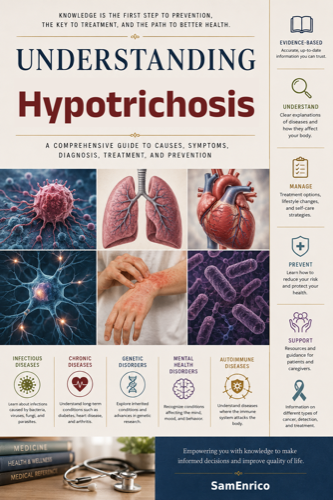
Understanding Hypotrichosis eBook
This disease publication, published by SamEnrico,
This disease publication, published by SamEnrico, covers Understanding Hypotrichosis
Formats
Free sample
Chapter 1: The Unseen Inheritance...--–- Emma was seven years old when she first realized her hair was different. Not thinner, not patchy – simply never there the way it was for the other girls in her first-grade class. She remembers standing in front of the bathroom mirror, holding a lock of her fine, wispy hair between her fingers, comparing it to her mother's thick ponytail. "Mommy, why is my hair so small?" she asked. Her mother, who had spent years searching for answers of her own, knelt down and said, "Because you, my love, were born special in a way that most people don't understand." That conversation, repeated in thousands of homes across the world, marks the beginning of a journey that this book is designed to guide.Hypotrichosis is not a single disease but a family of conditions united by one defining feature: a person is born with significantly less hair than typical, or the hair that does grow fails to develop into normal terminal strands.
Unlike the more familiar alopecias – where a person experiences hair loss after years of normal growth – hypotrichosis is a congenital difference. It is an inheritance, often written in the language of genes passed down through generations, sometimes silently, sometimes visibly, but always with profound implications for the person who carries it.This chapter serves as the foundation upon which the entire book rests. Before we can understand the genetics, the diagnostic challenges, the treatment options, or the psychosocial strategies that will fill the pages ahead, we must first grasp the basic biology of hair growth and the specific ways in which hypotrichosis disrupts it. Think of this chapter as learning the rules of a game so that you can understand how and why the rules are broken in the condition that affects you or your loved one.The Architecture of a Hair Follicle: A Microscopic Marvel To understand hypotrichosis, you must first appreciate the extraordinary complexity of the hair follicle – a structure so sophisticated that it has been called a "mini-organ." Each hair follicle is not merely a tube from which hair emerges; it is a dynamic, regenerative system that undergoes cycles of growth, regression, and rest throughout a person's lifetime.The mature hair follicle is divided into several distinct anatomical regions. At the very base lies the dermal papilla, a small cluster of specialized mesenchymal cells that serves as the command center for hair growth.
These cells send chemical signals – growth factors, cytokines, and morphogens – to the surrounding epithelial cells, instructing them to divide, differentiate, and produce the hair shaft. Without a functional dermal papilla, hair growth simply cannot occur. This is not merely academic: in several forms of hypotrichosis, the dermal papilla is present but fails to communicate properly with the rest of the follicle.Surrounding the dermal papilla is the hair matrix, a zone of rapidly dividing keratinocytes that will eventually become the hair shaft. Think of the matrix as a factory assembly line: cells are born at the bottom, differentiate as they move upward, and die a programmed death (a process called keratinization) to form the hard, fibrous structure we recognize as hair. Any disruption to this assembly line – whether from genetic mutations, nutritional deficiencies, or inflammatory attacks – results in abnormal hair production.Moving outward, the follicle is encased in concentric layers of specialized cells.
The inner root sheath provides structural support and molds the emerging hair shaft into its final shape – round, oval, or flattened – which determines whether hair appears straight, wavy, or curly. The outer root sheath connects the follicle to the surrounding epidermis and serves as a reservoir of stem cells capable of regenerating the entire follicle after injury. The bulge region, located near the insertion point of the arrector pili muscle (the tiny muscle that makes hair stand on end when you are cold or frightened), houses the follicle's stem cell population – cells that are ultimately responsible for initiating new hair cycles throughout life.The hair shaft itself, the visible portion above the skin, is composed of three layers. The cuticle is the outermost layer, a series of overlapping scales that protect the inner cortex. The cortex comprises the bulk of the hair, containing keratin proteins twisted into helical structures that give hair its strength, elasticity, and color.
The medulla, present only in thick terminal hairs, is a central core of loosely packed cells that serves no clearly understood function but may help regulate temperature.Why does any of this matter for understanding hypotrichosis? Because the specific genetic mutations that cause different forms of hypotrichosis target these structures at different points. Some mutations affect the dermal papilla signaling pathways, some disrupt the keratin proteins that form the hair shaft, and others impair the stem cell populations in the bulge region. The clinical appearance of the hair – whether it is sparse, short, brittle, twisted, or absent – provides clues to the underlying molecular defect.The Hair Cycle: Anagen, Catagen, Telogen, and Exogen Hair does not grow continuously. Unlike the hearts that beat or the lungs that breathe without pause, hair follicles cycle through phases of activity and quiescence.
Understanding this cycle is essential because hypotrichosis alters not only the initial formation of hair but often the cycling dynamics themselves.The anagen phase is the active growth period. During anagen, cells in the hair matrix divide every 23 to 72 hours – among the fastest cell divisions in the human body, rivaled only by bone marrow and intestinal epithelium. This explosive growth requires enormous energy and nutrient resources, which is why severe illness, malnutrition, or chemotherapy so dramatically affects hair. On the human scalp, anagen lasts between two and seven years. This wide range explains why some people can grow hair down to their waist while others struggle to reach their shoulders – the duration of anagen is largely genetically determined.
The longer the anagen phase, the longer the hair can grow.The catagen phase is a brief transitional period lasting only two to three weeks. During catagen, cell division in the matrix stops, the outer root sheath thickens and forms a protective "club" around the dermal papilla, and the follicle undergoes programmed regression. Blood supply to the lower follicle is cut off, and the dermal papilla detaches from the epithelial cells and moves upward toward the bulge region. Catagen is sometimes called the "apoptotic phase" because up to 70 percent of the cells in the lower follicle undergo programmed cell death. This may seem wasteful, but it is actually a brilliant evolutionary adaptation: by breaking down and recycling the lower follicle, the body avoids maintaining a metabolically expensive structure during the long resting period.The telogen phase is the resting period, lasting approximately two to four months on the scalp.
During telogen, the hair shaft is fully formed and sits dormant in the follicle, no longer growing but not yet shed. The dermal papilla remains in close proximity to the bulge stem cells, awaiting the signal to initiate a new anagen phase. At any given moment, approximately 10 to 15 percent of scalp hairs are in telogen – which is why it is normal to lose 50 to 100 hairs per day. Each of those hairs has completed its life cycle and…
This is the end of the free sample. Get the eBook to keep going. Buy now
About this book
Details
- Author
- Hoang Tanesha
- Publisher
- SamEnrico
- Language
- English
- Genre
- Non-Fiction, Informative, Educational
- Released
- 2026-06-02
- Pages (approx.)
- 160
- Available as
- eBook, Audiobook

Read better in the ZLOADR app
Your eBooks on your phone or tablet. Sign in with your SamEnrico account and start reading.
More by Hoang Tanesha
 Blue Light Blocking MeditationHoang Tanesha$11.99
 Slovenian Eco Fund IncentivesHoang Tanesha$11.99
 Dark Mode Email DesignHoang Tanesha$11.99
 Long Term Relationship Self WorthHoang Tanesha$11.99
 The Serpent’s Gambit: The Lost City of Punt’s Final VoyageHoang Tanesha$11.99
 The Lost Battle of the Celts: The Forgotten Siege of AlesiaHoang Tanesha$11.99
 Heliotrope (Variety of Chalcedony) MiningHoang Tanesha$11.99
 Holographic Teacher TechnologyHoang Tanesha$12.99
 US Green Tax Credits Guide 2025Hoang Tanesha$12.99
 How to Start a Hobby in Nature PhotographyHoang Tanesha$11.99
You may also like
 Hong Kong Handover 1997Dunn Johnnie$11.99
 Zumba For Postnatal Recovery CourseNeal Christian$11.99
 Zumba for BeginnersLadner Nikia$11.99
 YouTube Comment Mining GuideHumes Pandora$12.99
 Worry Box MeditationCarlin Rudy$11.99
 Workplace Stress MeditationNguyen Lynn$11.99
 Workplace Stress and Sleep RepairHawley Ivory$11.99
 Workplace Perfectionism CureDelaney Jeffry$11.99
 Workplace Injustice Anger GuideWallen Isabelle$11.99
 Work Addiction and Burnout LinkGreenwood Ester$11.99
 Women in Yoga and WellnessBeattie Galina$11.99
 Women in Stand Up ComedyChun Evangeline$11.99