
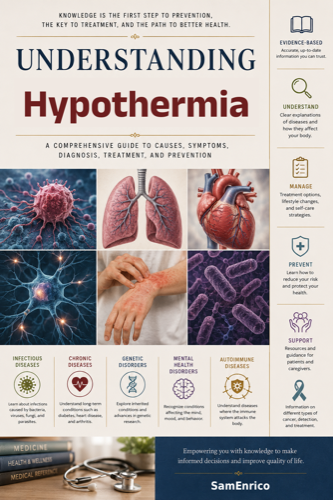
Non-FictionInformativeEducational
Understanding Hypothermia eBook
This disease publication, published by SamEnrico,
This disease publication, published by SamEnrico, covers Understanding Hypothermia
Formats
Free sample
Chapter 1: The City Killer...--–- The body lay in a tidy suburban living room, feet facing the television, hands folded across the chest as if arranged for viewing. The paramedics had seen this before—dozens of times—but the family never understood. The thermostat read 62 degrees Fahrenheit. Outside, the January air held steady at 28 degrees. The cause of death, listed on the report with clinical detachment, was hypothermia.
The deceased was seventy-three years old, lived alone, and had a minor balance issue that caused her to fall six days earlier. She had not frozen to death in the arctic or on a mountainside. She had died of cold on her own carpet, forty-eight inches from a working space heater she could no longer reach.This is the face of hypothermia that almost no one recognizes.Popular culture has painted a vivid but dangerously incomplete portrait of cold injury. When most people hear the word "hypothermia," they picture a frostbitten mountaineer on Everest, a shivering sailor clinging to an overturned lifeboat, or a lost hiker digging a snow cave. These images are not wrong—exposure hypothermia in wilderness settings is real and deadly—but they are catastrophically misleading.
They suggest that hypothermia is an exotic problem, something that happens to adventurers who take risks in remote places. The data tells a completely different story. Hypothermia is an urban and suburban epidemic, a silent killer that claims more lives in temperate climates than in polar extremes, and its victims are disproportionately the elderly, the intoxicated, the homeless, and the socially isolated. They die in apartments with broken furnaces, on park benches under thin blankets, in bathtubs after fainting, and on living room floors after falling. They die in places that feel safe, which is precisely why they are not prepared.The goal of this chapter—and of this book—is to shatter the myth of hypothermia as a mountaineer's disease and replace it with a more accurate, more urgent, and ultimately more useful understanding.
Hypothermia is the body's systematic failure when it cannot generate enough heat to maintain the core temperature necessary for organ function. It begins when the core drops below 95 degrees Fahrenheit, a threshold that can be crossed in a 50-degree rainstorm with a light breeze. It kills through cardiac arrest, respiratory failure, and coagulopathy—the blood's inability to clot. And it is almost entirely preventable, but only if the people most at risk understand the threat.The Epidemiology of Cold: Numbers That Should Shock You The statistics are sobering, yet they rarely make headlines. According to data compiled from the Centers for Disease Control and Prevention and peer-reviewed studies in wilderness medicine literature, hypothermia kills approximately 1,300 to 1,500 people annually in the United States alone.
This figure exceeds the combined annual deaths from lightning, tornadoes, floods, and hurricanes. More Americans die of cold than of all other weather-related phenomena combined. And yet, while hurricanes and tornadoes generate round-the-clock media coverage, hypothermia remains a footnote—partly because the deaths are dispersed across seasons and geographies, and partly because they lack the dramatic visual of a twister tearing through a town.The demographic distribution of hypothermia mortality tells the true story of who is at risk. The elderly account for nearly half of all hypothermia deaths. Individuals over seventy-five years old have a mortality rate more than ten times higher than the general population.
The reasons are physiological, behavioral, and social rolled into one. Aging bodies produce less metabolic heat due to reduced muscle mass and slower basal metabolic rates. The shivering response, so critical for early-stage rewarming, becomes less efficient with age. The hypothalamic thermostat loses precision, sometimes failing to detect a dropping core temperature until the patient is already in moderate hypothermia. Beyond physiology, elderly individuals living alone may keep their homes inadequately heated due to financial constraints, fear of high utility bills, or simply reduced sensitivity to cold.
A fall, a stroke, or a brief loss of consciousness can leave them on the floor for hours, losing heat to the conductive surface of the floor—a mode of heat transfer discussed in detail in Chapter 2.The second largest demographic is the intoxicated. Alcohol is involved in an estimated 30 to 50 percent of fatal hypothermia cases, a staggering association that deserves close examination. Alcohol creates the perfect physiological storm for cold injury. It causes peripheral vasodilation—the widening of blood vessels in the skin—which creates the subjective sensation of warmth. The drinker feels flushed and cozy, even as their core temperature plummets because dilated vessels are dumping heat to the environment at an accelerated rate.
At the same time, alcohol impairs the shivering response, reducing the body's primary mechanism for generating emergency heat. It clouds judgment, leading to poor clothing choices, extended outdoor exposure, or the fatal decision to "sleep it off" outside. And it increases the likelihood of falls, injuries, and other traumatic events that leave the victim immobile and exposed. A drunk person who stumbles into a snowy ditch on a 35-degree night is not at risk of hypothermia because it is freezing outside—it is not. But hypothermia begins at 95 degrees, and a 35-degree environment with wet clothing and wind can drop core temperature below that threshold within ninety minutes.The third major at-risk population is people experiencing homelessness.
Mortality studies consistently show that hypothermia is one of the leading causes of weather-related death among unhoused individuals, particularly in cities that experience winter temperatures below freezing. The risk is not limited to extreme cold. A 40-degree night with rain—common in Seattle, Portland, New York, and Boston—can be just as lethal as a 10-degree night if the victim lacks shelter, dry clothing, and the ability to generate metabolic heat through movement. The combination of wet clothing (evaporative cooling), wind exposure (convective cooling), and stationary posture (reduced metabolic heat production) creates a dangerous feedback loop that can overcome even a healthy adult within hours.The Case Studies: Three Deaths, Three Misunderstandings To understand how hypothermia operates in real-world conditions, it is useful to examine specific cases. These three examples, drawn from medical examiner reports and published case studies in emergency medicine literature, illustrate the diversity of hypothermia presentations and the common thread of misunderstanding that runs through each.Case One: The Elderly Woman in the 50-Degree House.An eighty-one-year-old woman living alone in a suburban Chicago bungalow was found deceased by her daughter after three days of telephone calls went unanswered.
The thermostat in the living room read 52 degrees Fahrenheit. The woman was dressed in a sweater, long pants, and wool socks. The cause of death was hypothermia. Her daughter told investigators that her mother had been "fine" during a phone call five days earlier and had mentioned that the furnace was "acting up" but that she had "plenty of blankets." The pathologist noted that the woman had a history of hypothyroidism, a condition that reduces basal metabolic rate and impairs thermoregulation. She had also been taking a beta-blocker for hypertension, a medication that can blunt the cardiovascular response to cold.
The combination of a cool but not freezing environment, physiological vulnerability, and social isolation proved fatal. She had not frozen—her core temperature at death was…
This is the end of the free sample. Get the eBook to keep going. Buy now
About this book
Details
- Author
- Cantwell Jennell
- Publisher
- SamEnrico
- Language
- English
- Genre
- Non-Fiction, Informative, Educational
- Released
- 2026-06-02
- Pages (approx.)
- 158
- Available as
- eBook, Audiobook

Read better in the ZLOADR app
Your eBooks on your phone or tablet. Sign in with your SamEnrico account and start reading.
More by Cantwell Jennell
 Greek Net Metering RetirementCantwell Jennell$11.99
 Falling Dream Symbols HandbookCantwell Jennell$11.99
 Referral Email AutomationCantwell Jennell$11.99
 Prescription Opioid Taper WorkbookCantwell Jennell$11.99
 Grace in Motion: The Royal Ballet of the African DiasporaCantwell Jennell$11.99
 The Phantom Pain: The Mystery of the 1950s Polio Vaccine ScandalCantwell Jennell$11.99
 USPTO Fee And Deadline Guide 2025Cantwell Jennell$12.99
 Computer Vision Lab AssistantCantwell Jennell$12.99
 Grip StrengthCantwell Jennell$11.99
 How to Start a Press Clipping Service Business (Beginners Guide)Cantwell Jennell$11.99
You may also like
 Hong Kong Handover 1997Dunn Johnnie$11.99
 Zumba For Postnatal Recovery CourseNeal Christian$11.99
 Zumba for BeginnersLadner Nikia$11.99
 YouTube Comment Mining GuideHumes Pandora$12.99
 Worry Box MeditationCarlin Rudy$11.99
 Workplace Stress MeditationNguyen Lynn$11.99
 Workplace Stress and Sleep RepairHawley Ivory$11.99
 Workplace Perfectionism CureDelaney Jeffry$11.99
 Workplace Injustice Anger GuideWallen Isabelle$11.99
 Work Addiction and Burnout LinkGreenwood Ester$11.99
 Women in Yoga and WellnessBeattie Galina$11.99
 Women in Stand Up ComedyChun Evangeline$11.99