
Non-FictionInformativeEducational
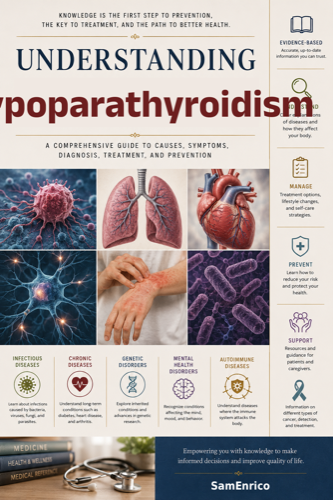
Understanding Hypoparathyroidism eBook
This disease publication, published by SamEnrico,
by Tom Ava
This disease publication, published by SamEnrico, covers Understanding Hypoparathyroidism
Formats
Free sample
Chapter 1: The Calcium Thief...--Imagine waking up one morning with fingers that feel like they are buzzing from an electric current. Your lips tingle as if you have just left the dentist's chair. You reach for your coffee, but your hand cramps into an unnatural claw, and the mug shatters on the floor. Your heart races. Your muscles twitch.
Your mind, usually sharp, feels wrapped in a thick fog that refuses to lift. You have slept ten hours, but you are exhausted. You try to call out for help, but your throat feels tight, as if someone is gently pressing on your windpipe.This is not a panic attack. This is not anxiety. This is not all in your head.
This is what happens when a tiny gland you have never heard of stops doing its job. This is hypoparathyroidism, and it is stealing the calcium from your blood.The human body is a masterpiece of biological engineering, capable of maintaining stability in the face of constant change. You can eat nothing for twenty-four hours, and your blood sugar will stay within a narrow range. You can run a marathon in the desert, and your body temperature will barely budge. You can drink a gallon of water, and your sodium levels will remain almost perfectly constant.
This remarkable stability is called homeostasis, and it relies on an intricate network of hormones, sensors, and feedback loops that work silently in the background, keeping you alive without a single conscious thought.Calcium is one of the most tightly regulated substances in the entire body. The concentration of calcium in your blood must stay within an extraordinarily narrow window—approximately 8.5 to 10.2 milligrams per deciliter, depending on the laboratory. If it drifts even slightly below this range, your nerves misfire. If it creeps above, your kidneys fail. Your body has dedicated an entire organ system—the parathyroid glands, four grains of rice hidden behind your thyroid—to the sole task of maintaining this delicate balance.When those glands fail, the calcium thief begins its work.
And everything falls apart.The Master Mineral You Never Think About Calcium is famous for building strong bones. Every milk commercial, every pediatrician's advice, every school nutrition poster has drilled this into your consciousness: drink milk, get calcium, build strong bones. This is true, as far as it goes. But it is like saying the Eiffel Tower is famous for being in Paris. It is correct, but it misses the point entirely.Bones are the bank account where calcium is stored, not where it is used.
The real action happens in your blood, where calcium exists as a charged particle called an ion. Ionized calcium is biological electricity. It is the spark that ignites every nerve impulse, the trigger for every muscle contraction, the signal that tells your heart to beat and your blood to clot. Without ionized calcium, you would be paralyzed, unconscious, and bleeding uncontrollably within minutes.Consider the humble nerve cell. It communicates with its neighbors by opening channels that allow charged particles—sodium, potassium, and calcium—to flow in and out.
When calcium enters a nerve ending, it triggers the release of neurotransmitters, the chemical messengers that allow one brain cell to talk to another. When blood calcium drops too low, those channels malfunction. Nerves fire spontaneously, without any signal from the brain. This is why hypocalcemia causes tingling, twitching, and eventually tetany—your nerves are screaming into the void, and your muscles are listening.Consider your heart. Each heartbeat is initiated by a group of specialized cells in the right atrium called the sinoatrial node.
These cells generate electrical impulses that spread through the heart, causing coordinated contraction. Calcium is essential for this process. The electrical signal that travels through your heart depends on calcium flowing into cardiac muscle cells. When calcium levels fall, the heart's electrical system becomes unstable. The QT interval—a measurement on an electrocardiogram—lengthens.
In severe hypocalcemia, this can degenerate into a fatal arrhythmia called torsade de pointes, in which the heart's electrical system spirals into chaos and the heart stops pumping effectively.Consider your blood. The clotting cascade, a series of protein activations that ultimately produces a fibrin mesh to seal wounds, requires calcium at multiple steps. Without adequate calcium, blood does not clot. A minor cut could become a major problem. More concerning is internal bleeding—a small hemorrhage that would normally seal itself could continue unchecked.Your body knows how important calcium is.
That is why it has evolved multiple layers of defense against hypocalcemia. Your bones contain approximately two pounds of calcium, far more than you could ever need in your blood. Your kidneys can reabsorb nearly all the calcium that passes through them, wasting almost nothing in urine. Your gut can increase its absorption of dietary calcium when supplies are low. And orchestrating all of this is a single hormone produced by four tiny glands: parathyroid hormone, or PTH.When PTH is missing, all of these defenses collapse.The Hormone That Does Everything Parathyroid hormone is a simple molecule—a chain of 84 amino acids folded into a specific three-dimensional shape.
It is produced exclusively in the chief cells of the parathyroid glands. Its half-life in the blood is approximately two to four minutes, meaning that your parathyroids must constantly produce PTH to maintain stable levels. When they fail, PTH levels plummet within hours, and the consequences are immediate.PTH acts on three organs: bone, kidney, and the gut. Each action is designed to raise blood calcium.In bone, PTH activates cells called osteoclasts. These are the demolition crew of the skeleton, responsible for breaking down old bone tissue to make way for new.
When PTH signals them to work, osteoclasts dissolve bone matrix—the hard, mineralized material that gives bone its strength—and release calcium and phosphorus into the bloodstream. This is the body's fastest way to raise blood calcium, drawing on the skeletal bank account in an emergency.In the kidney, PTH has two critical actions. First, it tells the kidney to reabsorb calcium from the fluid that is becoming urine, sending that calcium back into the blood instead of wasting it. Second, it tells the kidney to excrete phosphorus. This is important because phosphorus binds to calcium; high phosphorus levels keep calcium locked away in an unusable form.
By dumping phosphorus into urine, PTH frees calcium to do its work.In the gut, PTH acts indirectly. It stimulates the kidney to produce an enzyme that converts inactive vitamin D into its active form, calcitriol. Calcitriol then travels to the intestines and tells them to absorb more calcium from food. This is the slowest of PTH's actions, taking hours to days, but it is essential for long-term calcium balance.Together, these three actions raise blood calcium. When PTH is absent, none of them happen.
Bones are not broken down (which sounds good but actually leads to abnormally dense, brittle bone). Kidneys do not reabsorb calcium, so calcium is wasted in urine. Kidneys do not excrete phosphorus, so phosphorus accumulates in the blood. And the gut absorbs almost no calcium from food, because there is no calcitriol to unlock it.The result is hypocalcemia—low blood…
This is the end of the free sample. Get the eBook to keep going. Buy now
About this book
Details
- Author
- Tom Ava
- Publisher
- SamEnrico
- Language
- English
- Genre
- Non-Fiction, Informative, Educational
- Released
- 2026-05-09
- Pages (approx.)
- 158
- Available as
- eBook, Audiobook

Read better in the ZLOADR app
Your eBooks on your phone or tablet. Sign in with your SamEnrico account and start reading.
More by Tom Ava
 Parkinson's Stretching GuideTom Ava$11.99
 TikTok Algorithm Comparison TrapTom Ava$11.99
 Loneliness HandbookTom Ava$11.99
 Email Design Best PracticesTom Ava$11.99
 The Billion-Dollar Betrayal: How a Hedge Fund Gamble Crashed a NationTom Ava$11.99
 Huldra’s Hollow: The Enchantress of the Nordic WildsTom Ava$11.99
 Checkouts Co WorkerTom Ava$11.99
 How to Become a Chucking-and-sawing-machine OperatorTom Ava$11.99
 Supply Chain Carbon TrackingTom Ava$12.99
 Enforcement Trend Report HandbookTom Ava$12.99
You may also like
 Hong Kong Handover 1997Dunn Johnnie$11.99
 Zumba For Postnatal Recovery CourseNeal Christian$11.99
 Zumba for BeginnersLadner Nikia$11.99
 YouTube Comment Mining GuideHumes Pandora$12.99
 Worry Box MeditationCarlin Rudy$11.99
 Workplace Stress MeditationNguyen Lynn$11.99
 Workplace Stress and Sleep RepairHawley Ivory$11.99
 Workplace Perfectionism CureDelaney Jeffry$11.99
 Workplace Injustice Anger GuideWallen Isabelle$11.99
 Work Addiction and Burnout LinkGreenwood Ester$11.99
 Women in Yoga and WellnessBeattie Galina$11.99
 Women in Stand Up ComedyChun Evangeline$11.99