
Non-FictionInformativeEducational
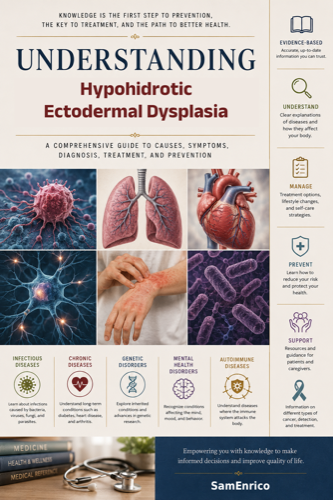
Understanding Hypohidrotic Ectodermal Dysplasia eBook
This disease publication, published by SamEnrico,
This disease publication, published by SamEnrico, covers Understanding Hypohidrotic Ectodermal Dysplasia
Formats
Free sample
Chapter 1: The Blueprint Within...--–- Imagine holding a set of architectural blueprints for a house. You see the foundation, the walls, the roof, the electrical wiring, and the plumbing—all drawn on a single sheet. Now imagine that a single smudge, a tiny error in one corner of the blueprint, somehow causes the wiring to be missing from half the rooms, the windows to be smaller than designed, and the roof tiles to be sparse and brittle. You would be confused, because one small mistake shouldn't affect so many seemingly unrelated parts of the house. But in the architecture of the human body, that is exactly what happens in Hypohidrotic Ectodermal Dysplasia.This chapter begins not with a diagnosis, not with a list of symptoms, and not with a genetic test result.
It begins much earlier—before a baby takes its first breath, before a heart begins to beat, before a mother even knows she is pregnant. It begins in the first few weeks of embryonic development, when the human body is nothing more than a flat disc of cells, each one identical to its neighbor. In that disc lies a hidden map, a set of instructions that will determine everything from the color of a child's eyes to the shape of their fingers. And for individuals with HED, that map has a single, tiny, profound error.To understand HED, you must first understand what the ectoderm is, why it matters, and how a disruption in its development creates the distinctive pattern of symptoms that defines this condition. Parents often ask, "Why does my child have missing teeth and sparse hair and trouble sweating?
Are these separate problems?" The answer is no. They are not separate problems. They are the predictable consequences of a single developmental pathway gone awry. This chapter will take you on a journey through the first eight weeks of pregnancy, using clear analogies and illustrated concepts, to show you exactly how the body builds itself—and what happens when the blueprint contains a small but significant mistake.The Master Electrical Panel Analogy Think of the ectoderm as a master electrical panel in a large building. This panel has dozens of circuit breakers, each one controlling a different part of the building—lights on the first floor, outlets in the kitchen, the air conditioning system, the security cameras.
Now imagine that the main power supply to the entire panel is slightly damaged. Not completely broken, but compromised. The lights might still work, but they flicker. The air conditioning runs but doesn't cool effectively. The security cameras power on but produce a fuzzy image.
Each circuit is affected in a different way, but all the problems trace back to the same source.The ectoderm is that master panel. It is one of the three primary germ layers—the ectoderm, mesoderm, and endoderm—that form during the third week of human embryonic development. These three layers are the fundamental building blocks of every tissue and organ in the body. The mesoderm will become muscles, bones, blood vessels, and the heart. The endoderm will become the lining of the lungs, the digestive tract, and associated organs like the liver and pancreas.
And the ectoderm, the outermost layer, will become the entire surface of the body and the entire nervous system.But here is what matters for HED: the ectoderm is responsible for four specific structures that might seem unrelated at first glance. It forms the epidermis (the outer layer of skin) and all of its appendages, including hair follicles, nails, and two types of glands—sweat glands (eccrine glands) and oil glands (sebaceous glands). It also forms the tooth buds (the precursors to both baby teeth and permanent teeth), the lenses of the eyes, the inner ear, and the entire nervous system including the brain and spinal cord. When a genetic mutation disrupts the ectoderm, it does not pick and choose randomly. It disrupts the development of all the structures that depend on a specific signaling pathway within the ectoderm.
That is why HED affects sweat glands, teeth, and hair together—they share a common developmental dependency.The First Eight Weeks: A Timeline of Building To truly grasp this, let us walk through the first eight weeks of pregnancy, week by week, and watch the body build itself. This timeline is crucial because it explains why HED cannot be "fixed" after birth—the structures either form correctly during these weeks or they do not form at all.Week 3 (Days 14–21): The Flat Disc Becomes Three Layers Fertilization has occurred. The fertilized egg has traveled down the fallopian tube, divided repeatedly, and implanted into the wall of the uterus. At this stage, the embryo is a flat disc composed of two layers (the bilaminar disc). Then, during a process called gastrulation, something remarkable happens.
Cells begin to migrate inward through a structure called the primitive streak, creating the three germ layers. The ectoderm takes its place as the outermost layer. This is the moment of origin. If a genetic mutation affecting ectodermal development is present, it has already begun to exert its effect.Week 4 (Days 22–28): The Neural Tube Closes The ectoderm now has two specialized regions. The neural ectoderm will become the brain and spinal cord.
The surface ectoderm will become the skin, hair, teeth, and glands. The neural tube forms and closes during this week—failure of closure leads to neural tube defects like spina bifida, which is not related to HED but illustrates how precise this process must be. The surface ectoderm, meanwhile, is a single layer of cells that will soon begin to thicken and specialize.Week 5 (Days 29–35): The First Signs of Teeth and Hair Around day 32 to 35, the first visible signs of tooth development appear. The dental lamina, a thickening of the surface ectoderm along the future gum line, forms. This is the foundation upon which all teeth will be built.
Simultaneously, hair follicles begin to form as the surface ectoderm sends down finger-like projections into the underlying mesenchyme (the connective tissue that will become the dermis). The signaling between the ectoderm and the mesenchyme—a conversation called epithelial-mesenchymal interaction—is critical. The ectoderm sends signals saying, "Build a tooth here," and the mesenchyme responds, "I will form the dental papilla to support it." In HED, this conversation is disrupted. The message is sent, but it is garbled, and the structures do not form properly.Week 6 (Days 36–42): Sweat Gland Primordia Appear This is a critical week for HED. The first sweat gland primordia (the earliest recognizable precursors of sweat glands) appear on the palms of the hands and soles of the feet.
These are called eccrine sweat glands, and they are the glands responsible for thermoregulation—the ones that produce watery sweat to cool the body. The signaling pathway that directs their formation involves a protein called ectodysplasin-A, which is encoded by the EDA gene. In X-linked HED, the EDA gene is mutated, and ectodysplasin-A is either absent or nonfunctional. Without this protein, the sweat gland primordia never develop beyond the earliest stage. The result, later in life, is a complete or near-complete absence of functional sweat glands.Week 7 (Days 43–49): Tooth Buds Form The tooth buds progress…
This is the end of the free sample. Get the eBook to keep going. Buy now
About this book
Details
- Author
- Chappell Kathrine
- Publisher
- SamEnrico
- Language
- English
- Genre
- Non-Fiction, Informative, Educational
- Released
- 2026-05-09
- Pages (approx.)
- 140
- Available as
- eBook, Audiobook

Read better in the ZLOADR app
Your eBooks on your phone or tablet. Sign in with your SamEnrico account and start reading.
More by Chappell Kathrine
 Insomnia Relief Sleep CourseChappell Kathrine$11.99
 Email Automation Workflow GuideChappell Kathrine$11.99
 Chronic Illness LonelinessChappell Kathrine$11.99
 Standing Stretching RoutineChappell Kathrine$11.99
 The Dragon’s Lament: The Ballad of Saint George and the Beast of CappadociaChappell Kathrine$11.99
 The Anthrax Letters: A Deadly Shadow in the MailChappell Kathrine$11.99
 Ultimate Handbook Guide to Vaduz : (Liechtenstein) Travel GuideChappell Kathrine$11.99
 Supply Chain Control Tower AIChappell Kathrine$12.99
 Employer Remote Compliance WorkbookChappell Kathrine$12.99
 Antimony MiningChappell Kathrine$11.99
You may also like
 Hong Kong Handover 1997Dunn Johnnie$11.99
 Zumba For Postnatal Recovery CourseNeal Christian$11.99
 Zumba for BeginnersLadner Nikia$11.99
 YouTube Comment Mining GuideHumes Pandora$12.99
 Worry Box MeditationCarlin Rudy$11.99
 Workplace Stress MeditationNguyen Lynn$11.99
 Workplace Stress and Sleep RepairHawley Ivory$11.99
 Workplace Perfectionism CureDelaney Jeffry$11.99
 Workplace Injustice Anger GuideWallen Isabelle$11.99
 Work Addiction and Burnout LinkGreenwood Ester$11.99
 Women in Yoga and WellnessBeattie Galina$11.99
 Women in Stand Up ComedyChun Evangeline$11.99