
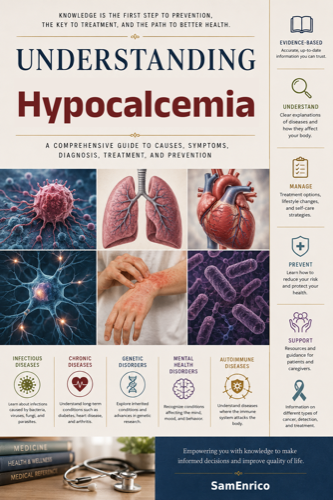
Non-FictionInformativeEducational
Understanding Hypocalcemia eBook
This disease publication, published by SamEnrico,
This disease publication, published by SamEnrico, covers Understanding Hypocalcemia
Formats
Free sample
Chapter 1: The Calcium Lie...--Most people believe they know what calcium does. Ask anyone on the street, and they will tell you calcium is for bones. Drink your milk, eat your yogurt, take your supplement, and your skeleton will thank you. That is the message we have heard since childhood, repeated by doctors, dietitians, and dairy advertisements for generations. But here is the truth that medical textbooks rarely spell out: calcium is not a bone mineral first.
It is an electrolyte. And when your blood calcium falls too low, your bones are the least of your worries.The human body treats calcium like a currency in a failing economy. When serum levels drop, the body does not simply shrug and move on. It robs the bones. It rewires nerve signals.
It disrupts the electrical rhythm of the heart. It throws the entire machinery of life into chaos. Hypocalcemia—the medical term for low blood calcium—is one of the most underdiagnosed, misunderstood, and dangerously dismissed conditions in modern medicine. It masquerades as anxiety, depression, chronic fatigue, fibromyalgia, and even epilepsy. Patients spend years, sometimes decades, bouncing from specialist to specialist, accumulating diagnoses like unwanted souvenirs, while the real culprit sits quietly in their lab work, waiting for someone to notice.This book exists because too many people have been told “your calcium is normal” when it was not.
Too many have been sent home with benzodiazepines for tetany mistaken for panic attacks. Too many have suffered seizures, cardiac arrhythmias, and permanent neurological damage from a condition that is entirely treatable—if only someone looks in the right place.Before we can fix hypocalcemia, we have to understand what it is, why it matters, and why almost everyone gets it wrong.The Definition That Most Doctors Misunderstand Hypocalcemia is defined as a total serum calcium concentration below 8.5 milligrams per deciliter (mg/d L) in adults, or an ionized calcium level below 4.65 mg/d L. For readers outside the United States, these values correspond to 2.12 millimoles per liter (mmol/L) for total calcium and 1.16 mmol/L for ionized calcium. These numbers are not arbitrary. They represent the threshold below which the body’s calcium-dependent systems begin to fail.But here is where the confusion begins.
Most routine blood tests measure total calcium, which includes three forms: ionized calcium (about 50 percent of total), calcium bound to proteins (mostly albumin, about 40 percent), and calcium complexed with anions like citrate or phosphate (about 10 percent). Only ionized calcium is biologically active. Only ionized calcium matters for nerve firing, heart contraction, and blood clotting. The other forms are essentially cargo—calcium in transit or temporarily parked.This distinction is not academic. It is the single most common reason hypocalcemia is missed.Consider a patient with low albumin.
Albumin is a protein produced by the liver that acts as a taxi for calcium in the bloodstream. When albumin falls—due to malnutrition, liver disease, kidney disease, or even simple dehydration—total calcium falls with it, even if ionized calcium remains normal. A doctor who looks only at total calcium might diagnose hypocalcemia where none exists, or worse, dismiss a patient with normal total calcium but dangerously low ionized calcium because the albumin is falsely elevating the total.The correction formula is simple but rarely applied: for every 1 g/d L that albumin falls below 4.0 g/d L, add 0.8 mg/d L to the total calcium measurement. A patient with an albumin of 2.5 g/d L and a total calcium of 7.5 mg/d L actually has a corrected calcium of 8.7 mg/d L—perfectly normal. Conversely, a patient with an albumin of 4.5 g/d L and a total calcium of 8.5 mg/d L has a corrected calcium of 8.1 mg/d L—mildly low.
Without this correction, the diagnosis is missed.The gold standard is ionized calcium measurement, but many outpatient labs do not offer it, and many doctors do not order it. This is not malice. It is habit. And habits in medicine can be deadly.The Seven Roles of Calcium: More Than Just Bones To understand why hypocalcemia wreaks such havoc, we have to appreciate everything calcium does. The human body contains approximately one kilogram of calcium.
Ninety-nine percent of it resides in bones and teeth, forming a mineral reservoir that can be tapped when blood levels drop. The remaining one percent circulates in blood and cells, but that tiny fraction is responsible for seven critical functions.First, nerve transmission. Calcium ions flood into nerve endings when an electrical signal arrives, triggering the release of neurotransmitters into the synapse. Without adequate calcium, nerves cannot communicate. The result is paresthesia—tingling in the lips, fingers, and toes—followed by muscle cramps, and eventually tetany, a state of continuous muscle contraction.Second, muscle contraction.
In every skeletal, cardiac, and smooth muscle cell, calcium acts as the trigger. When an action potential reaches a muscle, it opens calcium channels in the sarcoplasmic reticulum. Calcium floods out, binds to troponin, and allows actin and myosin to slide past each other. No calcium, no contraction. Too little calcium, weak or uncoordinated contraction.
The diaphragm can fail, leading to respiratory arrest. The larynx can spasm, causing stridor and airway obstruction.Third, cardiac electrophysiology. Calcium is the primary charge carrier for the plateau phase of the cardiac action potential. It enters heart cells during phase two, sustaining depolarization and allowing the heart to contract fully. When calcium is low, the QT interval prolongs on the electrocardiogram.
This creates a dangerous vulnerability to torsade de pointes, a ventricular arrhythmia that degenerates into cardiac arrest.Fourth, blood clotting. Calcium is clotting factor IV. It is required for the activation of prothrombin to thrombin, and for the conversion of fibrinogen to fibrin. Severe hypocalcemia can cause bleeding diatheses that mimic hemophilia. Patients with undiagnosed hypocalcemia who undergo surgery can bleed unexpectedly and excessively.Fifth, hormone secretion.
Calcium regulates the release of parathyroid hormone, insulin, and several pituitary hormones. Low calcium stimulates PTH secretion, but if the parathyroid glands themselves are damaged or absent, this feedback loop breaks. The result is a cascade of endocrine dysfunction.Sixth, enzyme activation. Over three hundred enzymes require calcium as a cofactor. These include protein kinases, phospholipases, and proteases involved in inflammation, metabolism, and cell death pathways.
Chronic hypocalcemia subtly impairs all of them.Seventh, cell signaling. Calcium is a universal second messenger. When a hormone binds to a receptor, it often triggers a transient rise in intracellular calcium, which then activates downstream pathways. Cells cannot make decisions without calcium. They cannot divide, differentiate, or die when they are supposed to.When blood calcium falls, every one of these systems suffers.
The body prioritizes—heart and nerves get what little calcium remains, at the expense of bones, which are demineralized over months or years. But even with this triage, severe hypocalcemia overwhelms the system. That is why acute drops are medical emergencies.Acute Versus Chronic: Two Different Diseases Hypocalcemia presents in two fundamentally different ways, and confusing them leads to catastrophic errors.Acute hypocalcemia develops over hours to days. The most common triggers are thyroid or parathyroid surgery (the parathyroid glands are tiny and easily damaged or removed by accident), pancreatitis (calcium precipitates with fatty acids…
This is the end of the free sample. Get the eBook to keep going. Buy now
About this book
Details
- Author
- Greene Yolanda
- Publisher
- SamEnrico
- Language
- English
- Genre
- Non-Fiction, Informative, Educational
- Released
- 2026-05-18
- Pages (approx.)
- 155
- Available as
- eBook, Audiobook

Read better in the ZLOADR app
Your eBooks on your phone or tablet. Sign in with your SamEnrico account and start reading.
More by Greene Yolanda
 Strength Training for Women GuideGreene Yolanda$11.99
 Trickster Figure Dream Decoder HandbookGreene Yolanda$11.99
 Weekly Review for CreativesGreene Yolanda$11.99
 Wrist and Forearm FlexibilityGreene Yolanda$11.99
 The Billionaire’s Secret Island: How the Ultra-Rich Hide in ParadiseGreene Yolanda$11.99
 Love Letters from the Front: The Secret Romance of Vera Brittain and Roland LeightonGreene Yolanda$11.99
 Product Marketing AnalystGreene Yolanda$11.99
 Family Office Philanthropy ManualGreene Yolanda$12.99
 Smart Contact Lens Health TechGreene Yolanda$12.99
 How to Start a Patrol Service BusinessGreene Yolanda$11.99
You may also like
 Hong Kong Handover 1997Dunn Johnnie$11.99
 Zumba For Postnatal Recovery CourseNeal Christian$11.99
 Zumba for BeginnersLadner Nikia$11.99
 YouTube Comment Mining GuideHumes Pandora$12.99
 Worry Box MeditationCarlin Rudy$11.99
 Workplace Stress MeditationNguyen Lynn$11.99
 Workplace Stress and Sleep RepairHawley Ivory$11.99
 Workplace Perfectionism CureDelaney Jeffry$11.99
 Workplace Injustice Anger GuideWallen Isabelle$11.99
 Work Addiction and Burnout LinkGreenwood Ester$11.99
 Women in Yoga and WellnessBeattie Galina$11.99
 Women in Stand Up ComedyChun Evangeline$11.99