
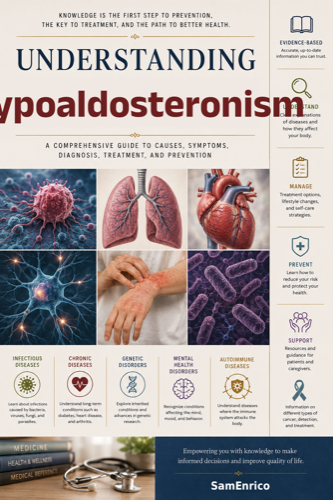
Non-FictionInformativeEducational
Understanding Hypoaldosteronism eBook
This disease publication, published by SamEnrico,
This disease publication, published by SamEnrico, covers Understanding Hypoaldosteronism
Formats
Free sample
Chapter 1: The Forgotten Hormone--On a cold December morning in 1952, a young physician named Jerome Conn walked into a hospital room at the University of Michigan and encountered a patient who would change the course of endocrinology forever. The woman before him was fifty-two years old. She complained of muscle weakness so profound that she could barely lift a coffee cup. Her blood pressure was dangerously high. Her potassium was dangerously low.
And every test that standard medicine could offer had failed to explain why.Conn spent the next several weeks unraveling the mystery. He eventually discovered a tiny tumor on one of her adrenal glands—a growth that was flooding her body with a hormone that most doctors at the time had never heard of. That hormone was aldosterone. The patient had primary hyperaldosteronism, the opposite of what this book will address. But Conn’s discovery opened a door that had been sealed for decades.
For the first time, the medical community understood that there existed a master regulator of sodium and potassium, a chemical messenger so powerful that a single overactive cluster of cells could cripple an otherwise healthy adult.What Conn and his contemporaries could not have predicted was that the opposite problem—too little aldosterone rather than too much—would prove to be far more common, far more subtle, and far more frequently missed. Today, seventy years later, hypoaldosteronism remains one of the most underdiagnosed conditions in clinical medicine. It lurks in the shadows of diabetic kidney disease, chronic kidney disease, and the aging process itself. It causes fatigue, muscle weakness, brain fog, and cardiac arrhythmias in millions of people who have been told that their lab results are “normal” and that their symptoms are “nothing to worry about.”This chapter is about the hormone that Conn dragged into the light. It is about what aldosterone does, what happens when it fails, and why that failure has been hiding in plain sight for generations.
By the time you finish reading, you will understand the basic physiology of your condition better than most primary care physicians. And you will be ready to take the next step: turning that understanding into a diagnosis and a treatment plan.The Adrenal Gland’s Secret Factory To understand hypoaldosteronism, you must first understand where aldosterone comes from. The answer lies in two small, triangular organs that sit atop your kidneys like floppy hats. Each adrenal gland weighs less than a stick of butter and measures about two inches across, but within that tiny volume, it produces dozens of hormones that regulate everything from your stress response to your blood pressure to your sex drive.The adrenal gland is divided into layers, like a geological formation. The outer layer, the cortex, is itself subdivided into three zones.
The innermost zone produces sex hormones. The middle zone produces cortisol. And the outermost zone—the zona glomerulosa—produces aldosterone and nothing else.The zona glomerulosa is remarkable for its relative simplicity. Unlike the other adrenal zones, which respond to complex signals from the brain and the immune system, the zona glomerulosa is primarily controlled by just three inputs: blood pressure, sodium concentration, and potassium concentration. When your blood pressure drops, when your sodium falls, or when your potassium rises, the zona glomerulosa releases aldosterone into your bloodstream.
When your blood pressure is high, your sodium is normal, and your potassium is low, the zona glomerulosa shuts down production almost entirely.This simplicity is a vulnerability. Because the zona glomerulosa has so few backup systems, any disruption to its blood supply, its cellular machinery, or its signaling pathways can dramatically impair aldosterone production. Diabetes damages the small arteries that feed the adrenal glands. Chronic kidney disease alters the chemical signals that tell the adrenals to work. Age itself gradually reduces the number of functional aldosterone-producing cells.
Even common medications—ibuprofen, naproxen, blood pressure pills like lisinopril—can blunt aldosterone release.In healthy people, the zona glomerulosa has enough reserve capacity to compensate for mild damage. In people with diabetes, kidney disease, or advancing age, that reserve is gradually depleted. The result is a slow, insidious decline in aldosterone production that may take years to become clinically apparent. By the time symptoms emerge, the patient has often been told that their fatigue and weakness are simply part of getting older, or a consequence of their diabetes, or a side effect of their medications.The tragedy is that this decline is measurable. It is treatable.
And in many cases, it is reversible. But first, you have to know to look for it.The RAAS System: A Cascade of Chemical Messengers Aldosterone does not work alone. It is the final step in a cascade known as the Renin-Angiotensin-Aldosterone System—the RAAS. Think of the RAAS as a three-stage rocket, with aldosterone as the payload that actually changes how your body behaves.Stage One: The Kidneys Sound the Alarm Embedded in the walls of the tiny arteries that supply your kidneys' filtering units are specialized cells called juxtaglomerular cells. These cells are exquisitely sensitive to three things: the pressure of blood flowing past them, the amount of sodium reaching the kidney tubules, and signals from your sympathetic nervous system.
When blood pressure drops—because you are dehydrated, because you have lost blood, or simply because you stood up too quickly—these cells release an enzyme called renin into your bloodstream.Renin is the trigger. Its only job is to start the cascade.Stage Two: The Liver Provides the Raw Material Your liver constantly produces a protein called angiotensinogen. Unlike most hormones, angiotensinogen circulates in your blood at all times, waiting for something to activate it. When renin reaches the liver, it cleaves angiotensinogen into a smaller protein called angiotensin I. This is the first transformation.Angiotensin I has no biological activity.
It floats through your bloodstream doing nothing until it reaches the capillaries of your lungs.Stage Three: The Lungs Complete the Transformation Embedded in the lining of your lung capillaries is an enzyme called ACE—angiotensin-converting enzyme. When angiotensin I passes through the lungs, ACE snips off two amino acids, converting it into angiotensin II.Angiotensin II is a biological powerhouse. It has two major functions. First, it binds to receptors on the smooth muscle cells surrounding your arteries, causing those vessels to constrict. This raises your blood pressure immediately—a short-term fix for hypotension.
Second, angiotensin II travels through your bloodstream to your adrenal glands, where it binds to receptors on the zona glomerulosa and stimulates the release of aldosterone.Stage Four: Aldosterone Executes the Final Command Aldosterone travels from the adrenal glands to the kidneys, where it binds to mineralocorticoid receptors on the cells of the collecting duct—the final tube through which urine passes before leaving the body. When aldosterone binds to these receptors, it triggers a cascade of genetic and cellular events that insert sodium channels and sodium-potassium pumps into the cell membranes.The result is a dramatic increase in sodium reabsorption from the urine back into the blood, and a corresponding increase in potassium excretion from the blood into the urine. The mantra that will appear throughout this book captures it perfectly:Aldosterone tells the kidney to HOLD…
This is the end of the free sample. Get the eBook to keep going. Buy now
About this book
Details
- Author
- Loftis Prudence
- Publisher
- SamEnrico
- Language
- English
- Genre
- Non-Fiction, Informative, Educational
- Released
- 2026-05-11
- Pages (approx.)
- 149
- Available as
- eBook, Audiobook

Read better in the ZLOADR app
Your eBooks on your phone or tablet. Sign in with your SamEnrico account and start reading.
More by Loftis Prudence
 Resistance Band Full Body WorkoutLoftis Prudence$11.99
 Breath Awareness Sleep GuideLoftis Prudence$11.99
 IT Band Stretching RoutineLoftis Prudence$11.99
 Weekly Review AssessmentLoftis Prudence$11.99
 The Vanishing Act: The CIA’s Secret War in LaosLoftis Prudence$11.99
 The Balloon That Broke the Sound Barrier: The Untold Story of the Red Bull Stratos JumpLoftis Prudence$11.99
 Proteomics Cancer Biomarker GuideLoftis Prudence$12.99
 Remote Logistics Coordinator HandbookLoftis Prudence$12.99
 Patient AdvocateLoftis Prudence$11.99
 How to Start a Broach for Metal Working Machine Tools Business (Beginners Guide)Loftis Prudence$11.99
You may also like
 Hong Kong Handover 1997Dunn Johnnie$11.99
 Zumba For Postnatal Recovery CourseNeal Christian$11.99
 Zumba for BeginnersLadner Nikia$11.99
 YouTube Comment Mining GuideHumes Pandora$12.99
 Worry Box MeditationCarlin Rudy$11.99
 Workplace Stress MeditationNguyen Lynn$11.99
 Workplace Stress and Sleep RepairHawley Ivory$11.99
 Workplace Perfectionism CureDelaney Jeffry$11.99
 Workplace Injustice Anger GuideWallen Isabelle$11.99
 Work Addiction and Burnout LinkGreenwood Ester$11.99
 Women in Yoga and WellnessBeattie Galina$11.99
 Women in Stand Up ComedyChun Evangeline$11.99