
Non-FictionInformativeEducational
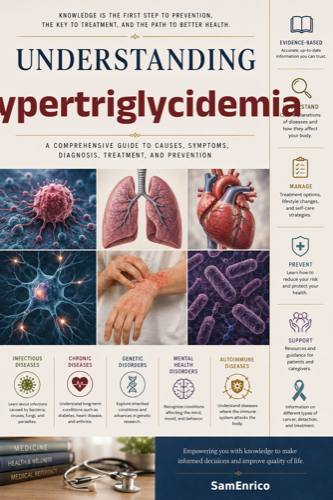
Understanding Hypertriglycidemia eBook
This disease publication, published by SamEnrico,
This disease publication, published by SamEnrico, covers Understanding Hypertriglycidemia
Formats
Free sample
Chapter 1: The Forgotten Epidemic...--–- The email arrived at 2:17 AM on a Tuesday. Dr. Sarah Chen, a 45-year-old primary care physician in Des Moines, Iowa, had just finished her last chart when her phone buzzed. It was from the emergency department: "Code STEMI. 52-year-old male.
Triglycerides 680. LDL 92. On atorvastatin 40mg. Please advise."She stared at the screen, frowning. The patient's LDL was perfect — below the guideline-recommended target of 100 mg/d L.
His statin was working exactly as intended. And yet here he was, at 2 AM, with a ST-elevation myocardial infarction — a "widowmaker" heart attack. His arteries were occluded, his heart muscle was dying, and his cholesterol panel showed a number that most doctors had been trained to ignore: triglycerides of 680 mg/d L.Dr. Chen had seen this scenario dozens of times over her 18-year career. Each time, it troubled her more deeply.
Medical school had taught her to focus on LDL cholesterol — the "bad cholesterol" — as the primary driver of heart disease. Clinical guidelines emphasized statin therapy to lower LDL. Quality metrics tracked how many of her patients with heart disease were on high-intensity statins. Pharmaceutical representatives visited her office monthly to discuss the latest LDL-lowering agents.But no one talked about triglycerides.The Most Ignored Number on Your Blood Test Every year, over 100 million lipid panels are ordered in the United States alone. Each of those reports contains six numbers: total cholesterol, LDL cholesterol, HDL cholesterol, triglycerides, VLDL cholesterol, and the calculated non-HDL cholesterol.
Of these six numbers, the one that receives the least attention from physicians — and is the least understood by patients — is consistently the triglyceride value.This is not an accident of medical education. It is the result of a half-century of scientific focus that prioritized cholesterol over other lipids, driven by the undeniable success of statin drugs in reducing heart attacks. When the first statin was approved in 1987, it revolutionized cardiovascular medicine. For the first time, physicians had a weapon that could reliably lower LDL cholesterol by 30-50% and reduce heart attacks by 25-35%. The message was simple, powerful, and marketable: lower LDL, save lives.But as the decades passed, a troubling pattern emerged.
Patients like the 52-year-old man in Dr. Chen's emergency department continued to have heart attacks despite achieving excellent LDL control. In clinical trials, even patients who lowered their LDL to levels below 70 mg/d L — far below the original targets — still experienced major cardiovascular events. The residual risk, as cardiologists began calling it, was substantial. Somewhere between 30% and 50% of cardiovascular events occurred despite optimal LDL management.The search for the source of this residual risk led researchers back to triglycerides — the most abundant type of fat in the human body, and the most consistently overlooked component of the standard lipid panel.What This Book Will Do for You This book is the definitive guide to understanding hypertriglyceridemia: what it is, why it matters, how to diagnose it, and most importantly, how to treat it.
Whether you are a physician seeking to update your practice, a medical trainee building your knowledge base, or a patient trying to understand your own blood work, this book will provide you with the evidence-based, clinically actionable information you need.We will cover the full spectrum of hypertriglyceridemia, from the mild elevations that silently accelerate atherosclerosis to the extreme levels that can trigger life-threatening pancreatitis. We will explore the genetic underpinnings that explain why some people can eat pizza with impunity while others cannot. We will review the lifestyle interventions that are often more effective than medications — and the medications that are essential for those who cannot achieve control through diet and exercise alone. We will examine special populations, including children, pregnant women, and patients with HIV. And we will look to the future, where new genetic therapies promise to transform the treatment of the most severe forms of this disorder.But before we dive into the details, we must first answer a fundamental question: What exactly are triglycerides, and why does the human body make them in the first place?The Biology of Energy Storage To understand hypertriglyceridemia, we must first understand triglycerides themselves.
These molecules are the body's primary mechanism for storing energy for future use, analogous to the fuel tank in your car or the battery in your smartphone. When you eat more calories than your body needs immediately, the excess is converted into triglycerides and stored in fat cells (adipocytes) distributed throughout your body. When you need energy between meals, hormones signal these fat cells to release triglycerides back into the bloodstream, where they are broken down and used by muscles, organs, and other tissues.This system is elegant, efficient, and evolutionarily ancient. Our hunter-gatherer ancestors faced unpredictable food availability; the ability to store energy during times of plenty and release it during times of scarcity was essential for survival. The human body can store enormous amounts of energy as triglycerides — a lean adult of 70 kg (154 pounds) carries approximately 15 kg (33 pounds) of fat tissue, representing nearly 150,000 calories of stored energy.
This is enough to survive for 60-90 days without food, assuming adequate water intake.But this same system that enabled our ancestors to survive famines has become maladaptive in our modern environment. We no longer face prolonged periods of food scarcity. Instead, we face constant access to calorie-dense, highly processed foods, combined with sedentary lifestyles that burn few calories. The result is a chronic oversupply of energy that overwhelms the body's storage capacity, leading to elevated triglyceride levels in the blood — a condition we call hypertriglyceridemia.A Brief History of a Misunderstood Marker The story of how triglycerides became the forgotten lipid is a story of scientific discovery, commercial success, and unintended consequences.In the 1950s and 1960s, researchers began to unravel the relationship between blood lipids and heart disease. The Framingham Heart Study, launched in 1948, was the first large prospective cohort study to identify risk factors for cardiovascular disease.
Its early findings pointed to total cholesterol as a major predictor of heart attacks. Subsequent research refined this observation, distinguishing between LDL (the "bad" cholesterol that deposits fat into arteries) and HDL (the "good" cholesterol that removes it).The pharmaceutical industry was quick to capitalize on these discoveries. Statins, which inhibit the rate-limiting enzyme in cholesterol synthesis (HMG-Co A reductase), were developed in the 1970s and 1980s. The landmark 4S trial (Scandinavian Simvastatin Survival Study) published in 1994 showed that simvastatin reduced all-cause mortality by 30% in patients with established heart disease. This was a watershed moment.
Statins became blockbuster drugs, generating billions of dollars in annual revenue and saving countless lives.In the wake of statins' success, clinical guidelines and quality metrics became increasingly focused on LDL cholesterol. Physicians were taught to "treat to target" — to titrate statin doses until LDL fell below specific thresholds (first 130 mg/d L, then 100 mg/d L, then 70 mg/d L for high-risk patients). Pharmaceutical detailing representatives distributed pocket cards with LDL targets. Electronic health records built alerts triggered by elevated LDL. The message was reinforced at every turn: LDL is the enemy.Triglycerides, meanwhile, were relegated to the footnotes.
They were seen as "confounding" factors — markers that were elevated in the same patients who had low HDL and…
This is the end of the free sample. Get the eBook to keep going. Buy now
About this book
Details
- Author
- Nation Jolanda
- Publisher
- SamEnrico
- Language
- English
- Genre
- Non-Fiction, Informative, Educational
- Released
- 2026-06-02
- Pages (approx.)
- 159
- Available as
- eBook, Audiobook

Read better in the ZLOADR app
Your eBooks on your phone or tablet. Sign in with your SamEnrico account and start reading.
More by Nation Jolanda
 Daily Reset Ritual GuideNation Jolanda$11.99
 Breath Awareness For VertigoNation Jolanda$11.99
 Franchise Builder's Employee RecognitionNation Jolanda$11.99
 Runner's Stretching HandbookNation Jolanda$11.99
 The Ghost of Flight 447: The Aviation Mystery That Stumped the WorldNation Jolanda$11.99
 The Last Broadcast: The Arecibo Telescope's Final HoursNation Jolanda$11.99
 Hydrogen Fuel Cell TechnologyNation Jolanda$11.99
 Telemedicine Robotics OutlookNation Jolanda$12.99
 Cruise Ship Entertainment Career ManualNation Jolanda$12.99
 How to Start a Patent Broker Business (Beginners Guide)Nation Jolanda$11.99
You may also like
 Hong Kong Handover 1997Dunn Johnnie$11.99
 Zumba For Postnatal Recovery CourseNeal Christian$11.99
 Zumba for BeginnersLadner Nikia$11.99
 YouTube Comment Mining GuideHumes Pandora$12.99
 Worry Box MeditationCarlin Rudy$11.99
 Workplace Stress MeditationNguyen Lynn$11.99
 Workplace Stress and Sleep RepairHawley Ivory$11.99
 Workplace Perfectionism CureDelaney Jeffry$11.99
 Workplace Injustice Anger GuideWallen Isabelle$11.99
 Work Addiction and Burnout LinkGreenwood Ester$11.99
 Women in Yoga and WellnessBeattie Galina$11.99
 Women in Stand Up ComedyChun Evangeline$11.99