
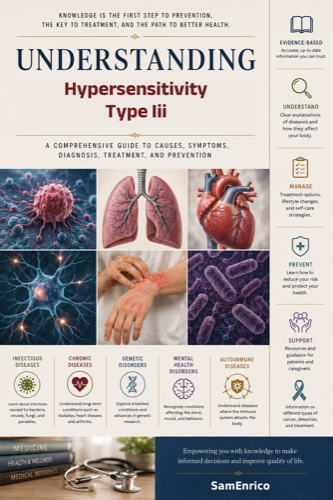
Non-FictionInformativeEducational
Understanding Hypersensitivity Type Iii Audiobook
This disease publication, published by SamEnrico,
by Shaver Paige
This disease publication, published by SamEnrico, covers Understanding Hypersensitivity Type Iii
Formats
Free sample
Chapter 1: The Masquerading Enemy...--–- It began with a rash that would not fade and a fatigue that no amount of coffee could fix. For Sarah Thompson, a 34-year-old middle school teacher from Ohio, the first signs were subtle enough to dismiss. A few purple spots on her shins—she must have bumped into her desk. Aching knees—probably from standing all day. Low-grade fevers every afternoon—just the end-of-semester stress.
Her doctor agreed, prescribing antihistamines for “probably some new allergy” and suggesting better sleep hygiene. But when the spots spread to her thighs and arms, and her morning stiffness began lasting well past noon, Sarah knew something deeper was wrong. She had stumbled, unknowingly, into the world of immune complex disease—a world where the body’s own defense system turns into a saboteur, and where the enemy wears a thousand disguises.The Allergy That Wasn’t For decades, the word “hypersensitivity” has been almost synonymous with “allergy” in the public imagination. Peanut allergies, hay fever, hives from strawberries—these immediate, dramatic reactions dominate our understanding of immune overreactions. But there is a quieter, more insidious category of immune dysfunction that operates on a different timescale and through a completely different mechanism.
It does not send patients into anaphylactic shock within minutes. Instead, it gnaws at blood vessels, clogs the microscopic filters of the kidneys, inflames joints until they swell like overripe fruit, and slowly suffocates the lungs over years of unrecognized exposure. This is Type III hypersensitivity, and it is the masquerading enemy of modern medicine.The Gell and Coombs classification system, developed in the 1960s by immunologists Robin Coombs and Philip Gell, remains the bedrock framework for understanding the four types of hypersensitivity reactions. Type I is the classic immediate allergy: Ig E antibodies binding to mast cells, triggering histamine release within seconds to minutes of allergen exposure. Type II involves antibodies directly attacking the surface of the body’s own cells—think autoimmune hemolytic anemia, where Ig G binds to red blood cells and marks them for destruction.
Type IV is the delayed-type reaction mediated by T-cells, responsible for the skin test for tuberculosis or the poison ivy rash that takes days to appear.And then there is Type III. Unlike its cousins, Type III does not target fixed cells (Type II) or rely primarily on T-cells (Type IV). Nor does it produce the explosive, histamine-driven…
This is the end of the free sample. Get the Audiobook to keep going. Buy now
About this book
Details
- Author
- Shaver Paige
- Publisher
- SamEnrico
- Language
- English
- Genre
- Non-Fiction, Informative, Educational
- Released
- 2026-06-03
- Pages (approx.)
- 160
- Available as
- eBook, Audiobook

Listen in the VoxFlicks app
Audiobooks and audio dramas wherever you go. Sign in with your SamEnrico account and press play.
More by Shaver Paige
 Full Body Breath AwarenessShaver Paige$11.99
 Workaholics Anonymous Step WorkbookShaver Paige$11.99
 Franchise Builder's Inventory MasteryShaver Paige$11.99
 Full Body Stretching Routine GuideShaver Paige$11.99
 Ashen Legacy: The Last Breath of TheraShaver Paige$11.99
 The Last Mile: The Untold Story of the 1975 Boston Marathon CheaterShaver Paige$11.99
 Crypto Job Search WorkbookShaver Paige$12.99
 B2B Payment Virtual CardsShaver Paige$12.99
 Crypto Advisory or Trading BusinessShaver Paige$11.99
 How to Start a Paving Slabs Made of Concrete Business (Beginners Guide)Shaver Paige$11.99
You may also like
 Hong Kong Handover 1997Dunn Johnnie$11.99
 Zumba For Postnatal Recovery CourseNeal Christian$11.99
 Zumba for BeginnersLadner Nikia$11.99
 YouTube Comment Mining GuideHumes Pandora$12.99
 Worry Box MeditationCarlin Rudy$11.99
 Workplace Stress MeditationNguyen Lynn$11.99
 Workplace Stress and Sleep RepairHawley Ivory$11.99
 Workplace Perfectionism CureDelaney Jeffry$11.99
 Workplace Injustice Anger GuideWallen Isabelle$11.99
 Work Addiction and Burnout LinkGreenwood Ester$11.99
 Women in Yoga and WellnessBeattie Galina$11.99
 Women in Stand Up ComedyChun Evangeline$11.99