
Non-FictionInformativeEducational
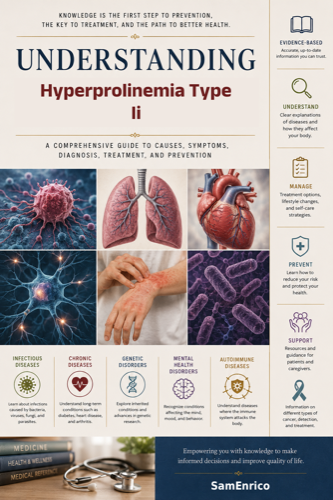
Understanding Hyperprolinemia Type Ii eBook
This disease publication, published by SamEnrico,
This disease publication, published by SamEnrico, covers Understanding Hyperprolinemia Type Ii
Formats
Free sample
Chapter 1: The Seizure Lie...--–- The beeping started first. Then the shouting. Then the silence that no parent should ever hear.At three in the morning, Sarah folded laundry in a hospital waiting room while her fourteen-month-old daughter, Maya, seized for the forty-fifth time that week. The EEG leads on Maya’s head looked like a failed science experiment. The phenobarbital had turned her into a sleepy, drooling version of the baby who used to laugh at peekaboo.
The Keppra had made her aggressive. The clonazepam had done nothing at all.“Sometimes,” the neurologist had said six days earlier, “we never find the cause. Some children just have refractory epilepsy. You’ll need to learn to manage expectations.”Sarah folded another onesie. She thought about the word “expectations.” She had expected to watch her daughter learn to walk.
Instead, she watched her daughter’s eyes roll back and her limbs stiffen like a doll possessed. She had expected first words. Instead, she got grunts and fatigue. She had expected birthday parties. Instead, she got MRI after normal MRI, blood draw after normal blood draw.“Try B6,” whispered a metabolic geneticist who happened to be passing through the neurology floor that night.
He was old, with glasses taped at the bridge and a coffee stain on his white coat. He looked like someone who had seen too many children like Maya. “Vitamin B6. Pyridoxine. High dose.
Ask them to try it.”“For seizures?” Sarah asked, incredulous.“For a metabolic trap,” he said. “For a broken assembly line inside her cells. For a problem that looks like epilepsy but isn’t. Just try it.”That night, Maya received her first dose of pyridoxine—vitamin B6—at one hundred milligrams intravenously. Twelve hours later, her seizures stopped.
Not reduced. Not improved. Stopped. Completely. As if someone had flipped a switch inside her brain.Maya was eventually diagnosed with Hyperprolinemia Type II (HPII).
The neurologist who had said “manage expectations” had never heard of it. The metabolic geneticist who suggested B6 had seen only two cases in forty years. Maya’s parents had never heard of it because almost no one had.This chapter is for every parent sitting in a waiting room right now, folding laundry, wondering if their child’s mystery symptoms have a name. They do. And for some children, the answer is as simple—and as overlooked—as a vitamin.What Is Proline and Why Should You Care?Before we can understand what goes wrong in Hyperprolinemia Type II, we need to understand what proline is and why your body bothers making it in the first place.Proline is an amino acid.
Amino acids are the building blocks of proteins, which are the workhorses of every cell in your body. Think of amino acids as letters of the alphabet. String them together in different orders, and you spell words like “collagen” (for your skin and joints), “hemoglobin” (for your blood), or “enzymes” (for every chemical reaction in your body).Most amino acids are “essential,” meaning your body cannot make them and you must get them from food. Proline is different. Proline is “non-essential,” meaning your body can manufacture it from other amino acids, primarily glutamate and ornithine.
Your body produces about 2 to 5 grams of proline every day, mostly in your liver and kidneys.So what does proline actually do? Three things:First, collagen formation. Proline makes up approximately 15 percent of all the amino acids in collagen, the protein that gives your skin its elasticity, your bones their strength, and your joints their cushion. Without proline, your body cannot produce stable collagen. Wounds would not heal.
Scars would not form. Blood vessels would rupture.Second, protein stability. Proline has a unique chemical structure—a rigid ring—that kinks and bends protein chains in specific ways. This rigidity allows proteins to fold into their proper three-dimensional shapes. Without proline’s unique geometry, many proteins would unravel and stop working.Third, cellular protection.
Under conditions of stress—infection, injury, starvation—proline helps protect cells by scavenging damaging free radicals and stabilizing cell membranes. Some researchers call proline a “stress amino acid” because your body ramps up production when things go wrong.Under normal circumstances, your body maintains a delicate balance. It produces proline when needed. It breaks down proline when there is too much. The breakdown pathway is a multi-step assembly line involving several enzymes, each performing a specific chemical conversion.
When all the enzymes work correctly, proline is converted first to P5C (we will explain what that is in a moment), then to glutamate, then to energy or other useful molecules.But what happens when one of those enzymes is broken? The assembly line jams. Proline backs up. And toxic intermediates accumulate. That is exactly what happens in Hyperprolinemia Type II.The Traffic Jam Analogy: Understanding Type I vs.
Type IIImagine a busy highway with two lanes entering a tunnel. At the far end of the tunnel, there is a toll booth. Cars represent proline molecules. The tunnel represents the metabolic pathway that breaks proline down. The toll booth represents the final enzyme that completes the job.In a healthy person, the toll booth is wide open.
Cars flow through smoothly. No backup. No traffic jam.Hyperprolinemia Type I is like a partial blockage at the toll booth. The booth is open, but only one lane gets through. Cars slow down.
A queue forms. But eventually, most cars make it through. This is caused by a deficiency in the enzyme proline oxidase (also called proline dehydrogenase). Proline levels in the blood rise to about 3 to 10 times normal, but the toxic intermediate P5C does not accumulate significantly because the next enzyme—the one we care about in Type II—is still working. Most people with Type I have no symptoms at all.
Some may have mild neurological issues, but the condition is generally considered benign.Hyperprolinemia Type II is a complete blockage at a different point in the tunnel. Imagine that just before the toll booth, a rock slide completely blocks both lanes. Cars cannot move at all. The backup is massive. And here is the critical difference: the blocked cars start to leak toxic exhaust.
In HPII, the blockage is caused by a deficiency in the enzyme P5C dehydrogenase (also called ALDH4A1). This enzyme normally converts P5C into glutamate. When it is broken, P5C accumulates to toxic levels. Proline also accumulates—typically 10 to 15 times normal—but proline itself is not the primary problem. The problem is P5C.Why does that matter?
Because P5C is chemically reactive. It binds to other molecules and inactivates them. Most importantly, P5C binds to and inactivates vitamin B6, creating a functional deficiency that drives the neurological symptoms of HPII.That is why Type II is rarer than Type I but far more clinically significant. Type I is a partial blockage with minimal consequences. Type II is a complete blockage with a toxic spill.
And because the two conditions share the same elevated proline marker, they are often confused—leading to the dangerous myth that all hyperprolinemia is benign.It is not. Type II is not benign. And the difference…
This is the end of the free sample. Get the eBook to keep going. Buy now
About this book
Details
- Author
- Woodward Etta
- Publisher
- SamEnrico
- Language
- English
- Genre
- Non-Fiction, Informative, Educational
- Released
- 2026-06-02
- Pages (approx.)
- 160
- Available as
- eBook, Audiobook

Read better in the ZLOADR app
Your eBooks on your phone or tablet. Sign in with your SamEnrico account and start reading.
More by Woodward Etta
 Franchise Builder's Passive IncomeWoodward Etta$11.99
 Time Blocking For Real Estate AgentsWoodward Etta$11.99
 Anger Trigger Smartphone LogWoodward Etta$11.99
 Al Anon Step StudiesWoodward Etta$11.99
 The Paradox of Zeno: A Philosopher’s Race Against TimeWoodward Etta$11.99
 How to Start a British Legion (other Than Social Club) Business (Beginners Guide)Woodward Etta$11.99
 Club AssociateWoodward Etta$11.99
 Full Time Creator Launch GuideWoodward Etta$12.99
 Expense Management AI GuideWoodward Etta$12.99
You may also like
 Hong Kong Handover 1997Dunn Johnnie$11.99
 Zumba For Postnatal Recovery CourseNeal Christian$11.99
 Zumba for BeginnersLadner Nikia$11.99
 YouTube Comment Mining GuideHumes Pandora$12.99
 Worry Box MeditationCarlin Rudy$11.99
 Workplace Stress MeditationNguyen Lynn$11.99
 Workplace Stress and Sleep RepairHawley Ivory$11.99
 Workplace Perfectionism CureDelaney Jeffry$11.99
 Workplace Injustice Anger GuideWallen Isabelle$11.99
 Work Addiction and Burnout LinkGreenwood Ester$11.99
 Women in Yoga and WellnessBeattie Galina$11.99
 Women in Stand Up ComedyChun Evangeline$11.99