
Non-FictionInformativeEducational
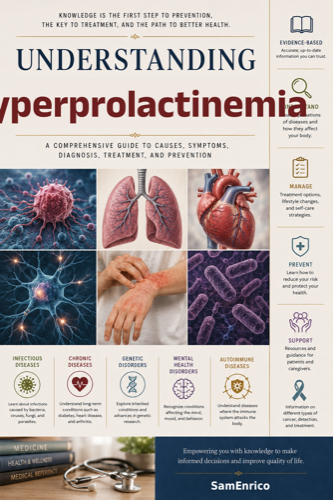
Understanding Hyperprolactinemia
This disease publication, published by SamEnrico,
This disease publication, published by SamEnrico, covers Understanding Hyperprolactinemia
Formats
About this book
Free sample
Chapter 1: The Milk Mystery...–- In the summer of 1933, a young researcher at the University of Pennsylvania made an observation that would echo through endocrinology for nearly a century. Dr. Oscar Riddle, who had been studying the pituitary glands of cattle obtained from a local slaughterhouse, injected an extract from these glands into the crop sacs of domesticated pigeons. The crop sac—a pouch-like expansion of the esophagus that pigeons and doves use to produce "pigeon milk" to feed their young—responded with dramatic swelling and proliferation of epithelial cells. Within days, the thin, membranous sac transformed into a thickened, milk-producing organ.
Riddle had stumbled upon something remarkable: a substance that could command a non-lactating organ to lactate. He named it "prolactin," from the Latin prolactum (for milk production). What Riddle could not have known was that he had discovered not just a lactation hormone, but a molecular maestro that orchestrates an astonishing array of biological functions—and whose overproduction would become one of the most commonly missed diagnoses in clinical medicine.The Hormone That History Forgot The decades following Riddle's discovery were marked by confusion and misdirection. For nearly forty years, prolactin was dismissed as a "specialist hormone" of interest primarily to comparative physiologists studying bird reproduction and mammalian lactation. Human endocrinologists largely ignored it.
The prevailing wisdom held that human prolactin was identical to growth hormone—a mistaken belief that persisted because early purification methods could not separate the two molecules. As late as 1970, leading textbooks of endocrinology devoted more space to pigeon crop sac bioassays than to any clinical syndrome related to prolactin excess in humans.This neglect came at a cost. Throughout those decades, countless patients—almost all of them women—presented to physicians with classic symptoms of hyperprolactinemia: unexplained milk production when not pregnant or nursing, menstrual cycles that had mysteriously ceased, infertility that defied explanation, and headaches that no one could localize. These patients were too often labeled with psychosomatic diagnoses. They were told their milk discharge was "just stress." Their absent periods were blamed on "hormonal imbalance" without further specification.
Their infertility was chalked up to "unexplained" after cursory evaluations. And their headaches were dismissed as migraines or tension-type pain.The…
This is the end of the free sample. Get the eBook to keep going. Buy now
Contents
- Chapter 1
- Chapter 2
- Chapter 3
- Chapter 4
- Chapter 5
- Chapter 6
- Chapter 7
- Chapter 8
- Chapter 9
- Chapter 10
- Chapter 11
- Chapter 12
Details
- Author
- Arreola Trisha
- Publisher
- SamEnrico
- Language
- English
- Genre
- Non-Fiction, Informative, Educational
- Released
- 2026-05-18
- Pages (approx.)
- 144
- Available as
- eBook, Audiobook

Read better in the ZLOADR app
Your eBooks on your phone or tablet. Sign in with your SamEnrico account and start reading.
More by Arreola Trisha
 Brand Ranking Metaverse PresenceArreola Trisha$11.99
 Time Blocking For Writers GuideArreola Trisha$11.99
 Overeaters Anonymous Step WorkbookArreola Trisha$11.99
 Franchise Builder's Master FranchiseeArreola Trisha$11.99
 The Last Waltz: The Night the Berlin Wall FellArreola Trisha$11.99
 The Alchemists of the Nile: Secrets of Ancient Egypt's Scientific PioneersArreola Trisha$11.99
 Merchant Cash Advance AIArreola Trisha$12.99
 Government Grant Application ManualArreola Trisha$12.99
 How to Start a Casting of Ferrous Patterns Business (Beginners Guide)Arreola Trisha$11.99
 Claim AnalystArreola Trisha$11.99
You may also like
 Hong Kong Handover 1997Dunn Johnnie$11.99
 Zumba For Postnatal Recovery CourseNeal Christian$11.99
 Zumba for BeginnersLadner Nikia$11.99
 YouTube Comment Mining GuideHumes Pandora$12.99
 Worry Box MeditationCarlin Rudy$11.99
 Workplace Stress MeditationNguyen Lynn$11.99
 Workplace Stress and Sleep RepairHawley Ivory$11.99
 Workplace Perfectionism CureDelaney Jeffry$11.99
 Workplace Injustice Anger GuideWallen Isabelle$11.99
 Work Addiction and Burnout LinkGreenwood Ester$11.99
 Women in Yoga and WellnessBeattie Galina$11.99
 Women in Stand Up ComedyChun Evangeline$11.99