
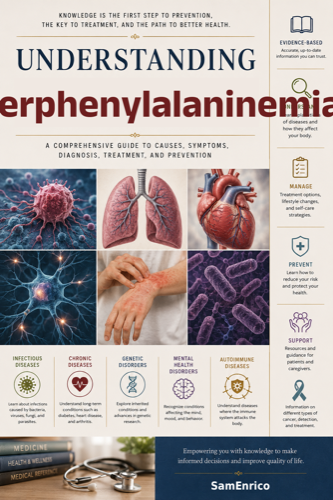
Non-FictionInformativeEducational
Understanding Hyperphenylalaninemia eBook
This disease publication, published by SamEnrico,
by Cerda Kellye
This disease publication, published by SamEnrico, covers Understanding Hyperphenylalaninemia
Formats
Free sample
Chapter 1: The Newborn’s Secret...--The phone rings on a Tuesday morning. The caller identifies herself as a nurse from the state newborn screening program. She asks if you are sitting down. Then she says the words that will permanently divide your life into before and after: "Your baby’s screening test came back positive for a condition called hyperphenylalaninemia. We need you to bring your infant to a metabolic specialist as soon as possible." You hang up, staring at your perfectly peaceful newborn sleeping in the bassinet.
Nothing looks wrong. Nothing smells wrong. Nothing feels wrong except for the sudden, crushing weight of medical uncertainty. This chapter is written for that moment. It is the hand to hold, the guide through the fog, and the honest but hopeful introduction to a condition that, while serious, is among the most successfully treatable genetic disorders known to medicine.The Diagnosis That Did Not Exist a Century Ago To understand where you are now, it helps to understand how far medicine has traveled.
In 1934, a Norwegian physician named Dr. Asbjørn Følling accepted a request to examine two young siblings who had been diagnosed with severe intellectual disability. The children, aged seven and ten, lived in an institution. Their parents were healthy. No obvious cause for their condition had been identified.
Følling, who held doctorates in both medicine and chemistry, decided to perform a simple experiment. He added a common chemical reagent called ferric chloride to samples of the children's urine. The liquid turned a deep, unmistakable green. That green color was a clue that a substance not normally found in human urine was present. Følling identified that substance as phenylpyruvic acid—a breakdown product that accumulates when the body cannot properly process the amino acid phenylalanine.This single observation launched the entire field of inherited metabolic disorders.
Følling had discovered the first treatable cause of intellectual disability. He called the condition "Følling's disease," though it would later become known as phenylketonuria or PKU—the most severe form of what we now call hyperphenylalaninemia. The significance of this discovery cannot be overstated. Before Følling, intellectual disability was largely seen as a tragic but untreatable condition, often attributed to birth injury, infection, or simply bad luck. Følling demonstrated that at least one form of intellectual disability had a discrete biochemical cause.
And if it had a biochemical cause, it might have a biochemical treatment. That radical idea took decades to fully materialize, but the seed was planted.The Race to Screen Every Newborn The journey from Følling's test tube to the phone call you just received took three decades and the work of several dedicated scientists. In the 1950s, German physician Dr. Horst Bickel demonstrated that a diet extremely low in phenylalanine could dramatically improve outcomes for children with PKU. His work proved that dietary intervention could prevent the worst neurological consequences of the disorder—but only if started early enough.
Children already showing severe symptoms did not fully recover. There was a narrow window of opportunity, and that window slammed shut within the first months of life.This finding created an urgent public health problem: how could you identify affected newborns before any symptoms appeared? The answer came from Dr. Robert Guthrie, an American microbiologist whose own child had a developmental disability. Guthrie was personally motivated to find a better way to screen newborns.
In 1963, he developed the bacterial inhibition assay, soon known simply as the "Guthrie test." It was a simple, inexpensive method that used a strain of bacteria requiring phenylalanine to grow. A small drop of blood from a newborn's heel was placed on filter paper. The paper was then applied to a culture plate containing the bacteria. The more phenylalanine in the blood, the more the bacteria grew, creating a visible ring of growth. The test was not perfectly precise by modern standards, but it worked.The Guthrie test launched universal newborn screening.
By the late 1960s, screening programs were established across North America, Europe, and other parts of the world. For the first time in history, it became possible to identify babies with PKU before they showed any signs of illness and to intervene with dietary treatment. The results were nothing short of miraculous. Children who would have otherwise developed severe intellectual disability grew up with normal or near-normal cognitive function. The number of cases eventually prevented runs into the millions.
Newborn screening for PKU remains one of the greatest public health achievements of the twentieth century.What the Positive Screen Really Means Let us pause here to address the most urgent question: what does a positive screening test actually mean for your baby? The answer requires understanding the difference between a screening test and a diagnostic test. A screening test is designed to be very sensitive—it will catch almost every true case. But this sensitivity comes at a cost. Screening tests also produce false positives, meaning they flag babies who do not actually have the condition.
This trade-off is intentional. In newborn screening, it is far better to temporarily worry a hundred families than to miss one affected baby who would otherwise go untreated until permanent brain damage occurred.For HPA, the screening test measures the level of an amino acid called phenylalanine in your baby's blood. Amino acids are the building blocks of proteins. Phenylalanine is one of the essential amino acids—meaning the body cannot make it and must obtain it entirely from food, specifically from protein-containing foods like breast milk, formula, meat, eggs, dairy, nuts, and beans. In a healthy baby, an enzyme in the liver called phenylalanine hydroxylase (PAH) converts excess phenylalanine into another amino acid called tyrosine.
The whole system works quietly in the background, processing the protein from every feeding without any conscious effort.In a baby with HPA, the PAH enzyme does not work properly because of a genetic mutation. Phenylalanine builds up in the blood instead of being converted. The screening test detects this buildup. However, there are many potential reasons for a high phenylalanine level on a screening test that have nothing to do with HPA. The baby might have been slightly dehydrated when the sample was collected.
The baby might have been fed a high-protein formula shortly before the sample. The baby's liver might be maturing a bit slowly, a common and harmless variation in newborns. The baby might have a temporary illness affecting metabolism. Or the baby might have one of several genetic conditions that cause elevated phenylalanine but have different treatment requirements, as discussed in Chapter 3.This is why a positive screen is not a diagnosis. It is an alarm bell that triggers confirmatory testing.
That confirmatory testing is the next step for your baby, and it will provide definitive answers.The Confirmatory Testing Journey The confirmatory testing process begins as quickly as possible after a positive screen, ideally within 24 to 48 hours. You will be directed to bring your baby to a metabolic center—usually a specialized clinic at a children's hospital or academic medical center. There, a team that includes metabolic physicians, genetic counselors, and metabolic dietitians will take over your baby's care.The first confirmatory…
This is the end of the free sample. Get the eBook to keep going. Buy now
About this book
Details
- Author
- Cerda Kellye
- Publisher
- SamEnrico
- Language
- English
- Genre
- Non-Fiction, Informative, Educational
- Released
- 2026-05-08
- Pages (approx.)
- 154
- Available as
- eBook, Audiobook

Read better in the ZLOADR app
Your eBooks on your phone or tablet. Sign in with your SamEnrico account and start reading.
More by Cerda Kellye
 Parenting Anger Trigger GuideCerda Kellye$11.99
 Anger When Child Comes Out LateCerda Kellye$11.99
 PNE Motivational InterviewingCerda Kellye$11.99
 Goal Progress Time BlockingCerda Kellye$11.99
 The Iron Geniuses of Meroë: Forging an Empire in Bronze and StoneCerda Kellye$11.99
 The Secret Codebreaker: Alan Turing’s War of NumbersCerda Kellye$11.99
 US Remote Payroll For Mexicans GuideCerda Kellye$12.99
 Real Time Fraud Prevention GuideCerda Kellye$12.99
 Audio EngineerCerda Kellye$11.99
 How to Become a Chick SexerCerda Kellye$11.99
You may also like
 Hong Kong Handover 1997Dunn Johnnie$11.99
 Zumba For Postnatal Recovery CourseNeal Christian$11.99
 Zumba for BeginnersLadner Nikia$11.99
 YouTube Comment Mining GuideHumes Pandora$12.99
 Worry Box MeditationCarlin Rudy$11.99
 Workplace Stress MeditationNguyen Lynn$11.99
 Workplace Stress and Sleep RepairHawley Ivory$11.99
 Workplace Perfectionism CureDelaney Jeffry$11.99
 Workplace Injustice Anger GuideWallen Isabelle$11.99
 Work Addiction and Burnout LinkGreenwood Ester$11.99
 Women in Yoga and WellnessBeattie Galina$11.99
 Women in Stand Up ComedyChun Evangeline$11.99