

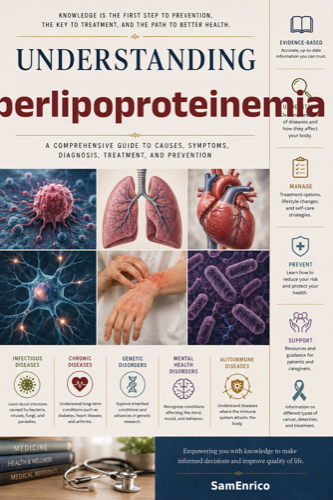
Non-FictionInformativeEducational
Understanding Hyperlipoproteinemia eBook
This disease publication, published by SamEnrico,
by Coble Tomiko
This disease publication, published by SamEnrico, covers Understanding Hyperlipoproteinemia
Formats
Free sample
Chapter 1: The Cholesterol Lie...--The first thing you need to know is that cholesterol is not your enemy.If every molecule of cholesterol vanished from your body tonight, you would be dead by morning. No exceptions. No second chances. Cholesterol is so essential to human life that every single one of your trillions of cells can manufacture it from scratch. Your liver produces somewhere between 800 and 1,500 milligrams of cholesterol every single day—roughly the amount contained in seven egg yolks—whether you eat a single bite of food or not.
Cholesterol is the raw material for every sex hormone you produce: testosterone, estrogen, progesterone. It is the precursor to cortisol, the stress hormone that keeps you alive in an emergency. It is the building block of vitamin D, which you require for bone health, immune function, and mood regulation. Without cholesterol, your nerve cells could not form the insulating myelin sheaths that allow electrical signals to travel from your brain to your toes in milliseconds. Without cholesterol, the membranes surrounding your cells would become so floppy and permeable that they would literally fall apart.So when someone tells you that cholesterol is "bad," what they really mean is that they have not read this chapter.The problem is not cholesterol.
The problem is the transportation system that moves cholesterol through your bloodstream. And that transportation system—a network of microscopic, fat-carrying particles called lipoproteins—has been hiding in plain sight for decades, misunderstood by millions of patients and, frankly, by many physicians as well.You have been lied to. Not maliciously, not conspiratorially, but systematically. The standard cholesterol test that your doctor orders—the one that gives you four numbers: total cholesterol, LDL cholesterol, HDL cholesterol, and triglycerides—tells you approximately one-tenth of what you need to know about your actual risk of heart attack and stroke. It is like checking the oil level in your car by looking at the color of the driver's seat.
It measures the wrong thing in the wrong way and then presents the result as if it were definitive.This book exists because that lie has consequences. Every year, millions of people are told their cholesterol is "normal" or "borderline" and sent home without treatment. One in three of those people will go on to have a heart attack or stroke caused by lipid abnormalities that their standard test completely missed. Another group of people—those with very high numbers—are prescribed statins that they may not need while being denied information about lifestyle changes that could actually save them. And a third group, perhaps the most tragic, are people with genetically high lipoprotein(a) or familial hypercholesterolemia who suffer cardiac events in their thirties and forties because no one ever ran the right test.This chapter is going to fix that for you.
By the time you finish reading, you will understand what lipoproteins actually are, why particle number matters more than cholesterol content, and why the standard lipid panel is essentially a lie of omission. You will also understand why this knowledge is the single most important tool you have for preventing the number one cause of death in the developed world.Let us begin.The Architecture of a Lipoprotein: A Fat Ball in a Skinny Suit Imagine you are trying to transport a substance that does not dissolve in water through a system that is 92 percent water. That is the fundamental problem your body faces with fats and cholesterol. Blood is essentially saltwater with some proteins floating in it. Fats and cholesterol are hydrophobic—they repel water, just as oil floats on top of vinegar.
If your liver simply dumped cholesterol into your bloodstream, it would clump together into useless, dangerous globules that would lodge in small capillaries and cause immediate damage.So evolution solved the problem with an elegant piece of biological engineering: the lipoprotein. A lipoprotein is a tiny spherical particle, far smaller than a red blood cell, that acts as a molecular shipping container. The core of the particle is filled with hydrophobic lipids—triglycerides and cholesterol esters, which are cholesterol molecules with a fatty acid attached to make them even more water-repellent. Wrapped around this core is a single layer of phospholipids, molecules that have a water-loving head and a water-fearing tail. The tails point inward toward the fat core; the heads point outward into the watery blood.
Embedded in this phospholipid shell are apolipoproteins—specialized proteins that act as identification badges, signaling to cells and enzymes where the particle came from, where it is going, and what should be done with it.Think of a lipoprotein as a bus. The bus is the particle itself. The passengers inside are the cholesterol and triglycerides. The bus driver is the apolipoprotein, holding a sign that says "I am going to the liver" or "I am delivering triglycerides to muscle." Without the bus driver, the bus has no destination. Without the bus, the passengers are lost in traffic.Different lipoproteins carry different passengers, have different drivers, and go to different destinations.
Understanding these differences is the key to understanding why some lipoproteins are dangerous and others are protective. Let us meet the family.The Lipoprotein Family Portrait Your body produces five major classes of lipoproteins. They range in size from the largest particles in your bloodstream down to the smallest. Each has a unique job, unique apolipoproteins, and—most important for your health—a unique relationship with heart disease.Chylomicrons: The Delivery Trucks for Dinner Chylomicrons are the largest lipoproteins—so large that they scatter light, which is why your blood plasma looks milky for a few hours after a very fatty meal. They are produced by your intestinal cells after you eat.
Their job is to transport dietary triglycerides and cholesterol from your gut to your tissues. Chylomicrons carry a specific apolipoprotein called Apo B-48 (a truncated version of the Apo B family), along with Apo C-II and Apo E. As they circulate, an enzyme called lipoprotein lipase—think of it as a dock worker—unloads the triglycerides into your muscle cells (for energy) and your fat cells (for storage). The remnants, now much smaller, are taken up by your liver. Chylomicrons themselves are not directly atherogenic—they are too large to penetrate artery walls.
But their remnants can be, especially in people with diabetes or genetic disorders of remnant clearance, as we will explore in Chapter 3.Very Low-Density Lipoprotein (VLDL): The Liver's Export Once your liver receives chylomicron remnants, it repackages the lipids into a new particle: VLDL. VLDL is the primary vehicle your liver uses to export triglycerides to the rest of your body. It contains Apo B-100 (the full-length version of Apo B, distinct from the intestinal Apo B-48), along with Apo C-II and Apo E. As VLDL circulates, lipoprotein lipase again removes triglycerides, causing the particle to shrink. As it shrinks, it first becomes intermediate-density lipoprotein (IDL), then ultimately LDL.
Most VLDL particles go through this transformation within 6 to 12 hours.Low-Density Lipoprotein (LDL): The Most Important Particle You Have Never Understood LDL is what most people think of as "bad cholesterol." But that label is misleading, because LDL is not a substance—it is…
This is the end of the free sample. Get the eBook to keep going. Buy now
About this book
Details
- Author
- Coble Tomiko
- Publisher
- SamEnrico
- Language
- English
- Genre
- Non-Fiction, Informative, Educational
- Released
- 2026-05-11
- Pages (approx.)
- 154
- Available as
- eBook, Audiobook

Read better in the ZLOADR app
Your eBooks on your phone or tablet. Sign in with your SamEnrico account and start reading.
More by Coble Tomiko
 Paper Planner Time Block MethodCoble Tomiko$11.99
 Brand Value Employee AdvocacyCoble Tomiko$11.99
 Anger And Child Mental Illness GuideCoble Tomiko$11.99
 PNE Meta Analysis GuideCoble Tomiko$11.99
 The Golden Notes: Black Opera's Majesty from Africa to the World StageCoble Tomiko$11.99
 The Vanishing Heiress: A Witness in ShadowsCoble Tomiko$11.99
 Microfinance ManagementCoble Tomiko$11.99
 Transition To UXR ManualCoble Tomiko$12.99
 Conversational Banking TechnologyCoble Tomiko$12.99
 How to Start a Hobby in Model nationsCoble Tomiko$11.99
You may also like
 Hong Kong Handover 1997Dunn Johnnie$11.99
 Zumba For Postnatal Recovery CourseNeal Christian$11.99
 Zumba for BeginnersLadner Nikia$11.99
 YouTube Comment Mining GuideHumes Pandora$12.99
 Worry Box MeditationCarlin Rudy$11.99
 Workplace Stress MeditationNguyen Lynn$11.99
 Workplace Stress and Sleep RepairHawley Ivory$11.99
 Workplace Perfectionism CureDelaney Jeffry$11.99
 Workplace Injustice Anger GuideWallen Isabelle$11.99
 Work Addiction and Burnout LinkGreenwood Ester$11.99
 Women in Yoga and WellnessBeattie Galina$11.99
 Women in Stand Up ComedyChun Evangeline$11.99