
Non-FictionInformativeEducational
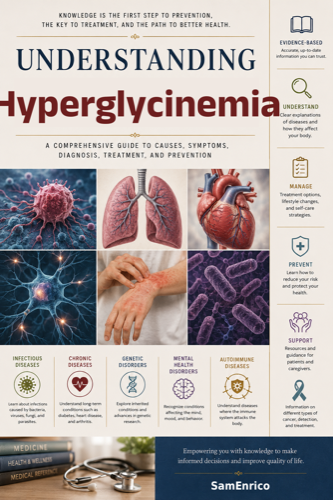
Understanding Hyperglycinemia eBook
This disease publication, published by SamEnrico,
by Laney Cecil
This disease publication, published by SamEnrico, covers Understanding Hyperglycinemia
Formats
Free sample
Chapter 1: The Glycine Paradox...--–- The first time a parent hears the word “hyperglycinemia,” they are usually sitting in a hospital conference room, the air thick with antiseptic and exhaustion, facing a geneticist who holds a stack of papers they cannot yet read. The word itself sounds like a spell from a fantasy novel—long, Latin-derived, and utterly foreign. But the reality behind that word is neither fantasy nor foreign. It is the story of the smallest molecule in the human body causing the largest possible catastrophe in the developing brain. That molecule is glycine, and its paradox is this: it is absolutely essential for life, and in the wrong amounts, it is absolutely devastating.To understand hyperglycinemia—specifically the form this book addresses, Nonketotic Hyperglycinemia (NKH), also known as Glycine Encephalopathy—one must first understand that the human body runs on chemical conversations.
Every thought, every movement, every heartbeat is preceded by molecules whispering to one another across microscopic spaces. Glycine is one of the most ancient and prolific of these conversationalists. It is the simplest amino acid in existence, built from just two carbon atoms, five hydrogen atoms, two oxygen atoms, and one nitrogen atom. Its chemical formula, C₂H₅NO₂, is so uncomplicated that it seems almost humble. But humility in biochemistry is often a mask for power.In the brain, glycine wears two masks.
At one set of receptors—the inhibitory glycine receptors found primarily in the brainstem and spinal cord—glycine tells neurons to be quiet, to slow down, to stop firing. This is essential. Without that inhibitory whisper, the muscles would lock into permanent spasm, the breathing reflex would become erratic, and the body would shake itself apart. At another set of receptors—the NMDA (N-methyl-D-aspartate) receptors found throughout the forebrain, hippocampus, and cortex—glycine acts as a co-agonist, meaning it must be present for the primary excitatory neurotransmitter, glutamate, to do its job. Here, glycine tells neurons to wake up, to fire, to learn, to remember, to feel.
This, too, is essential. Without that excitatory permission slip, the brain would sink into a stupor, unable to form memories or process sensation.One molecule. Two opposing jobs. This is the Glycine Paradox, and it is the key to understanding everything that follows in this book.When the glycine concentration in the brain rises to two, three, or five times normal levels, as it does in Nonketotic Hyperglycinemia, that elegant paradox collapses into chaos. The inhibitory receptors become overwhelmed and eventually desensitize—they stop listening to the shouts of “be quiet” because the shouting never stops.
Meanwhile, the NMDA receptors are overactivated continuously, as glycine is always present to give glutamate permission to fire. The result is excitotoxicity: neurons fire until they burn out and die. This is not a subtle process. It is the biochemical equivalent of leaving the lights on in every room of a house until the wiring melts and the walls catch fire.The Developing Brain: A Window of Vulnerability The human brain develops at a breathtaking pace in the final trimester of pregnancy and the first two years of life. During this period, neurons are migrating to their final positions, extending axons across the brain like telephone lines being strung between cities, and forming synapses—the connections that will underpin every skill, memory, and personality trait the child will ever possess.
This is a time of extraordinary plasticity, but it is also a time of extraordinary vulnerability.In a fetus or infant with NKH, the glycine concentration in the cerebrospinal fluid (CSF) begins to rise silently, often before birth. The mother’s body does a remarkable job of clearing glycine from the fetal blood, which is why most newborns with severe NKH appear completely normal at delivery. The Apgar scores are fine. The first feeding goes well. The parents breathe a sigh of relief.
But inside the baby’s brain, the glycine level is climbing because the Glycine Cleavage System—the enzyme complex responsible for breaking down glycine—is broken.The Glycine Cleavage System: The Body’s Glycine Garbage Disposal The Glycine Cleavage System (GCS) is a four-part enzyme complex located inside the mitochondria, the energy-producing compartments of cells. Its entire job is to take one molecule of glycine and split it into three parts: carbon dioxide (CO₂), ammonia (NH₃), and a one-carbon unit that gets transferred to a molecule called tetrahydrofolate. This sounds like a dry biochemical detail, but it is actually a matter of life and death. The GCS is the only significant pathway for glycine breakdown in the body. Without it, glycine has nowhere to go.
It accumulates in the blood, then in the CSF, then in the brain tissue itself.The GCS is composed of four proteins, each encoded by a different gene:The P-protein (encoded by GLDC), which performs the initial cleavage of glycine.The T-protein (encoded by AMT), which transfers the one-carbon unit.The H-protein (encoded by GCSH), which shuttles intermediates between the other proteins.The L-protein (encoded by DLD), which regenerates the system.Mutations in any of these genes can cause NKH, but the vast majority—approximately 80%—occur in GLDC, followed by about 20% in AMT. Mutations in GCSH and DLD are rare, accounting for less than 1% of cases combined. What all these mutations have in common is that they reduce or eliminate the activity of the GCS. The more residual activity remains, the milder the disease. The less residual activity remains, the more severe the outcome.But here is the crucial point that confuses many families and even some clinicians: the GCS is expressed throughout the body, but its failure causes brain disease far more than it causes systemic disease.
Why? Because the brain produces glycine endogenously—it makes its own glycine from the amino acid serine, via the enzyme serine hydroxymethyltransferase (SHMT). This means that even if a patient with NKH stops eating all protein (which contains glycine), the brain will continue to synthesize glycine from serine. This is why dietary protein restriction, the cornerstone of treatment for disorders like phenylketonuria (PKU), is not effective in NKH. The problem is not dietary glycine.
The problem is the brain’s own internal production, combined with the broken garbage disposal that cannot clear it.A brief note on terminology: The condition is called “Nonketotic” Hyperglycinemia because unlike other metabolic disorders that cause elevated glycine (such as propionic acidemia or methylmalonic acidemia), NKH does not produce ketones. Ketones are byproducts of fatty acid breakdown that accumulate when the body cannot properly process certain amino acids. In NKH, the urine organic acid analysis is normal. No ketones. This negative finding is actually a powerful diagnostic clue.
If a child has elevated glycine but normal urine organic acids, with no ketosis, the clinician should think immediately of NKH.The Two Faces of the Disease: Why Not All NKH Is Alike One of the most important concepts introduced in this chapter—and explored in full depth in Chapter 3—is that NKH is not one disease but a spectrum. At the severe end, infants present within the first 48 hours of life with progressive lethargy, hypotonia (profound floppiness), apnea (breathing pauses that require resuscitation), and myoclonic seizures. These children typically…
This is the end of the free sample. Get the eBook to keep going. Buy now
About this book
Details
- Author
- Laney Cecil
- Publisher
- SamEnrico
- Language
- English
- Genre
- Non-Fiction, Informative, Educational
- Released
- 2026-06-02
- Pages (approx.)
- 150
- Available as
- eBook, Audiobook

Read better in the ZLOADR app
Your eBooks on your phone or tablet. Sign in with your SamEnrico account and start reading.
More by Laney Cecil
 Anger And Parental Burnout ManualLaney Cecil$11.99
 Anger Trigger Environmental ScanLaney Cecil$11.99
 Financial Stress Foreclosure GuideLaney Cecil$11.99
 Failure Autopsy Growth LessonsLaney Cecil$11.99
 The Pharaoh's Sky Needle: How Imhotep Built the First ObeliskLaney Cecil$11.99
 The Billion-Dollar Bet: How a Casino Mogul Built a Real Estate EmpireLaney Cecil$11.99
 Wearable Telehealth Integration OutlookLaney Cecil$12.99
 Client Onboarding And Retainer ManualLaney Cecil$12.99
 How to Start a Shower Cabinets Made of Metal Business (Beginners Guide)Laney Cecil$11.99
 Tire Inflation (Commercial With Monitoring Systems)Laney Cecil$11.99
You may also like
 Hong Kong Handover 1997Dunn Johnnie$11.99
 Zumba For Postnatal Recovery CourseNeal Christian$11.99
 Zumba for BeginnersLadner Nikia$11.99
 YouTube Comment Mining GuideHumes Pandora$12.99
 Worry Box MeditationCarlin Rudy$11.99
 Workplace Stress MeditationNguyen Lynn$11.99
 Workplace Stress and Sleep RepairHawley Ivory$11.99
 Workplace Perfectionism CureDelaney Jeffry$11.99
 Workplace Injustice Anger GuideWallen Isabelle$11.99
 Work Addiction and Burnout LinkGreenwood Ester$11.99
 Women in Yoga and WellnessBeattie Galina$11.99
 Women in Stand Up ComedyChun Evangeline$11.99