
Non-FictionInformativeEducational
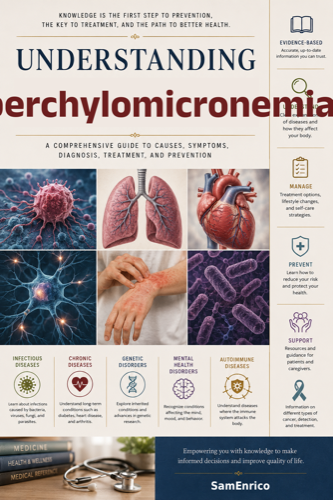
Understanding Hyperchylomicronemia eBook
This disease publication, published by SamEnrico,
This disease publication, published by SamEnrico, covers Understanding Hyperchylomicronemia
Formats
Free sample
Chapter 1: The Milky Blood...-- The first time Sarah saw her own blood drawn, she assumed the nurse had made a mistake. The vial, which should have held the deep red of venous blood, looked instead like strawberry milkshake—pinkish, opaque, and strangely creamy. The nurse frowned, held the vial up to the light, and said nothing. Sarah was 34 years old, a mother of two, and had spent the last six years being told she had "stomach problems," "anxiety," and once, memorably, "a low tolerance for normal digestive discomfort." She had endured three episodes of severe abdominal pain that landed her in the emergency room, two of which were labeled "idiopathic pancreatitis" because no gallstones were found and she "didn't drink enough to cause this." No one had ever looked at her blood before. No one had ever let it sit in the refrigerator overnight.
And no one had ever explained that blood is not supposed to look like a dessert.The milky appearance of Sarah's blood was not a lab error or a venipuncture artifact. It was the visible signature of a fundamental failure in how her body processes fat. Her blood was not red because it was crowded with chylomicrons—large, triglyceride-rich lipoproteins that should have been transient visitors to her bloodstream after meals but had instead taken up permanent residence. Her fasting triglyceride level, drawn after she had eaten nothing for 14 hours, came back at 4,200 milligrams per deciliter. The normal range for fasting triglycerides is less than 150.
She was twenty-eight times above the upper limit of normal. And she had never been told.This chapter is about what hyperchylomicronemia is, but more importantly, it is about what it is not. It is not high cholesterol, though the two are constantly confused. It is not a heart disease risk factor in its pure form, though patients are routinely put on statins that do nothing for them. It is not a lifestyle disease caused by eating too much fast food, though diet is the cornerstone of treatment.
And it is not uniformly severe across all patients, which is perhaps the most important distinction of all. Understanding hyperchylomicronemia begins with unlearning everything you think you know about "high lipids" and starting from a different foundation.The Definition That Most Doctors Get Wrong Hyperchylomicronemia is a disorder of triglyceride metabolism characterized by the pathological accumulation of chylomicrons in the fasting state. In a healthy person, chylomicrons appear in the bloodstream only for two to four hours after a meal, then are rapidly cleared by the enzyme lipoprotein lipase (Lp L). In a person with hyperchylomicronemia, chylomicrons persist in the blood for days or even weeks, creating the milky appearance that Sarah's nurse recognized but did not understand.The formal medical classification is Fredrickson Type I Hyperlipoproteinemia, a name that reflects a classification system developed in the 1960s by Donald Fredrickson at the National Institutes of Health. Fredrickson identified five patterns of lipoprotein abnormalities based on electrophoresis, and Type I was the rarest—characterized by the exclusive elevation of chylomicrons with normal or low levels of other lipoproteins.
This exclusivity matters. When a patient has elevated chylomicrons and also elevated VLDL (very low-density lipoproteins), the condition is classified as Fredrickson Type V, and it behaves differently, responds to different treatments, and carries different risks. The distinction between Type I and Type V is not a minor academic detail; it is the single most important clinical distinction a patient or physician can make.In pure hyperchylomicronemia (Type I), the problem is almost always genetic. The patient inherits two defective copies of a gene required for chylomicron clearance—most commonly the LPL gene encoding lipoprotein lipase itself, or the APOC2 gene encoding the protein that activates Lp L. Without functional Lp L, chylomicrons accumulate in direct proportion to dietary fat intake.
Eat fat, make chylomicrons. Make chylomicrons, cannot clear them. Cannot clear them, triglycerides rise. It is a linear, predictable, and entirely diet-driven process. There is no escape mechanism, no alternative clearance pathway that compensates for missing Lp L.
This is why the very low-fat diet described in Chapter 7 is not a suggestion but a medical necessity.In mixed hyperlipidemia (Type V), the picture is more complicated. These patients have both chylomicrons and VLDL, meaning their triglycerides come from two sources: dietary fat (via chylomicrons) and hepatic synthesis (via VLDL). Their Lp L may be partially functional but overwhelmed by the combined load. They may have genetic mutations that impair Lp L activity partially rather than completely, or they may have secondary factors—diabetes, obesity, alcohol, medications—that drive VLDL production beyond the capacity of a normal Lp L system. For these patients, diet alone may not be sufficient, and medications such as fibrates or omega-3 fatty acids may help.
But for the pure form, medications are largely useless.Throughout this book, the distinction between pure and mixed disease will be maintained because the two conditions require different approaches. Chapter 1 establishes this distinction as foundational. A patient who reads Chapter 7 and implements a very low-fat diet without knowing whether they have Type I or Type V may be doing the right thing, but they may also be missing opportunities to address VLDL through weight loss or diabetes control. A physician who prescribes a fibrate for a patient with pure Type I is wasting the patient's money and exposing them to side effects without benefit. And a patient who is told by their doctor that they have "high cholesterol" and given a statin is being actively misinformed.
The distinction matters. It matters for every decision that follows.The Visual Diagnosis: What Blood Should Not Look Like Before genetic testing, before lipid panels, before any of the sophisticated tools of modern medicine, there is the cold test. It costs nothing. It requires no special training. And it provides a diagnosis in twelve hours that might otherwise take years, as Sarah's case demonstrates.Here is how the cold test works: draw a patient's blood into a plain tube (without anticoagulant, or with EDTA which preserves lipoproteins), place it upright in a standard refrigerator at 4 degrees Celsius (39 degrees Fahrenheit), and leave it overnight.
In the morning, examine the tube. If the patient is normal, the blood will have separated into two layers: red blood cells at the bottom and clear, straw-colored serum at the top. If the patient has pure hyperchylomicronemia, the top layer will be opaque, creamy, and white—sometimes described as looking like whipped cream or sour cream. This creamy layer is the chylomicrons, which are so low in density that they literally float to the top of the tube. If the patient has mixed hyperlipidemia, the top layer will be creamy, but the liquid below will also be cloudy or turbid—evidence of VLDL, which is denser than chylomicrons but still light enough to remain suspended.Sarah's blood, when her new lipidologist finally performed the cold test, showed a thick creamy top layer covering one-third of the tube and clear liquid below.
Pure hyperchylomicronemia. No VLDL elevation. Her Lp L activity, measured in a specialized research laboratory, was undetectable. Genetic testing later revealed two loss-of-function mutations in the LPL gene. She had been living with…
This is the end of the free sample. Get the eBook to keep going. Buy now
About this book
Details
- Author
- Addison Ernie
- Publisher
- SamEnrico
- Language
- English
- Genre
- Non-Fiction, Informative, Educational
- Released
- 2026-06-02
- Pages (approx.)
- 156
- Available as
- eBook, Audiobook

Read better in the ZLOADR app
Your eBooks on your phone or tablet. Sign in with your SamEnrico account and start reading.
More by Addison Ernie
 Financial Stress Forgiveness GuideAddison Ernie$11.99
 Sensory Overload Parent Rescue ManualAddison Ernie$11.99
 Physician PNE CommunicationAddison Ernie$11.99
 Childhood Anger Roots GuideAddison Ernie$11.99
 The Bone Collector: How the Wendigo Stole WinterAddison Ernie$11.99
 The Billion-Dollar Bet: How a Poker Player Bought the NBAAddison Ernie$11.99
 Rf Interference HuntingAddison Ernie$11.99
 Skills Translation WorkbookAddison Ernie$12.99
 Chronic Care Telehealth OutlookAddison Ernie$12.99
You may also like
 Hong Kong Handover 1997Dunn Johnnie$11.99
 Zumba For Postnatal Recovery CourseNeal Christian$11.99
 Zumba for BeginnersLadner Nikia$11.99
 YouTube Comment Mining GuideHumes Pandora$12.99
 Worry Box MeditationCarlin Rudy$11.99
 Workplace Stress MeditationNguyen Lynn$11.99
 Workplace Stress and Sleep RepairHawley Ivory$11.99
 Workplace Perfectionism CureDelaney Jeffry$11.99
 Workplace Injustice Anger GuideWallen Isabelle$11.99
 Work Addiction and Burnout LinkGreenwood Ester$11.99
 Women in Yoga and WellnessBeattie Galina$11.99
 Women in Stand Up ComedyChun Evangeline$11.99