
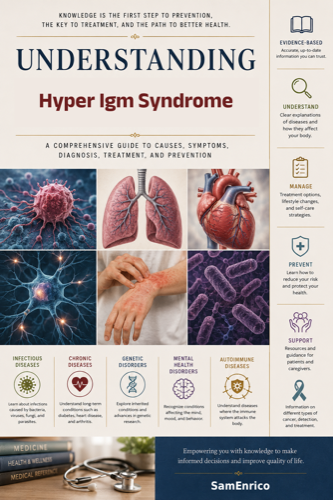
Non-FictionInformativeEducational
Understanding Hyper Igm Syndrome eBook
This disease publication, published by SamEnrico,
This disease publication, published by SamEnrico, covers Understanding Hyper Igm Syndrome
Formats
Free sample
Chapter 1: The Missing Signal...--The first time Emily noticed something was wrong, it was a Tuesday. Her son Liam, eight months old, had his fourth ear infection in as many months. The pediatrician called it "bad luck." The daycare called it "normal for winter." But Emily noticed something the doctors didn't: Liam’s gums bled when he chewed on his teething ring, and a crop of painful mouth ulcers had appeared overnight, making him refuse to eat. She didn't know it yet, but she was watching the opening act of a rare genetic drama—one where the body’s elaborate defense system fails not because it lacks weapons, but because it never receives the order to fire.This is the story of Hyper Ig M Syndrome, a disease defined by a single, catastrophic communication breakdown. To understand it, you must first understand that your immune system is not a wall.
It is not a sword. It is a conversation—a relentless, silent, life-sustaining dialogue between billions of cells. And in Hyper Ig M Syndrome, someone cut the line.The Conversation That Keeps You Alive Every day, without your knowledge, your immune system holds millions of microscopic meetings. Imagine a busy airport control tower, where every signal matters and a single missed transmission can bring down a plane. Your body is that airport.
The pathogens—bacteria, viruses, fungi, parasites—are the planes trying to land unannounced. And your immune cells are the air traffic controllers, constantly shouting, “Who goes there? Friend or foe? Authorized or not?”The most important conversation happens between two types of white blood cells: B-cells and T-cells. Here is what they do:B-cells are the weapons manufacturers.
They produce antibodies—Y-shaped proteins that stick to invaders like Velcro, marking them for destruction. Each B-cell is pre-programmed to make one specific type of antibody, but it cannot activate itself. It is a loaded gun waiting for permission to fire.T-cells are the generals. They patrol the body, identify threats, and then deliver the exact signal that tells a B-cell, “You are needed now. Switch to high-output mode.
Here is your target.”When this conversation works, your body produces five classes of antibodies (immunoglobulins), each with a specialized job:Antibody Primary Role Where It Works Ig MFirst responder, forms large complexes to trap pathogens Bloodstream Ig GLong-term memory, crosses placenta to protect newborns Blood and tissues Ig AGuards mucosal surfaces (gut, lungs, nose)Tears, saliva, mucus Ig EFights parasites (and causes allergies)Skin, lungs, mucous membranes Ig DHelps activate B-cells (least understood)B-cell surfaces In a healthy person, this system is elegant and redundant. But in Hyper Ig M Syndrome, something fundamental breaks.The Class Switch Defect: Why Ig M Keeps Coming To understand Hyper Ig M, you must understand one specific immune process: class switching.Think of a B-cell as a factory that can produce five different products (Ig M, Ig G, Ig A, Ig E, Ig D). At birth, every B-cell factory is set to produce only Ig M—the emergency responder. Ig M is fast, aggressive, and effective at clumping bacteria together. But it has a fatal flaw: it disappears from the blood within weeks.
It has no memory.For long-term protection, the factory needs to switch production from Ig M to Ig G or Ig A. Ig G circulates for months or years, providing lasting immunity after an infection or vaccine. Ig A patrols your gut and lungs, where most invaders enter.How does the factory know when to switch? It receives a signal from a T-cell. Specifically, a T-cell that has encountered a pathogen extends a molecular handshake—a protein called CD40 ligand (CD40L) on the T-cell surface binds to CD40 on the B-cell surface.
This handshake tells the B-cell: “Stop making Ig M. Start making Ig G or Ig A. Here is the blueprint for the specific invader we just fought.”In Hyper Ig M Syndrome, that handshake never happens.There are two ways this handshake fails:The T-cell cannot extend its hand. This is X-linked Hyper Ig M Syndrome (Type 1), caused by a mutation in the CD40LG gene. The T-cell lacks CD40 ligand.
It wants to help, but it cannot physically deliver the signal.The B-cell cannot receive the hand. This is rarer (Types 2-5), caused by mutations in the B-cell’s receptor machinery (AID, UNG, CD40, NEMO). The T-cell shouts, but the B-cell is deaf.In either case, the result is the same: B-cells remain stuck in Ig M mode. The patient produces normal or even high levels of Ig M—the body frantically making the only antibody it knows how to make—but cannot produce meaningful amounts of Ig G, Ig A, or Ig E.Imagine a fire department that can only send fire trucks but has no ladders, no hoses, and no axes. That is the HIGM immune system.
It has the alarm system (Ig M) but lacks the tools to extinguish the fire (Ig G, Ig A). The result is not a weakened immune system. It is a misdirected immune system—one that fights the wrong battles and surrenders on the wrong fronts.The Five Faces of Hyper Ig M: Genetic Types and What They Mean Hyper Ig M Syndrome is not one disease. It is five genetically distinct disorders that share a similar laboratory finding (high Ig M, low Ig G/Ig A) but can have dramatically different clinical courses. Knowing the specific type is not an academic exercise; it determines treatment, prognosis, and family planning.Here are the five known types of HIGM, ranked by frequency and severity:Type 1: X-Linked Hyper Ig M (CD40L Deficiency)Gene affected: CD40LG on the X chromosome Inheritance: X-linked recessive (affects almost exclusively males)Frequency: 70-80% of all HIGM cases Severity: Most severe This is the classic form.
The T-cell cannot produce CD40 ligand, so it cannot activate B-cells. But the problem goes deeper: T-cells also need CD40L to activate other T-cells and to fight certain infections directly. This means X-linked HIGM is not just an antibody deficiency—it is a combined immunodeficiency (both B-cell and T-cell dysfunction).Boys with X-linked HIGM typically present in the first year of life with:Severe, recurrent bacterial infections (pneumonia, sinusitis, ear infections)Opportunistic infections like Pneumocystis jirovecii pneumonia (PJP)Chronic diarrhea from Cryptosporidium or other gut pathogens Neutropenia (low neutrophils) that comes and goes Liver disease (sclerosing cholangitis) from chronic Cryptosporidium infection Without treatment, most affected boys die before age 10. With modern treatment (IVIG, prophylaxis, and HSCT), many survive into adulthood, though with ongoing risks.Carrier females (mothers, sisters, aunts) are usually asymptomatic but have a 50% chance of passing the mutation to each son. Rarely, carriers can have mild immune problems due to skewed X-inactivation.Type 2: AID Deficiency (Autosomal Recessive)Gene affected: AICDA (activation-induced cytidine deaminase)Inheritance: Autosomal recessive (affects males and females equally)Frequency: 10-15% of non-X-linked cases Severity: Milder than Type 1In Type 2, the T-cells work normally.
The B-cells receive the CD40 handshake but cannot execute the command because AID is the enzyme that physically rewrites the DNA to switch from Ig M to Ig G. Think of it as a factory that gets the order but…
This is the end of the free sample. Get the eBook to keep going. Buy now
About this book
Details
- Author
- Marquez Lovie
- Publisher
- SamEnrico
- Language
- English
- Genre
- Non-Fiction, Informative, Educational
- Released
- 2026-06-02
- Pages (approx.)
- 148
- Available as
- eBook, Audiobook

Read better in the ZLOADR app
Your eBooks on your phone or tablet. Sign in with your SamEnrico account and start reading.
More by Marquez Lovie
 The Second Generation MayorMarquez Lovie$11.99
 Brand Ranking Radar SystemMarquez Lovie$11.99
 International Expansion FrameworkMarquez Lovie$11.99
 Student Loan Stress HandbookMarquez Lovie$11.99
 The Great Vaccine Heist: How a Stolen Formula Saved MillionsMarquez Lovie$11.99
 Frozen Silence: The Lost Expedition of the *Karluk*Marquez Lovie$11.99
 Volunteer ManagerMarquez Lovie$11.99
 Remote Patient Monitoring OutlookMarquez Lovie$12.99
 Creative Portfolio Career GuideMarquez Lovie$12.99
 How to Start a Cases Made of Corrugated Cardboard Business (Beginners Guide)Marquez Lovie$11.99
You may also like
 Hong Kong Handover 1997Dunn Johnnie$11.99
 Zumba For Postnatal Recovery CourseNeal Christian$11.99
 Zumba for BeginnersLadner Nikia$11.99
 YouTube Comment Mining GuideHumes Pandora$12.99
 Worry Box MeditationCarlin Rudy$11.99
 Workplace Stress MeditationNguyen Lynn$11.99
 Workplace Stress and Sleep RepairHawley Ivory$11.99
 Workplace Perfectionism CureDelaney Jeffry$11.99
 Workplace Injustice Anger GuideWallen Isabelle$11.99
 Work Addiction and Burnout LinkGreenwood Ester$11.99
 Women in Yoga and WellnessBeattie Galina$11.99
 Women in Stand Up ComedyChun Evangeline$11.99