
Non-FictionInformativeEducational
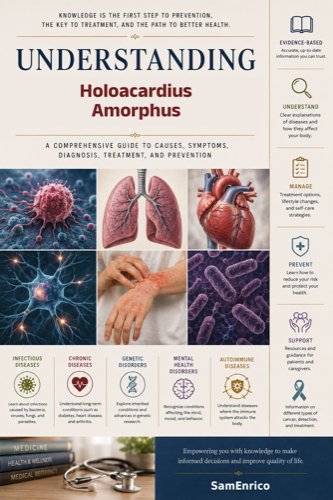
Understanding Holoacardius Amorphus eBook
This disease publication, published by SamEnrico,
This disease publication, published by SamEnrico, covers Understanding Holoacardius Amorphus
Formats
Free sample
Chapter 1: The Apple-Shaped Mystery...--The first time a physician held a Holoacardius Amorphus in their hands, they likely did what anyone would do: they stared in silence, turned it over slowly, and asked a question that would echo through five centuries of medical literature. What is this?The mass was warm from the womb, covered in translucent skin, perfectly spherical, and utterly unrecognizable as anything human. It had no face, no limbs, no spine, no heart. Yet there it was—delivered alongside a perfectly formed, living twin. The mother, exhausted and hopeful, wanted to know if her surviving baby would be okay.
The father wanted to know if this was somehow their fault. The medical student in the corner wanted to know if it was a tumor, a parasite, or something that had never been named.This chapter answers that question in the first way any reader—whether a terrified parent, a curious medical student, or a seasoned perinatologist—needs to understand. We begin not with the mechanism of reversed blood flow or the intricacies of placental anastomoses. Those come later. We begin with a simple definition, a corrected classification, a clear distinction from other masses, and most importantly, an immediate answer to the question every family asks: Was this ever a baby?The answer, delivered with both scientific precision and profound compassion, is no.
The Holoacardius Amorphus never had a heartbeat, never developed a brain, never had the capacity for consciousness or pain. It is a malformed twin—yes, a twin—but one that never progressed beyond disorganized tissue. Understanding this distinction is the first step toward replacing terror with knowledge, guilt with science, and confusion with clarity.What the Name Actually Means The term "Holoacardius Amorphus" comes from Greek and Latin roots that describe exactly what this condition is not. "Holo" means entire or complete. "Acardius" means without a heart.
"Amorphus" means without form. Put together, the name tells us: a completely heartless, formless thing. The name is accurate but terrifying. It sounds like a monster from medieval bestiary, which is precisely how early observers described it.In 1533, the Italian anatomist Benedetti wrote of a "monstrum" delivered alongside a healthy infant—a shapeless mass that he could not classify. In the centuries that followed, these masses were given names like "fetus amorphous," "acardiac monster," and "parasitic twin." Each name carried a different assumption about what the mass was and whether it deserved sympathy, study, or disposal.Modern terminology has settled on "Holoacardius Amorphus" as the most precise descriptor.
It belongs to a family of four related conditions, all of which involve monozygotic (identical) twinning gone wrong. Understanding where the Amorphus fits in this family is essential for diagnosis, prognosis, and communication with affected families.The Four Faces of Acardiac Twinning (Corrected and Complete)Before we can understand the most extreme form—our Amorphus—we must understand its siblings. All four types share one critical feature: they are monozygotic twins (originating from a single fertilized egg) that share a monochorionic placenta. None of them have a functional heart of their own. They are sustained entirely by the "pump twin"—the normal co-twin whose heart works for two.Acardius Acephalus (The Most Common, 60-75% of Cases)This is the form most frequently encountered in clinical practice.
The name means "without a heart, without a head." The Acephalus has no head, no heart, no upper limbs, and no thoracic organs. However, it retains a recognizable lower body: legs, pelvis, sometimes intestines, and often a rudimentary spine that stops at the lower thoracic level. To see an Acephalus is to see a body that begins at the hips and ends at the knees—a pair of legs attached directly to the placenta by an umbilical cord. No face, no brain, no chest, no arms. Just legs.
This form is the most survivable for the pump twin because the mass is smaller and creates less cardiovascular strain.Acardius Acormus (Rare)The Acormus is the opposite of the Acephalus. "Without a trunk." This mass has a head—sometimes with recognizable facial features, hair, and even a rudimentary brainstem—but no body below the neck. It attaches directly to the placenta, a floating head with no torso, no heart, no limbs except occasionally tiny arm buds. The Acormus is exceedingly rare, representing perhaps 5-10% of acardiac twins. Its existence is proof that the TRAP sequence (which we will explore in Chapter 4) does not destroy all tissues equally; the head and brain are so metabolically demanding that they usually fail first, but in the rare Acormus, they persist while the trunk disappears.Acardius Amorphus (Our Focus, Rare)Now we arrive at the subject of this book.
The Amorphus is the most extreme and, to the untrained eye, the most bewildering. It has no head, no trunk, no limbs, no heart, no recognizable organs in any normal anatomical arrangement. It is formless—hence "amorphus." Typically spherical or ovoid, covered in skin, ranging from the size of a golf ball to a grapefruit (though larger specimens have been reported). Inside, one finds a chaos of tissue: bone islands without marrow, cartilage, hair follicles, fat, scattered blood vessels, and occasionally rudimentary renal glomeruli or loops of bowel. But nothing is organized.
No spine. No brain. No chambers of a heart. No lungs. No liver.
The Amorphus is what happens when the vascular accident occurs so early that even the attempt to form a body fails entirely.Hemiacardius (Rarest of All)The Hemiacardius has a partial heart. Not a working heart—never a working heart—but a recognizable structure: a single ventricle, a rudimentary chamber, sometimes even a small outflow tract. The rest of the body is correspondingly more formed. A Hemiacardius might have a partial trunk, one leg, or a malformed head. This form is so rare that most perinatologists will never see a case.
It represents the mildest end of the acardiac spectrum, where the vascular accident occurred later, allowing some cardiac tissue to develop before reversed flow destroyed it.Why Classification Matters A reader might reasonably ask: why does any of this matter beyond academic curiosity? The answer is both clinical and emotional.Clinically, classification predicts outcomes. An Acardius Acephalus (just legs) creates less strain on the pump twin's heart than an Acardius Acormus (a head) because head tissue is metabolically demanding. The Amorphus, being mostly bone, cartilage, and connective tissue, creates an intermediate burden—more than legs, less than a head. Knowing which type you are looking at on ultrasound helps the maternal-fetal medicine specialist decide whether to intervene immediately, watch closely, or prepare for expectant management.Emotionally, classification gives parents a vocabulary for their loss.
The mother who sees an ultrasound of a shapeless mass next to her healthy baby needs to know: this is not a random tumor. This is your child's twin. It had its own umbilical cord, its own amniotic sac, its own genetic code. It was never going to be a baby, but it was always a twin. That distinction—between "never a baby" and "always a twin"—is the key to grieving well.
Parents who understand this do not mourn the mass as a lost infant; they mourn the healthy twin pregnancy they…
This is the end of the free sample. Get the eBook to keep going. Buy now
About this book
Details
- Author
- Casillas Charity
- Publisher
- SamEnrico
- Language
- English
- Genre
- Non-Fiction, Informative, Educational
- Released
- 2026-06-02
- Pages (approx.)
- 150
- Available as
- eBook, Audiobook

Read better in the ZLOADR app
Your eBooks on your phone or tablet. Sign in with your SamEnrico account and start reading.
More by Casillas Charity
 Jungle Explorer Anaconda CoilCasillas Charity$11.99
 EMDR for Sex Addiction TraumaCasillas Charity$11.99
 The Missing 411 Pattern RevealedCasillas Charity$11.99
 Parkinson Body Image GuideCasillas Charity$11.99
 The Last Great Ice Cap: The Untold Story of the 1968 Trans-Arctic ExpeditionCasillas Charity$11.99
 The Oracle's Gambit: A Spy Among the GodsCasillas Charity$11.99
 VA Performance Management HandbookCasillas Charity$12.99
 Critical Infrastructure OutlookCasillas Charity$12.99
 Millet HarvestingCasillas Charity$11.99
 How to Start a Pressure Reducing Valves Business (Beginners Guide)Casillas Charity$11.99
You may also like
 Hong Kong Handover 1997Dunn Johnnie$11.99
 Zumba For Postnatal Recovery CourseNeal Christian$11.99
 Zumba for BeginnersLadner Nikia$11.99
 YouTube Comment Mining GuideHumes Pandora$12.99
 Worry Box MeditationCarlin Rudy$11.99
 Workplace Stress MeditationNguyen Lynn$11.99
 Workplace Stress and Sleep RepairHawley Ivory$11.99
 Workplace Perfectionism CureDelaney Jeffry$11.99
 Workplace Injustice Anger GuideWallen Isabelle$11.99
 Work Addiction and Burnout LinkGreenwood Ester$11.99
 Women in Yoga and WellnessBeattie Galina$11.99
 Women in Stand Up ComedyChun Evangeline$11.99