
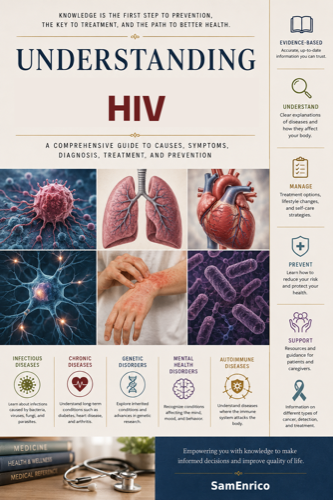
Non-FictionInformativeEducational
Understanding HIV eBook
This disease publication, published by SamEnrico,
This disease publication, published by SamEnrico, covers Understanding HIV
Formats
Free sample
Chapter 1: The Unseen Enemy...--–- It began not with a bang, but with a whisper. In the early spring of 1981, Dr. Michael Gottlieb, a young immunologist at the University of California, Los Angeles, encountered a patient whose case would defy every medical convention he had been taught. The man, previously healthy and in his early thirties, presented with a persistent fever, dramatic weight loss, and a mouth overgrown with a white, yeasty fungus called Candida albicans—a condition so rare in otherwise healthy adults that Gottlieb had to reach for his oldest medical textbooks to even find a reference. But it was the laboratory results that stopped him cold.
The patient’s immune system, specifically his CD4+ T-cells—the very generals of the body’s defensive army—had been nearly wiped out. Gottlieb had seen such profound immunodeficiency before, but only in elderly organ transplant recipients who were intentionally immunosuppressed with drugs, or in premature infants born without a functioning thymus. He had never, in his years of training or practice, seen anything like this in a young, ambulatory adult.This chapter transports the reader back to that moment of collective medical bewilderment. It chronicles the earliest known cases, the frantic and often misguided search for a cause, the tragic and heroic figures who first sounded the alarm, and the eventual scientific triumph—and lingering controversy—that led to the discovery of the human immunodeficiency virus (HIV). But to truly understand the epidemic that would reshape the world, we must look back even further, to the dense rainforests of Central Africa, where a simmering simian virus made the fateful leap from chimpanzee to human, setting in motion a pandemic that has now claimed over 40 million lives.
This is the story of HIV’s journey from a silent, cross-species transmission to a global health emergency. It is a story of science, of stigma, of extraordinary courage, and of profound loss.The First Alarms: When the Unthinkable Became Routine By the summer of 1981, the trickle of strange cases had become a stream. In New York City, Dr. Alvin Friedman-Kien, a dermatologist specializing in sexually transmitted infections, began seeing an explosion of a previously rare cancer called Kaposi’s Sarcoma (KS). Before 1981, KS was mostly seen in elderly men of Mediterranean or Jewish descent, and it typically grew slowly on the skin of the lower legs.
But now, Friedman-Kien was witnessing a horrifyingly aggressive version of the disease. Purple, bruise-like lesions erupted not just on the legs, but on the face, the trunk, inside the mouth, and even in the gastrointestinal tract of young, otherwise fit men. The cancer wasn’t just appearing; it was metastasizing and killing its hosts within months.Simultaneously, a cluster of cases of Pneumocystis carinii pneumonia (PCP)—a rare, parasitic lung infection that previously only affected severely malnourished children or cancer patients on heavy chemotherapy—was being reported in gay men in Los Angeles, San Francisco, and New York. PCP is what doctors call an “opportunistic infection” (a term we will explore in depth in Chapter 4). It takes advantage of an immune system that has already been destroyed.
Seeing a single case of PCP in a young adult was a medical oddity. Seeing five, then ten, then twenty cases in a matter of months was a medical earthquake.On June 5, 1981, the U.S. Centers for Disease Control and Prevention (CDC) published a dry, one-page report in its Morbidity and Mortality Weekly Report (MMWR) that would become one of the most famous documents in medical history. Titled “Pneumocystis Pneumonia—Los Angeles,” the report objectively noted five cases of PCP in young gay men, two of whom had already died. The report offered no conclusions, no theories, and certainly no warnings of a pandemic.
It was a simple, data-driven observation. But for those who were paying attention—clinicians in the gay communities of the nation’s largest cities—it was a confirmation of their deepest fears. Something was out there. Something was killing their patients.The Shadow of Stigma: The Naming of a Plague The immediate response to these initial reports was not purely scientific. It was filtered through the lens of social prejudice.
Because the first identified cluster of cases was almost exclusively among gay men, the condition was quickly, and wrongly, labeled by the media and even some in the medical community as GRID—Gay-Related Immune Deficiency. This name was a catastrophe. It suggested that the condition was intrinsic to homosexuality itself, rather than a transmissible infectious agent. It gave cover to politicians who wanted to ignore the crisis, to religious leaders who framed the disease as divine punishment, and to a public that was already comfortable marginalizing gay men.The name GRID had real, deadly consequences. It delayed funding for research because the disease was seen as affecting only a “disposable” minority.
It prevented public health officials from looking for cases outside the gay community, meaning that cases among people who injected drugs (IDU) and hemophiliacs were initially missed or dismissed as anomalies. It also sewed terror within the gay community itself. For many gay men, the appearance of a purplish KS lesion, a persistent dry cough, or night sweats so severe they had to change their sheets felt like a mark of Cain—a physical manifestation of an identity that society had already condemned.It would take years of activism and grief to banish the term GRID from the lexicon. By 1982, the CDC officially adopted the term AIDS—Acquired Immune Deficiency Syndrome. The shift from “Gay-Related” to “Acquired” was revolutionary.
It moved the focus from who the patient was to what was happening to them. It opened the door to the idea that this was an infectious, transmissible condition, not a genetic curse. But the stigma would never fully disappear. Even today, the shadow of those early labels lingers, contributing to the discrimination, denial, and shame that continue to fuel the epidemic (a topic we will explore fully in Chapter 11).The Scientific Race: Gallo vs. Montagnier Identifying a new disease is one thing.
Finding the virus that causes it is another, far more difficult, endeavor. In the early 1980s, two laboratories began a fierce, often bitter, race to be the first to isolate the AIDS virus. On one side was Dr. Robert Gallo, a charismatic and ambitious American researcher at the National Cancer Institute (NCI). Gallo was a giant in retrovirology—he had co-discovered the first human retrovirus, HTLV-1 (Human T-cell Leukemia Virus), which causes a rare form of leukemia.
He was convinced that AIDS was also caused by a retrovirus, a class of viruses that, unlike the flu or common cold, inserts its genetic code directly into the DNA of the host cell, hiding there for years.On the other side was Dr. Luc Montagnier, a quieter, more methodical virologist at the Pasteur Institute in Paris. Montagnier’s approach was different. He didn’t look for the virus in the blood of sick patients; he looked inside the lymph nodes—the “factories” where immune cells are produced and where he suspected the virus was hiding and replicating. In January 1983, Montagnier’s team took a lymph node biopsy from a French AIDS patient with early-stage lymphadenopathy (swollen lymph nodes).…
This is the end of the free sample. Get the eBook to keep going. Buy now
About this book
Details
- Author
- Button Susannah
- Publisher
- SamEnrico
- Language
- English
- Genre
- Non-Fiction, Informative, Educational
- Released
- 2026-06-02
- Pages (approx.)
- 141
- Available as
- eBook, Audiobook

Read better in the ZLOADR app
Your eBooks on your phone or tablet. Sign in with your SamEnrico account and start reading.
More by Button Susannah
 Mojave Desert Lost HikerButton Susannah$11.99
 Under the Gold DomeButton Susannah$11.99
 Lipedema Body Acceptance GuideButton Susannah$11.99
 Sexual Sobriety First Steps GuideButton Susannah$11.99
 The Hollow Echo of the Black DeathButton Susannah$11.99
 The Vanished Diplomat: The CIA’s Secret War in Guatemala’s ShadowButton Susannah$11.99
 Lactation ConsultantButton Susannah$11.99
 Paystack And Flutterwave PrimerButton Susannah$12.99
 Ransomware Evolution Outlook 2026Button Susannah$12.99
 How to Become a Chief EngineerButton Susannah$11.99
You may also like
 Hong Kong Handover 1997Dunn Johnnie$11.99
 Zumba For Postnatal Recovery CourseNeal Christian$11.99
 Zumba for BeginnersLadner Nikia$11.99
 YouTube Comment Mining GuideHumes Pandora$12.99
 Worry Box MeditationCarlin Rudy$11.99
 Workplace Stress MeditationNguyen Lynn$11.99
 Workplace Stress and Sleep RepairHawley Ivory$11.99
 Workplace Perfectionism CureDelaney Jeffry$11.99
 Workplace Injustice Anger GuideWallen Isabelle$11.99
 Work Addiction and Burnout LinkGreenwood Ester$11.99
 Women in Yoga and WellnessBeattie Galina$11.99
 Women in Stand Up ComedyChun Evangeline$11.99