
Non-FictionInformativeEducational
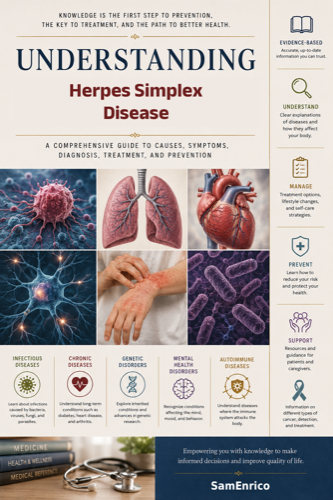
Understanding Herpes Simplex Disease eBook
This disease publication, published by SamEnrico,
This disease publication, published by SamEnrico, covers Understanding Herpes Simplex Disease
Formats
Free sample
Chapter 1: The 3 AM Diagnosis...--The phone buzzed on the nightstand at 3:17 AM. Sarah, a 28-year-old graphic designer from Portland, reached for it groggily, expecting a spam notification or an overnight email from a client in a different time zone. Instead, she saw a message from her clinic's patient portal: "Your test results are ready."She had been waiting three days. Three days of avoiding the bathroom mirror, of wearing loose sweatpants to work, of telling her roommate she had "a bad rash." Three days of googling images she desperately wished she had never seen, of convincing herself it couldn't be that, and then convincing herself it was definitely that, and then starting the cycle over again.She opened the results. Two lines.
Her eyes caught the word "detected" before her brain could prepare itself.HSV-1: Detected. HSV-2: Not Detected.She didn't know what that meant. She only knew that the word "herpes" had entered her life like an uninvited guest who had somehow already moved in, rearranged the furniture, and changed the locks. She put the phone down. She picked it up again.
She typed "HSV-1 positive" into the search bar and immediately regretted it. The first result was a Web MD page that mentioned, in bold letters, "lifelong infection." The second was a forum where someone described themselves as "damaged goods." The third was an advertisement for a $400 herbal supplement that promised to "eliminate the virus forever."Sarah cried until her alarm went off at 7:00 AM. She called in sick. She did not leave her apartment for four days.Her story is not unique. It is, in fact, astonishingly common.
But that's precisely what no one told her, because no one talks about it. Her friends had shared stories of yeast infections, UTIs, pregnancy scares, and even HPV. But no one had ever, not once, mentioned the word herpes. She had no script, no reference point, no friend who had admitted to the same diagnosis. She felt entirely alone in a room that was, unbeknownst to her, crowded with millions of other people standing in identical isolation.The Silent Majority: What No One Tells You Let us begin with a number: 3.7 billion.That is the number of people under the age of 50 who carry herpes simplex virus type 1 (HSV-1), according to the World Health Organization's 2020 global estimates.
To put that number in perspective: it represents approximately two-thirds of the entire global population under 50. If you are reading this book and you are under 50, statistically speaking, two out of every three people you pass on the street share this same infection. They have it on their lips, or perhaps genitally, or asymptomatically in their nervous system. But they have it.Another 500 million people carry herpes simplex virus type 2 (HSV-2).Combined, over 4 billion people—more than half the human race—live with some form of herpes simplex.If herpes were a political candidate, it would win every election in a landslide. If it were a religion, it would be the world's largest by an enormous margin.
If it were a conspiracy, it would be the worst-kept secret in human history.And yet, the moment an individual receives a positive diagnosis, they feel marked. Stigmatized. Isolated. Dirty. These feelings are not natural—they are manufactured.
They come from a specific historical, cultural, and commercial history that this chapter will dismantle piece by piece. The goal is not to minimize the real challenges of living with a chronic viral infection. The goal is to separate fact from fiction, biology from stigma, and to place the reader firmly in the company of the majority rather than the isolation of a misunderstood minority.Before we dive into the virology, the immunology, the treatment strategies, and the practical psychology of living well with herpes, we must first understand how this condition became so feared in the first place. Because the fear, as we will see, is not proportional to the medical reality for the vast majority of those infected.Ancient Sores, Modern Shame: A Brief History Herpes is not new. In fact, it is one of the oldest recorded human diseases.
Ancient Greek physicians—from Hippocrates himself to the scholar Herophilus—described lesions that "herped," meaning "to creep" or "to crawl" along the skin. The term "herpes" appears in Greek medical texts from around 400 BCE, referring to the characteristic spreading pattern of fever blisters. The Romans, ever practical, called them "febris blisterae" and noted their tendency to appear during times of stress or illness.For most of human history, herpes was treated as what it was: a nuisance. A painful but temporary skin condition. Roman naturalist Pliny the Elder recommended applying a particular type of fly ash to lesions.
Medieval European physicians prescribed herbal poultices. Traditional Chinese medicine used acupuncture and topical preparations. None of these worked particularly well, but neither did they provoke moral panic.The distinction between "cold sores" (above the waist) and "genital sores" (below the waist) emerged in European medical literature during the 18th century, largely due to anatomical location rather than any biological understanding. Physicians observed that some patients had recurrent lesions on the lips and nose, while others had similar lesions on the genitals. They assumed they were different diseases.In 1919, a Japanese scientist named Y.
Toyoda demonstrated that filtered extracts from herpetic vesicles could transmit the disease to rabbits, establishing for the first time that herpes was caused by an infectious agent—a virus. Over the next several decades, researchers slowly characterized the virus's behavior, noting its tendency to recur at the same anatomical site and its affinity for nerve tissue.The true breakthrough came in the 1960s, when virologists discovered that what they had been calling "herpes virus" was actually two distinct viruses. Using serological surveys (tests that detect antibodies), researchers found that some patients had antibodies to one strain, some to another, and some to both. They named them Herpes Simplex Virus Type 1 and Type 2.For the next three decades, a convenient but oversimplified orthodoxy took hold: HSV-1 lives above the waist, causing cold sores. HSV-2 lives below the waist, causing genital herpes.
This distinction appeared in medical textbooks, patient education materials, and public health campaigns. It was clean. It was memorable. And it was wrong.The 1980s Panic: When Herpes Became an Epidemic If herpes had stayed in the domain of nuisance skin conditions, this book would not exist—or would be a brief pamphlet. But something happened in the late 1970s and early 1980s that transformed herpes from a minor medical annoyance into a cultural phenomenon of fear.Several factors converged simultaneously.First, the sexual revolution of the 1960s and 1970s had dramatically changed attitudes toward sex, but not toward sexually transmitted infections.
The introduction of oral contraceptives had decoupled sex from pregnancy, but no equivalent innovation had decoupled sex from infection. When genital herpes rates began to rise in urban clinics—partly due to better detection, partly due to increased sexual networks—the conditions were ripe for moralizing.Second, a pharmaceutical company called Burroughs Wellcome (now part of Glaxo Smith Kline) was developing the first effective antiviral drug. In 1982, they launched a massive public awareness campaign about genital herpes. The stated goal was to encourage people…
This is the end of the free sample. Get the eBook to keep going. Buy now
About this book
Details
- Author
- Kenny Herschel
- Publisher
- SamEnrico
- Language
- English
- Genre
- Non-Fiction, Informative, Educational
- Released
- 2026-05-09
- Pages (approx.)
- 156
- Available as
- eBook, Audiobook

Read better in the ZLOADR app
Your eBooks on your phone or tablet. Sign in with your SamEnrico account and start reading.
More by Kenny Herschel
 Last Mile Lockers And Pickup Points CourseKenny Herschel$11.99
 Resentment Energy RecoveryKenny Herschel$11.99
 Faith Based Counseling PartnershipsKenny Herschel$11.99
 Self Esteem Marriage Maintenance GuideKenny Herschel$11.99
 The Jade Serpent's GambitKenny Herschel$11.99
 The Gold Rush Heist: How the Carters Built an Empire from NothingKenny Herschel$11.99
 Customer Development ExecutiveKenny Herschel$11.99
 Online Co-Founder Search HandbookKenny Herschel$12.99
 Cloud Compliance Outlook 2030Kenny Herschel$12.99
You may also like
 Hong Kong Handover 1997Dunn Johnnie$11.99
 Zumba For Postnatal Recovery CourseNeal Christian$11.99
 Zumba for BeginnersLadner Nikia$11.99
 YouTube Comment Mining GuideHumes Pandora$12.99
 Worry Box MeditationCarlin Rudy$11.99
 Workplace Stress MeditationNguyen Lynn$11.99
 Workplace Stress and Sleep RepairHawley Ivory$11.99
 Workplace Perfectionism CureDelaney Jeffry$11.99
 Workplace Injustice Anger GuideWallen Isabelle$11.99
 Work Addiction and Burnout LinkGreenwood Ester$11.99
 Women in Yoga and WellnessBeattie Galina$11.99
 Women in Stand Up ComedyChun Evangeline$11.99