

Non-FictionInformativeEducational
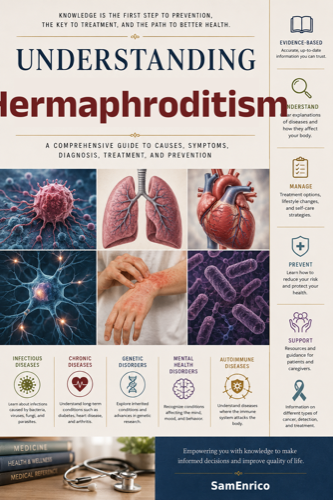
Understanding Hermaphroditism eBook
This disease publication, published by SamEnrico,
This disease publication, published by SamEnrico, covers Understanding Hermaphroditism
Formats
Free sample
Chapter 1: The Weight of Words--– In a delivery room somewhere in Ohio, a baby is born. The nurses count fingers and toes. The Apgar score is a perfect nine. But when the obstetrician performs a routine visual examination, there is a pause—a hesitation that lasts only a few seconds but feels, to the mother who notices it, like an eternity. The doctor pulls the sheet back up.
Nothing is said. Not yet. Later, in a hallway out of earshot, the doctor will tell the father that the baby’s genitals are “ambiguous.” The father will be told not to tell his wife, not yet, not until they know more. A geneticist will be consulted. An endocrinologist will be paged.
Somewhere in the hospital, a surgeon will be asked to clear their schedule.The baby, who is healthy in every meaningful sense, will be taken to the operating room within the first year of life. The parents will be told this surgery is “necessary.” They will be told that waiting would be “cruel.” They will be told that their child would never develop a normal gender identity without “correction.” They will be told none of the things that are actually true: that the surgery is irreversible, that it carries a significant risk of chronic pain and loss of sexual sensation, that it is almost never medically necessary, and that every major inters rights organization in the world condemns it as a human rights violation.This baby is not hypothetical. This scene, with minor variations, has played out thousands of times across the United States and Europe in the past fifty years. It continues to play out today. And the single most important factor determining whether this baby grows up with a sense of intact bodily integrity or a lifetime of medical trauma is not the nature of their variation—it is the language used to describe it.The Weight of Words Language is not merely descriptive.
It is prescriptive, performative, and deeply political. The words we choose to describe a phenomenon do not simply reflect an underlying reality; they actively construct that reality for the speaker, the listener, and especially the person being described. This is nowhere more true than in the contested terrain of sex development.Consider the difference between three seemingly similar phrases: “a child born with a disorder,” “a child born with a difference,” and “a child born with a variation.” The first implies pathology, disease, something broken that requires fixing. The second implies otherness, a departure from an implicit norm, something that may or may not require accommodation. The third implies a natural range of human diversity, no different in kind from having red hair or being left-handed.
Each framing leads to a different clinical response, a different family conversation, and a different lived experience for the child.This chapter establishes the terminological and conceptual foundation for everything that follows. It traces the origins of the word “hermaphrodite,” explains the competing contemporary terms (“intersex,” “DSD,” “VSC”), clarifies the crucial distinction between non-human and human usage, addresses the contested prevalence statistics, and introduces the two competing frameworks—the Medical Gaze and the Social Model—that will structure our analysis throughout this book.The Mythological Origin: Hermaphroditus The word “hermaphrodite” enters the English language in the late fourteenth century, derived from the Latin hermaphroditus, which in turn comes from the Greek ἑρμαφρόδιτος (hermaphroditos). The term refers to the son of Hermes and Aphrodite—Hermaphroditus—whose story is told in Ovid’s Metamorphoses.According to the myth, Hermaphroditus was a strikingly beautiful youth born to the messenger god and the goddess of love. At the age of fifteen, while traveling through Caria (in modern-day Turkey), he came upon a pool of clear water inhabited by the naiad Salmacis. Salmacis, unlike the chaste nymphs who typically fled male attention, was instantly overcome with desire.
Hermaphroditus rejected her advances—he was, Ovid tells us, innocent and unaware of the nature of adult desire. Salmacis pretended to leave but hid in the bushes, watching.When Hermaphroditus stripped off his clothes and dove into the water, thinking himself alone, Salmacis dove in after him. She wrapped her body around his like a serpent, crying out to the gods that they should never be parted. The gods answered. Their bodies merged into one.
Ovid writes: “They were no longer two beings, nor could they be called both man and woman—they seemed neither or both.”The result was a being who possessed both male and female physical characteristics. Hermaphroditus, now transformed, prayed to his parents that any man who bathed in the pool would become weak and effeminate. His prayer was granted.The myth is rich with interpretive possibilities, none of which are particularly flattering to the modern understanding of intersex variation. The original Hermaphroditus is not born with a variation—he is transformed into one as a punishment, or at least as an unwanted merging. The pool thereafter emasculates men who enter it.
This is not a story of natural diversity; it is a story of boundary violation, of the frightening dissolution of clear categories, of a world in which male and female—so carefully separated in Greek thought—can collapse into each other with terrifying consequences.For centuries, the myth shaped the Western understanding of real people born with variations of sex characteristics. They were seen as omens, portents, monsters, or signs of divine displeasure—precisely because they blurred a boundary that culture insisted was absolute. The word carried, from its very origin, a weight of fear and revulsion that it has never fully shed.The Modern Terminology Battleground Today, several competing terms exist to describe people born with sex characteristics that do not fit typical binary definitions of male or female. Each term carries different assumptions, political commitments, and practical consequences.Intersex The term “intersex” emerged in the early twentieth century as a medical descriptor, replacing earlier terms like “hermaphrodite” (for those with both ovarian and testicular tissue) and “pseudohermaphrodite” (for those with ambiguous genitalia but only one type of gonad). By the 1990s, intersex activists had reclaimed the term, transforming it from a medical label into a political identity.Today, “intersex” is the preferred term for most advocacy organizations and many individuals.
It has the advantage of being relatively neutral—it simply means “between the sexes”—while carrying the political weight of a community that has organized around shared experiences of medical abuse. The Intersex Society of North America (ISNA), founded in 1993, chose the term deliberately to signal a break from both the mythological baggage of “hermaphrodite” and the pathologizing framework of “pseudohermaphrodite.”However, “intersex” is not without its critics. Some clinicians argue that it is too broad, lumping together conditions as different as complete androgen insensitivity syndrome (CAIS) and congenital adrenal hyperplasia (CAH) that have different etiologies, different medical implications, and different lived experiences. Some intersex individuals reject the term because they do not see themselves as “between” anything—they are women or men who happen to have a particular medical variation. And some prefer “DSD” or “VSC” for reasons we will explore.DSD: Disorders/Differences of Sex Development The term “DSD” was introduced in 2006 by a consensus conference of international medical experts.…
This is the end of the free sample. Get the eBook to keep going. Buy now
About this book
Details
- Author
- Sager Rosario
- Publisher
- SamEnrico
- Language
- English
- Genre
- Non-Fiction, Informative, Educational
- Released
- 2026-05-06
- Pages (approx.)
- 135
- Available as
- eBook, Audiobook

Read better in the ZLOADR app
Your eBooks on your phone or tablet. Sign in with your SamEnrico account and start reading.
More by Sager Rosario
 Mobile Therapy for Remote AreasSager Rosario$11.99
 Delivery Density Improvement CourseSager Rosario$11.99Delivery Density Improvement CourseSager Rosario$11.99
 Anxiety Energy ManagementSager Rosario$11.99
 Partner Validation Seeking GuideSager Rosario$11.99
 The Dromedary Detectives: Uncovering the Secrets of the Arabian Desert with Bedouin GuidesSager Rosario$11.99
 The Windigo's Hunger: A Cautionary Tale of the Northern WoodsSager Rosario$11.99
 How to Start a Shuttering Made of Steel Business (Beginners Guide)Sager Rosario$11.99
 Construction CoordinatorSager Rosario$11.99
 Cloud Middle East Outlook 2026Sager Rosario$12.99
 India GST Registration HandbookSager Rosario$12.99
You may also like
 Hong Kong Handover 1997Dunn Johnnie$11.99
 Zumba For Postnatal Recovery CourseNeal Christian$11.99
 Zumba for BeginnersLadner Nikia$11.99
 YouTube Comment Mining GuideHumes Pandora$12.99
 Worry Box MeditationCarlin Rudy$11.99
 Workplace Stress MeditationNguyen Lynn$11.99
 Workplace Stress and Sleep RepairHawley Ivory$11.99
 Workplace Perfectionism CureDelaney Jeffry$11.99
 Workplace Injustice Anger GuideWallen Isabelle$11.99
 Work Addiction and Burnout LinkGreenwood Ester$11.99
 Women in Yoga and WellnessBeattie Galina$11.99
 Women in Stand Up ComedyChun Evangeline$11.99