
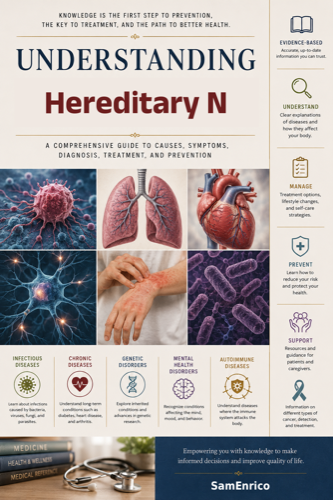
Non-FictionInformativeEducational
Understanding Hereditary N eBook
This disease publication, published by SamEnrico,
This disease publication, published by SamEnrico, covers Understanding Hereditary N
Formats
Free sample
Chapter 1: The Wires Within...--The first time nine-year-old Liam fell off his bicycle for no apparent reason, his mother chalked it up to clumsiness. The second time, she wondered if he needed new sneakers. By the seventh fall—when his toe caught on a perfectly flat sidewalk crack, sending him sprawling and bloodying both knees for the third time that month—she made an appointment with their pediatrician. "He's just a boy," the doctor said with a dismissive wave. "Boys fall.
Give him time."Time passed. Liam kept falling.Two years later, when an exasperated gym teacher wrote "refuses to keep up" on his report card, Liam's mother finally demanded answers. A neurologist—the fourth doctor they had seen—spent less than ten minutes in the examination room. She watched Liam walk down the hallway, noted the way he lifted his knees unusually high with each step, and asked to see his bare feet. "Has anyone ever mentioned his arches?" the neurologist asked quietly.
Liam's feet were so highly arched that when he stood on wet paper, the print showed only a heavy heel and a wide ball—with nothing but air in between.That evening, sitting in the parking lot of the medical building, Liam's mother typed three words into her phone: high arches falling. The search results led her to something she had never heard of: Charcot-Marie-Tooth disease, a hereditary neuropathy. For the first time in years, someone had a name for the silent thief that had been stealing her son's balance, his strength, and his childhood confidence.This book begins with Liam not because his story is unusual—but because it is painfully ordinary.If you are reading these words, you or someone you love has likely been touched by a hereditary neuropathy. You may have spent years—perhaps decades—being told that your symptoms were "all in your head," or "just aging," or "idiopathic," which is a medical word that simply means we don't know. You may have been misdiagnosed with something treatable, like chronic inflammatory demyelinating polyneuropathy (CIDP), and endured treatments that didn't work.
You may have been told that nothing could be done, that you should just learn to live with it. Or you may have just received a genetic test result—a string of letters and numbers that looks like a foreign language—and you have no idea what it means for your future, your family, or your children.This book is for you.Understanding Hereditary Neuropathy is not a dry medical textbook. It is not a collection of impenetrable jargon or alarmist warnings. It is a guide—a compassionate, practical, and scientifically accurate roadmap that begins with the most fundamental question of all: What exactly is hereditary neuropathy, and do I have it?What This Chapter Will Teach You By the end of this chapter, you will understand:The basic function of your peripheral nervous system and how it differs from your central nervous system The critical distinction between hereditary and acquired neuropathies—and why that distinction matters for your treatment Why "hereditary" does not always mean "runs in the family" (and why that fact changes everything)The three most common forms of hereditary neuropathy and how they differ Why you may have been misdiagnosed for years—and how to ensure that doesn't continue The single most important myth to abandon before reading further Let us begin.The Body's Electrical Grid: Understanding Your Peripheral Nervous System Imagine, for a moment, that your body is a major city. Your brain is the central command center—the mayor's office, the power plant, the traffic control hub all rolled into one.
Your spinal cord is the main highway leading out of the city, carrying orders and information to every neighborhood. But no city functions on highways alone. What you need—what every city needs—is an intricate network of local roads, side streets, and electrical lines that reach every single house, every apartment building, every streetlight, and every fire hydrant.That network is your peripheral nervous system (PNS) .The PNS consists of approximately 43 pairs of nerves—some carrying signals from your brain to your muscles (motor nerves), others carrying signals from your skin and organs back to your brain (sensory nerves), and still others managing automatic functions like digestion, heart rate, and sweating (autonomic nerves). These nerves extend from your spinal cord to the very tips of your fingers and toes. The longest nerves in your body—the ones that travel from your lower spine all the way down to your feet—can be over three feet long in an average adult.
That is the distance from a control center in your lower back to a tiny nerve ending in your big toe.Every time you stand up, your peripheral nerves tell your leg muscles to contract in exactly the right sequence. Every time you touch a hot stove, your peripheral nerves scream a warning to your brain faster than you can consciously think. Every time you close your eyes and touch your nose, your peripheral nerves are reporting back the position of your arm, your hand, and each individual finger.When the peripheral nervous system works correctly, you never notice it. It is the silent, invisible infrastructure of every movement, every sensation, every balance adjustment you make thousands of times a day. You become aware of your peripheral nerves only when something goes wrong—when they become damaged, diseased, or degraded.That damage is called neuropathy.The Great Divide: Hereditary versus Acquired Neuropathy Neuropathy is not a single disease.
It is a pattern of injury—like saying someone has a "rash" without saying whether it is poison ivy, psoriasis, or a drug reaction. The treatment, the prognosis, and the impact on your life depend entirely on what is causing the nerve damage.The first and most important distinction is between hereditary and acquired neuropathy.Acquired neuropathies are caused by external factors or internal diseases that damage previously healthy nerves. The list of causes is long and sobering: diabetes (the most common cause of neuropathy in the developed world), chronic alcohol abuse, chemotherapy drugs, certain antibiotics, vitamin deficiencies (especially B12), autoimmune diseases (like lupus or Sjögren's syndrome), kidney failure, liver disease, thyroid disorders, and infections such as Lyme disease, HIV, or shingles. In many cases, acquired neuropathies can be treated—or at least halted—by addressing the underlying cause. Stop drinking, and the neuropathy may slowly improve.
Correct the B12 deficiency, and the symptoms often reverse. Treat the autoimmune condition, and the nerve inflammation may subside.Hereditary neuropathies, by contrast, are caused by a spelling mistake—a mutation—in your DNA. You were born with this mutation. It has been present in every cell of your body since the moment of conception. And while the symptoms may not appear until childhood, adolescence, or even middle age, the underlying genetic error has been quietly waiting, like a time bomb, for years or decades.This distinction matters—enormously—because the treatments are completely different.
Giving immunotherapy to a person with hereditary neuropathy (something that happens with heartbreaking frequency) not only fails to help but exposes the patient to serious risks and delays the correct diagnosis by…
This is the end of the free sample. Get the eBook to keep going. Buy now
About this book
Details
- Author
- Scarborough Shae
- Publisher
- SamEnrico
- Language
- English
- Genre
- Non-Fiction, Informative, Educational
- Released
- 2026-05-07
- Pages (approx.)
- 154
- Available as
- eBook, Audiobook

Read better in the ZLOADR app
Your eBooks on your phone or tablet. Sign in with your SamEnrico account and start reading.
More by Scarborough Shae
 The Bedtime Battle Parent Self CareScarborough Shae$11.99
 Prazosin For Nightmares GuideScarborough Shae$11.99
 Creative Energy ManagementScarborough Shae$11.99
 Gaslighting Self Esteem RecoveryScarborough Shae$11.99
 The Singaporean Codebreakers: AI’s Silent Revolution in the Cold WarScarborough Shae$11.99
 Excalibur’s Forgotten Forge: The Blacksmith Who Shaped the WorldScarborough Shae$11.99
 How to Start a Press Cutting Agency Business (Beginners Guide)Scarborough Shae$11.99
 Business Development SpecialistScarborough Shae$11.99
 Group Chat To Client PrimerScarborough Shae$12.99
 Cloud Gaming Outlook 2026Scarborough Shae$12.99
You may also like
 Hong Kong Handover 1997Dunn Johnnie$11.99
 Zumba For Postnatal Recovery CourseNeal Christian$11.99
 Zumba for BeginnersLadner Nikia$11.99
 YouTube Comment Mining GuideHumes Pandora$12.99
 Worry Box MeditationCarlin Rudy$11.99
 Workplace Stress MeditationNguyen Lynn$11.99
 Workplace Stress and Sleep RepairHawley Ivory$11.99
 Workplace Perfectionism CureDelaney Jeffry$11.99
 Workplace Injustice Anger GuideWallen Isabelle$11.99
 Work Addiction and Burnout LinkGreenwood Ester$11.99
 Women in Yoga and WellnessBeattie Galina$11.99
 Women in Stand Up ComedyChun Evangeline$11.99