
Non-FictionInformativeEducational
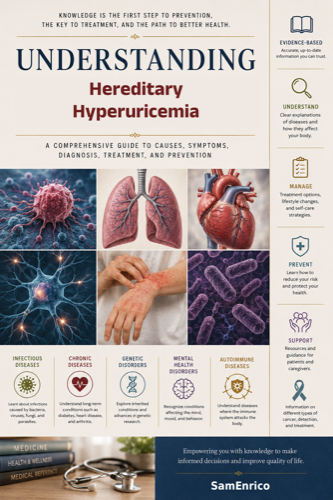
Understanding Hereditary Hyperuricemia eBook
This disease publication, published by SamEnrico,
This disease publication, published by SamEnrico, covers Understanding Hereditary Hyperuricemia
Formats
Free sample
Chapter 1: The Silent Crystal...--The pain arrived like a thief in the night. Sixteen-year-old Marcus woke at 3 AM with his left big toe on fire—swollen, red, and so sensitive that the weight of a bedsheet was unbearable. He had never felt anything like it. His first thought was a broken bone, but he hadn't injured himself. His second thought was an infection, but there was no cut or wound.
His father, woken by the sound of his son crying, came into the bedroom and stopped cold. He didn't need a doctor to tell him what he was seeing. He had seen it before, on his own foot, a decade ago. And before that, on his father's foot. Gout.The question that haunted Marcus's family is the same question that haunts millions of people worldwide: Why do some families seem "cursed" by uric acid crystals while others eat the same diet without problems?
The family gathered around the kitchen table—father with his history of gout attacks, grandfather with tophi on his elbows, uncle who passed kidney stones every few years—ate the same food as their neighbors. They weren't heavy drinkers. They didn't subsist on red meat and seafood. Yet generation after generation, the men in this family suffered. The women, mostly, did not.
Something was being passed down. Something invisible. Something in the blood.That something is hereditary hyperuricemia. And this book is written to explain it.What Is Hyperuricemia?Let's start with a definition that will serve as our foundation. Hyperuricemia is a condition characterized by an excess of uric acid in the blood.
More precisely, it is defined as a blood uric acid level exceeding 420 μmol/L (7.0 mg/d L) measured on two separate days when the patient is not experiencing an acute flare. This number isn't arbitrary. It represents the solubility threshold of urate in human blood at normal body temperature. Think of it like salt dissolving in water: you can keep adding salt, but at a certain point, the water becomes saturated, and any additional salt will sink to the bottom as crystals. Uric acid behaves the same way in your blood.
Below 420 μmol/L, urate stays dissolved and flows harmlessly through your bloodstream. Above that threshold, it begins to crystallize.Those crystals—monosodium urate, or MSU—are the real problem. They are needle-shaped, sharp, and irritating to human tissues. They can deposit anywhere in your body: in the synovial fluid of your joints, where they trigger the explosive inflammation of a gout flare; in your kidneys, where they form stones or damage the delicate filtering units called nephrons; and in soft tissues like your earlobes, elbows, and Achilles tendons, where they accumulate into visible, chalky deposits called tophi.But here's the crucial insight that many patients never learn: most people with hyperuricemia are asymptomatic. They have no idea that crystals are forming in their bodies.
Their first warning sign may be a gout flare years or even decades after the crystals first appeared. This is the "iceberg" concept. The visible tip of the iceberg—the gout flare or kidney stone—represents only a small fraction of the total crystal burden. Below the waterline, silent crystals are accumulating, eroding cartilage, scarring kidneys, and setting the stage for future complications. The damage begins long before the first symptom.Primary vs.
Secondary Hyperuricemia: A Critical Distinction Not all hyperuricemia is created equal. The most important distinction for patients to understand is between primary and secondary hyperuricemia.Primary hyperuricemia is genetic. It is the result of inherited variations in the genes that control uric acid production or excretion—the subject of Chapters 3 and 4 of this book. If you have primary hyperuricemia, your body either produces too much uric acid (overproduction type) or, far more commonly, fails to excrete enough through your kidneys and intestines (underexcretion type). Your genetics set the stage.
Your diet and lifestyle determine when the first curtain rises.Secondary hyperuricemia is acquired. It is caused by an underlying condition or medication that raises urate levels secondarily. Common causes include chronic kidney disease (impaired filtration), certain medications (thiazide diuretics, low-dose aspirin, cyclosporine, niacin, pyrazinamide, ethambutol), myeloproliferative disorders (polycythemia vera, essential thrombocythemia, myelofibrosis, which cause high cell turnover and thus high urate production), chemotherapy or radiotherapy (tumor lysis syndrome), psoriasis (rapid skin cell turnover), hemolytic anemias, and lead toxicity (chronic interstitial nephritis).Why does this distinction matter? Because treatment differs. If you have secondary hyperuricemia, treating the underlying cause—stopping the offending medication, managing the kidney disease, controlling the myeloproliferative disorder—may normalize your urate levels without long-term urate-lowering therapy.
If you have primary hereditary hyperuricemia, you will almost certainly need lifelong medication. Understanding which type you have is the first step toward effective management.How Common Is This Condition?Hyperuricemia is not rare. Far from it. The prevalence varies dramatically by population, reflecting differences in genetic ancestry, dietary patterns, and diagnostic thresholds. In China, large-scale screening studies have found that 13.3% of adults meet the diagnostic criteria for hyperuricemia.
Worldwide estimates range from 2.6% to 36%, with the highest rates in Pacific Islander populations (Māori, Samoan, Tongan) and certain East Asian groups. In the United States, approximately 21% of adults have hyperuricemia, though most are asymptomatic.These numbers translate into tens of millions of people. Many of them are undiagnosed. Many have been told that their condition is their fault—the result of poor diet, excessive alcohol consumption, or lack of exercise. That message is not only shaming; it is often scientifically inaccurate.
While diet and lifestyle matter, they are rarely the primary cause of hyperuricemia in otherwise healthy people.Why Heredity Matters: The 30-50% Heritability Estimate Genome-wide association studies (GWAS) and twin studies have consistently shown that serum urate levels are highly heritable. Estimates vary across populations, but large twin studies and GWAS consistently show heritability of 30-50%. That means approximately one-third to one-half of your uric acid level is determined at conception. The remainder is influenced by diet, kidney function, medications, and other environmental factors.This is not an opinion. It is a statistical finding from decades of genetic research.
When researchers compare monozygotic (identical) twins, who share 100% of their DNA, with dizygotic (fraternal) twins, who share approximately 50% of their segregating DNA, the difference in urate concordance is striking. Identical twins have much more similar urate levels than fraternal twins, even when raised in different environments. The genes matter.The remaining 50-70% is influenced by modifiable factors: diet, hydration, weight, alcohol intake, medication use, and kidney function. This is the part you can change. Understanding the genetic component does not mean resignation.
It means knowing which cards you were dealt so you can play your hand wisely.The Misconception of Blame One of the most damaging messages that patients with hyperuricemia and gout receive is that they are to blame. Eat less meat. Drink less beer. Lose weight. Exercise more.
These are not bad recommendations—they help. But they are rarely sufficient. And the implicit message is that if you are not getting better, you are not trying hard enough.Consider the math. A strict low-purine diet lowers uric acid by approximately 60 μmol/L (1 mg/d L)—barely a drop compared to the 300-500 μmol/L reductions achievable with medication.…
This is the end of the free sample. Get the eBook to keep going. Buy now
About this book
Details
- Author
- Trammell Sherryl
- Publisher
- SamEnrico
- Language
- English
- Genre
- Non-Fiction, Informative, Educational
- Released
- 2026-05-11
- Pages (approx.)
- 93
- Available as
- eBook, Audiobook

Read better in the ZLOADR app
Your eBooks on your phone or tablet. Sign in with your SamEnrico account and start reading.
More by Trammell Sherryl
 Parenting Stress And Adult ChildrenTrammell Sherryl$11.99
 Naked Dreams Trauma GuideTrammell Sherryl$11.99
 Cognitive Energy ProtectionTrammell Sherryl$11.99
 Attachment Styles Self Esteem GuideTrammell Sherryl$11.99
 Operation Black Tide: The Fall of the Sinaloa Cartel's Golden TriangleTrammell Sherryl$11.99
 Seams of Power: The Invisible Threads of the Silk RoadTrammell Sherryl$11.99
 International Founder Banking ManualTrammell Sherryl$12.99
 Cloud Database Outlook 2030Trammell Sherryl$12.99
 How to Start a Pressing of Base Metal Business (Beginners Guide)Trammell Sherryl$11.99
 Bread BakerTrammell Sherryl$11.99
You may also like
 Hong Kong Handover 1997Dunn Johnnie$11.99
 Zumba For Postnatal Recovery CourseNeal Christian$11.99
 Zumba for BeginnersLadner Nikia$11.99
 YouTube Comment Mining GuideHumes Pandora$12.99
 Worry Box MeditationCarlin Rudy$11.99
 Workplace Stress MeditationNguyen Lynn$11.99
 Workplace Stress and Sleep RepairHawley Ivory$11.99
 Workplace Perfectionism CureDelaney Jeffry$11.99
 Workplace Injustice Anger GuideWallen Isabelle$11.99
 Work Addiction and Burnout LinkGreenwood Ester$11.99
 Women in Yoga and WellnessBeattie Galina$11.99
 Women in Stand Up ComedyChun Evangeline$11.99