
Non-FictionInformativeEducational
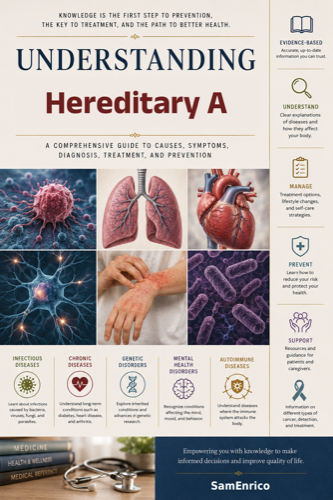
Understanding Hereditary A eBook
This disease publication, published by SamEnrico,
This disease publication, published by SamEnrico, covers Understanding Hereditary A
Formats
Free sample
Chapter 1: The Swell That Wouldn't Stop...--For seven years, Sarah Thompson woke up every morning and checked her hands before she checked her phone.It was an involuntary ritual, a prayer disguised as observation. She would hold her palms up to the morning light filtering through her bedroom curtains, flexing her fingers, watching for any asymmetry. One day her left ring finger would be a plump sausage, impossible to bend. Another day her entire right hand would resemble a catcher's mitt, the skin stretched tight and shiny as a drumhead. Sometimes—those were the bad days—she would press her thumb into her lower lip, feeling for the subtle firmness that preceded the swelling of her tongue or throat.
That firmness was the difference between an inconvenience and a visit to the emergency room.Sarah was not an anxious person by nature. She had been a competitive swimmer in college, then a marketing director at a midsize firm in Portland, Oregon. She was the friend who remembered birthdays, the employee who volunteered for difficult projects, the mother who never missed a school play. But somewhere between her thirtieth birthday and her thirty-fifth, the swelling had rewritten her personality. She became the woman who carried an Epi Pen she didn't need, who declined dinner invitations because she couldn't predict whether tomorrow would bring an attack, who had a standing order for CT scans at three different emergency rooms within a twenty-mile radius.Each ER visit followed the same script, and Sarah had memorized it by heart.The Emergency Room Script She would arrive, often in the early hours of the morning, with her hand or foot or lip visibly distorted.
The triage nurse would ask her allergy history. She would say she had none. The nurse would note the swelling and assume anaphylaxis anyway, because that is what emergency rooms do with swelling. Sarah would be given an intramuscular injection of epinephrine, followed by intravenous diphenhydramine (Benadryl) and methylprednisolone (a steroid). She would wait four to six hours.
The swelling would not go down. Sometimes it would get worse.The emergency physician would then order blood work and a CT scan of her abdomen if the swelling involved her gut. The CT would show free fluid in her abdominal cavity—ascites—and thickening of the bowel wall. The radiologist's report would use words like "nonspecific" and "suggestive of inflammation." The emergency physician would consult a surgeon. The surgeon would recommend observation rather than operation, because no clear surgical pathology was visible.
Sarah would be admitted to the hospital for twenty-four to forty-eight hours. The swelling would gradually resolve on its own, usually after about sixty hours. She would be discharged with a diagnosis of "idiopathic angioedema" and a referral to an allergist.The allergist would perform skin prick testing for sixty-eight common allergens. All would be negative. The allergist would draw blood for specific Ig E testing.
All would be negative. The allergist would shrug and prescribe high-dose cetirizine and famotidine—an H1 and H2 antihistamine combination—and tell Sarah to follow up in three months.Sarah would take the medications faithfully. The swelling would continue. She would return to the allergist. The allergist would increase the doses.
The swelling would continue. She would be referred to a second allergist, then a rheumatologist, then a gastroenterologist, then a neurologist. The rheumatologist would test her for lupus, for mixed connective tissue disease, for Sjögren's syndrome. All negative. The gastroenterologist would perform an endoscopy and a colonoscopy.
Normal. The neurologist would order an MRI of her brain to rule out multiple sclerosis. Normal.Seven years. Twelve doctors. Four emergency room visits per year.
Two surgeries that should never have happened—an appendectomy in year three (the surgeon was convinced her abdominal pain was appendicitis, but the pathology report showed a normal appendix) and an exploratory laparotomy in year five (the surgeon was certain she had endometriosis, but found nothing). Both surgeries left her with scars that she would touch absentmindedly while waiting for the next swell.The Broken Brake What Sarah's doctors failed to recognize was not a failure of intelligence or compassion. It was a failure of pattern recognition. They were trained to think of angioedema as a variant of allergy, because that is what angioedema is in 99% of the cases they see. The patient eats a peanut, the throat swells, the epinephrine works, the crisis passes.
That is the story of histamine-mediated angioedema, and it is a story with a beginning, a middle, and an end.Sarah's story was different. Her swelling came without urticaria—no hives, no itching. It lasted not minutes or hours but days. It did not respond to epinephrine, antihistamines, or steroids. It had a family history.
Her mother, now sixty-two, had experienced similar episodes of hand and foot swelling throughout her forties and fifties. Her maternal grandmother, now deceased, had died suddenly at age fifty-four after developing throat swelling following a dental procedure. The death certificate listed "airway obstruction of unknown etiology."This family history was the clue that every one of Sarah's doctors overlooked. Not because they were bad doctors, but because they were looking for a different kind of story. They were looking for an allergic story.
Sarah was living a genetic story.The genetic story of Hereditary Angioedema begins with a single protein called C1 esterase inhibitor, or C1-INH. This protein is the body's primary brake on a biochemical pathway known as the kallikrein-kinin system. When C1-INH is working properly, it keeps the system in check, preventing the excessive production of a small peptide called bradykinin. Bradykinin is a potent vasodilator—it causes blood vessels to become leaky, allowing fluid to escape from the bloodstream into the surrounding tissues. That fluid is what we call swelling.
In small, controlled amounts, bradykinin is a normal part of inflammation and healing. But when the brake is broken, bradykinin floods the system, and the body becomes a garden hose with a busted nozzle, spraying water everywhere.In Sarah's case, genetic testing would eventually reveal a mutation in the SERPING1 gene on chromosome 11. This mutation caused her body to produce only about 30% of the normal amount of C1-INH protein. The brake was not completely absent, but it was weak. It could handle everyday traffic—minor stresses, small injuries, the usual ups and downs of life.
But when a significant trigger arrived—an infection, a dental procedure, a bout of intense stress, or even just the hormonal fluctuations of her menstrual cycle—the system would overwhelm the weakened brake, bradykinin would surge, and Sarah would swell.This is Type I Hereditary Angioedema, accounting for approximately 85% of cases. Type II, accounting for another 15%, produces normal amounts of C1-INH protein, but the protein is dysfunctional—it is present but cannot do its job. Type III, the rarest and most mysterious form, occurs in patients with normal C1-INH levels and function; these patients often have mutations in other genes, such as Factor XII (F12), plasminogen (PLG), or angiopoietin-1 (ANGPT1), that affect bradykinin production through other mechanisms.The Diagnostic Delay Sarah's seven-year diagnostic odyssey is not unusual. In fact, it is tragically typical. Studies of Hereditary Angioedema patients around the world…
This is the end of the free sample. Get the eBook to keep going. Buy now
About this book
Details
- Author
- Duggan Jazmin
- Publisher
- SamEnrico
- Language
- English
- Genre
- Non-Fiction, Informative, Educational
- Released
- 2026-06-02
- Pages (approx.)
- 154
- Available as
- eBook, Audiobook

Read better in the ZLOADR app
Your eBooks on your phone or tablet. Sign in with your SamEnrico account and start reading.
More by Duggan Jazmin
 Energy Draining Work HabitsDuggan Jazmin$11.99
 Sleep And Trauma ProcessingDuggan Jazmin$11.99
 The Scream Free Parent Self CareDuggan Jazmin$11.99
 Behavioral Addiction in RetailDuggan Jazmin$11.99
 The Beast of the Labyrinth: Minotaur’s Last StandDuggan Jazmin$11.99
 The Silent Depths: Trieste’s Descent into the MarianasDuggan Jazmin$11.99
 Alamosite MiningDuggan Jazmin$11.99
 First Cold Call Script WorkbookDuggan Jazmin$12.99
 E-Commerce Long Term Outlook 2035Duggan Jazmin$12.99
 How to Start a Hobby in Modeling ShipsDuggan Jazmin$11.99
You may also like
 Hong Kong Handover 1997Dunn Johnnie$11.99
 Zumba For Postnatal Recovery CourseNeal Christian$11.99
 Zumba for BeginnersLadner Nikia$11.99
 YouTube Comment Mining GuideHumes Pandora$12.99
 Worry Box MeditationCarlin Rudy$11.99
 Workplace Stress MeditationNguyen Lynn$11.99
 Workplace Stress and Sleep RepairHawley Ivory$11.99
 Workplace Perfectionism CureDelaney Jeffry$11.99
 Workplace Injustice Anger GuideWallen Isabelle$11.99
 Work Addiction and Burnout LinkGreenwood Ester$11.99
 Women in Yoga and WellnessBeattie Galina$11.99
 Women in Stand Up ComedyChun Evangeline$11.99