
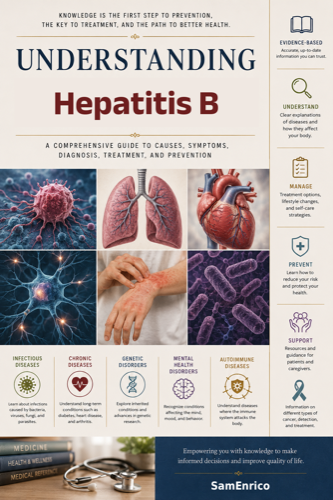
Non-FictionInformativeEducational
Understanding Hepatitis B eBook
This disease publication, published by SamEnrico,
This disease publication, published by SamEnrico, covers Understanding Hepatitis B
Formats
Free sample
Chapter 1: The Silent Epidemic...--In the winter of 2018, a 34-year-old marathon runner named David walked into his doctor's office for a routine life insurance physical. He felt fine. He had just completed his third marathon, had never been hospitalized, and had no family history of liver disease. Three weeks later, his insurance application was denied. Buried in the fine print was a single laboratory abnormality: he tested positive for Hepatitis B surface antigen (HBs Ag).
Further testing revealed an HBV DNA level of 8 million IU/m L and an ALT of 312 U/L—more than six times the upper limit of normal. David had chronic Hepatitis B. He had likely been infected for fifteen years, perhaps during a brief relationship in college or from a tattoo he received abroad. He never had a single symptom. This is the defining paradox of Hepatitis B: it is simultaneously one of the most common chronic viral infections on Earth and one of the most overlooked, until it is too late.David's story is not unusual.
It is, in fact, the rule. Approximately 250 to 300 million people worldwide are chronically infected with the Hepatitis B virus (HBV). That is roughly the entire population of the United States and Indonesia combined. Yet most of these individuals—up to two-thirds—have no idea they carry the virus. They feel healthy.
They run marathons, raise children, build careers, and donate blood, all while a silent biological process unfolds inside their livers. This is why Hepatitis B is rightly called the silent epidemic. Unlike a heart attack that announces itself with crushing chest pain, unlike a bacterial infection that declares war with fever and pus, HBV often operates in complete stealth for decades. By the time symptoms arrive, the damage is frequently irreversible: cirrhosis, liver failure, or hepatocellular carcinoma (HCC)—liver cancer.This book exists because David deserved better. He deserved to know his status before the virus gained ground.
He deserved a clear, compassionate, evidence-based guide to understanding what HBV is, how it behaves, and what he could do about it. You, the reader, deserve the same. Whether you were diagnosed yesterday, have lived with HBV for years, or love someone who carries the virus, this chapter will establish the foundational knowledge you need. We will explore what Hepatitis B is at the molecular level, why the liver is its preferred target, how it differs from Hepatitis A and C, who is most affected globally, and why the outdated term "carrier" has caused more confusion than clarity. By the end of this chapter, you will understand the enemy you face—and more importantly, why surveillance is the single most powerful tool in your arsenal.What Exactly Is Hepatitis B?Hepatitis B is a potentially life-threatening liver infection caused by the Hepatitis B virus (HBV).
The word "hepatitis" simply means inflammation of the liver, derived from the Greek hepar (liver) and the suffix -itis (inflammation). But HBV is not just any liver irritant. It is a highly specialized, exquisitely adapted DNA virus that has evolved over thousands of years to do one thing very well: establish persistent infection in human hepatocytes, the primary cells of the liver.Unlike many viruses that cause acute illness and then disappear, HBV carries a molecular weapon that allows it to remain indefinitely. That weapon is covalently closed circular DNA, abbreviated as ccc DNA. When HBV enters a hepatocyte, it does not simply replicate and burst out.
Instead, it transports its genetic material to the cell's nucleus and converts it into ccc DNA, a stable, mini-chromosome that can persist for the life of the cell. Think of ccc DNA as a viral time bomb that writes itself into the operating system of your liver cells. Even if you suppress active replication with antiviral medications, the ccc DNA remains, capable of reactivating at any time. This is why chronic Hepatitis B is so difficult to cure—a theme we will revisit in depth later in this book regarding emerging therapies and clinical trials.The virus itself is remarkably small, measuring only 42 nanometers in diameter. To put that in perspective, approximately 2,500 HBV virions could fit side by side across the width of a single human hair.
Despite its microscopic size, HBV is extraordinarily infectious. It is 50 to 100 times more infectious than HIV, the virus that causes AIDS. Fortunately, it is far less infectious than the common cold or influenza, which spread through casual respiratory droplets. HBV requires direct access to the bloodstream or mucous membranes, which we will explore in Chapter 2.The Liver: An Unlikely Battlefield To understand Hepatitis B, you must understand the organ it attacks. The liver is the body's largest internal organ, weighing approximately three pounds in an average adult.
It sits in the upper right quadrant of the abdomen, just below the diaphragm, and performs over 500 essential functions. Among them: filtering toxins from the blood, producing bile for fat digestion, synthesizing clotting factors, storing glucose as glycogen, regulating cholesterol, and metabolizing medications. The liver is also the only internal organ with remarkable regenerative capacity; you can remove up to two-thirds of a healthy liver, and it will grow back to near its original size within months.This regenerative capacity is both a blessing and a curse in the context of HBV. The blessing is that the liver can endure decades of low-level viral activity without losing function. The curse is that this resilience allows HBV to cause progressive damage without producing symptoms.
Scar tissue, known as fibrosis, accumulates slowly over years. As fibrosis advances, it distorts the liver's architecture, eventually leading to cirrhosis—a condition in which scar tissue replaces healthy liver tissue, impairing blood flow and function. And cirrhosis sets the stage for liver cancer.The relationship between HBV and liver cancer is so strong that the World Health Organization classifies HBV as a Group 1 carcinogen, meaning there is conclusive evidence that it causes cancer in humans. Approximately 50 to 80 percent of all liver cancer cases worldwide are attributed to chronic HBV infection. This is why the Hepatitis B vaccine, which you will learn about in Chapter 8, is often called the first anti-cancer vaccine.
Prevent HBV, and you prevent the vast majority of liver cancer deaths that follow.Hepatitis A, B, C, and D: Untangling the Alphabet One of the most common sources of confusion for newly diagnosed patients is the alphabet soup of hepatitis viruses: A, B, C, D, and E. They are not the same disease. They do not spread the same way. They do not have the same outcomes. Understanding the differences is essential for both peace of mind and appropriate medical care.Hepatitis A is an RNA virus transmitted through the fecal-oral route, meaning ingestion of contaminated food or water.
It causes an acute infection that resolves on its own within weeks to months. Hepatitis A never becomes chronic, and a vaccine exists. For most healthy people, Hepatitis A is unpleasant but not life-threatening. You cannot get chronic Hepatitis A, and it does not cause liver cancer.Hepatitis B is the subject of this book: a DNA virus transmitted through blood, semen, and other body fluids. It can be acute or chronic.
The chronic form, defined as persistence of HBs Ag for longer than six months, affects approximately 250-300 million people worldwide.…
This is the end of the free sample. Get the eBook to keep going. Buy now
About this book
Details
- Author
- Beaty Armanda
- Publisher
- SamEnrico
- Language
- English
- Genre
- Non-Fiction, Informative, Educational
- Released
- 2026-05-08
- Pages (approx.)
- 154
- Available as
- eBook, Audiobook

Read better in the ZLOADR app
Your eBooks on your phone or tablet. Sign in with your SamEnrico account and start reading.
More by Beaty Armanda
 Parenting Through Trauma Self CareBeaty Armanda$11.99
 Self Esteem After Partner's CriticismBeaty Armanda$11.99
 Energy Audit Personal GuideBeaty Armanda$11.99
 Behavioral Addiction in VeteransBeaty Armanda$11.99
 The Iron Tide: How One Man Built a Global Shipping Empire from NothingBeaty Armanda$11.99
 The Dragon’s Lament: Saint George and the Beast of CappadociaBeaty Armanda$11.99
 How to Become a Kelp CutterBeaty Armanda$11.99
 ABAP DeveloperBeaty Armanda$11.99
 Ivy League Alternative Degree PrimerBeaty Armanda$12.99
 E-Commerce Chatbot Support OutlookBeaty Armanda$12.99
You may also like
 Hong Kong Handover 1997Dunn Johnnie$11.99
 Zumba For Postnatal Recovery CourseNeal Christian$11.99
 Zumba for BeginnersLadner Nikia$11.99
 YouTube Comment Mining GuideHumes Pandora$12.99
 Worry Box MeditationCarlin Rudy$11.99
 Workplace Stress MeditationNguyen Lynn$11.99
 Workplace Stress and Sleep RepairHawley Ivory$11.99
 Workplace Perfectionism CureDelaney Jeffry$11.99
 Workplace Injustice Anger GuideWallen Isabelle$11.99
 Work Addiction and Burnout LinkGreenwood Ester$11.99
 Women in Yoga and WellnessBeattie Galina$11.99
 Women in Stand Up ComedyChun Evangeline$11.99