
Non-FictionInformativeEducational
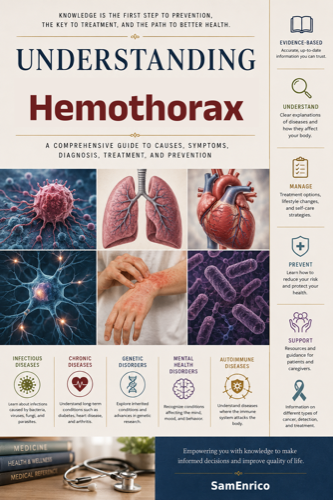
Understanding Hemothorax eBook
This disease publication, published by SamEnrico,
by Mojica Devin
This disease publication, published by SamEnrico, covers Understanding Hemothorax
Formats
Free sample
Chapter 1: The Silent Reservoir...–- The human chest is a master of deception. It can fill silently, chamber by chamber, with your own blood while you sit upright, talking, breathing, and believing that nothing is seriously wrong. This is the first and most dangerous fact about hemothorax: the body does not scream. It whispers. And by the time it shouts, the reservoir is nearly full.Every year, approximately 300,000 people in the United States develop a hemothorax.
Most of them never saw it coming. A teenager falls off a bicycle and walks home, only to collapse six hours later. An elderly man on a blood thinner bumps his chest against a countertop and ignores the mild ache, then wakes up gasping. A construction worker takes a glancing blow from a falling pipe, finishes his shift, and drives himself to the emergency room—where his blood pressure is 80/40 and his chest X-ray shows one white lung drowning in blood.These are not rare cases. They are the everyday reality of a condition that kills not through dramatic violence but through quiet accumulation.
The pleural space—that capillary-thin gap between the lung and the chest wall—can hold nearly half of a person's circulating blood volume before the chest wall even begins to bulge. One and a half to two liters of blood, enough to fill two large soda bottles, can pool inside the chest while the patient appears deceptively stable. This is the "20/40 rule," the first principle of hemothorax: losing 20 percent of your blood volume puts you into class II hemorrhagic shock, but your chest can hide 40 percent without visible external evidence.To understand why this happens, you must first understand the anatomy that makes it possible.The Pleural Space: A Potential Catastrophe The lungs do not simply float loosely inside the chest. They are enclosed in a double-layered sac called the pleura. The visceral pleura adheres directly to the surface of the lung, thin as cellophane and nearly transparent.
The parietal pleura lines the inside of the chest wall, covering the ribs, the diaphragm, and the mediastinum (the central compartment that holds the heart and great vessels). Between these two layers lies the pleural space—not an empty cavity but a "potential space," meaning it exists only as a gap that can open when fluid or air enters.In health, the pleural space contains just five to fifteen milliliters of serous fluid, barely enough to lubricate the two layers as they slide against each other with every breath. The visceral and parietal pleurae are separated by a distance measured in micrometers—thinner than a human hair. The surface tension between them, combined with the negative pressure generated by the chest wall pulling outward and the lungs pulling inward, keeps the lungs expanded against the ribs.This elegant system works flawlessly until something goes wrong. When blood enters the pleural space, the rules change entirely.Unlike air, which compresses the lung but does not consume volume, blood accumulates relentlessly.
Each heartbeat pushes more blood from the injured vessel into the potential space. The lung, unable to expand against rising pressure, begins to collapse. The mediastinum—that central compartment containing the heart and the opposite lung—shifts toward the uninjured side. The diaphragm flattens. The ribs spread slightly.
And all of this happens inside a closed, rigid box: the thoracic cage.The Dual Threat: Bleeding and Suffocation Hemothorax kills through two simultaneous mechanisms, and understanding both is essential to understanding why this condition is so dangerous.The first mechanism is hypovolemic shock. Blood that ends up in the pleural space is blood that is no longer circulating. The heart pumps but the volume returns diminished. Blood pressure drops. Tissues become starved of oxygen.
The kidneys shut down. The brain becomes confused. If enough blood is lost—typically more than 40 percent of total volume, or about two liters in an average adult—the heart simply cannot pump enough to sustain life. The patient bleeds to death, not externally where it can be seen, but internally into a space that conceals the hemorrhage.The second mechanism is respiratory failure. The lung on the affected side cannot expand against the column of blood.
The more blood accumulates, the more the lung collapses. But the problem does not stop there. As the mediastinum shifts, the opposite lung also becomes compressed. The patient now has two compromised lungs: one filled with blood externally (in the pleural space) and the other squeezed by a displaced heart and trachea. Oxygen saturation falls.
Carbon dioxide rises. The patient suffocates while still having blood in their veins—a cruel paradox.These two threats do not operate independently. They amplify each other. Hypovolemia reduces oxygen delivery to the tissues, including the remaining functioning lung tissue. Respiratory failure causes hypoxemia, which further impairs the heart's ability to pump.
The patient enters a downward spiral where each organ failure worsens the others.This is why a small, slow bleed can be more dangerous than a large, fast one. In a rapid, massive hemorrhage, the patient collapses immediately—blood pressure crashes, consciousness is lost, and the trauma team responds with urgent intervention. But in a slow bleed, the body compensates. The heart rate increases. Peripheral blood vessels constrict to maintain blood pressure.
The patient looks pale but alert. They complain of mild shortness of breath, which the emergency department attributes to anxiety or the pain of their rib fracture.And all the while, the chest is filling.The Spectrum of Severity: From Trivial to Deadly Not every hemothorax is a life-threatening emergency. The clinical significance of blood in the pleural space depends on three variables: volume, rate of accumulation, and the patient's underlying physiology.A minimal hemothorax is defined as less than 300 milliliters of blood. On an upright chest X-ray, this appears as a subtle blunting of the costophrenic angle—the sharp corner where the diaphragm meets the ribs. Many patients with minimal hemothorax are completely asymptomatic.
They have normal oxygen saturation, normal blood pressure, and no respiratory distress. Some trauma centers observe these patients without placing a chest tube, repeating the X-ray in six to twelve hours to ensure the bleeding has stopped. The majority of minimal hemothoraces resolve on their own as the body reabsorbs the blood over several weeks.A moderate hemothorax contains 300 to 1500 milliliters of blood. This is the range where symptoms become noticeable. The patient reports shortness of breath with exertion, pleuritic chest pain (sharp pain that worsens with inspiration), and a sensation of fullness or heaviness on the affected side.
Oxygen saturation may be 90 to 94 percent on room air. The chest X-ray shows opacification of the lower half of the hemithorax, often with a visible meniscus sign—a curved line where blood meets air. Most moderate hemothoraces require chest tube drainage, not only to relieve symptoms but also to prevent the blood from clotting and causing long-term complications.A massive hemothorax is defined as more than 1500 milliliters of blood, or more than one third of the patient's total blood volume. This is a surgical emergency. The patient is hypotensive (systolic blood pressure below 90 mm Hg), tachycardic (heart rate over 120 beats per minute), and tachypneic (respiratory rate over 30 breaths per minute).
The affected side of the chest is dull to percussion and silent to auscultation. The trachea may deviate toward the…
This is the end of the free sample. Get the eBook to keep going. Buy now
About this book
Details
- Author
- Mojica Devin
- Publisher
- SamEnrico
- Language
- English
- Genre
- Non-Fiction, Informative, Educational
- Released
- 2026-06-02
- Pages (approx.)
- 152
- Available as
- eBook, Audiobook

Read better in the ZLOADR app
Your eBooks on your phone or tablet. Sign in with your SamEnrico account and start reading.
More by Mojica Devin
 Legacy for ScientistsMojica Devin$11.99
 Self Esteem And Physical IntimacyMojica Devin$11.99
 The MBSR for OCD GuideMojica Devin$11.99
 Bingo Addiction Recovery GuideMojica Devin$11.99
 Code of the Ancients: The DNA Enigma of the Terracotta WarriorsMojica Devin$11.99
 Stanley and Livingstone: The Final Quest Across the UnknownMojica Devin$11.99
 Rheology TestingMojica Devin$11.99
 A Beginners Guide to Carrom (Volume 1)Mojica Devin$11.99
 Industry-Facing AI Master's GuideMojica Devin$12.99
 E-Commerce Europe Market OutlookMojica Devin$12.99
You may also like
 Hong Kong Handover 1997Dunn Johnnie$11.99
 Zumba For Postnatal Recovery CourseNeal Christian$11.99
 Zumba for BeginnersLadner Nikia$11.99
 YouTube Comment Mining GuideHumes Pandora$12.99
 Worry Box MeditationCarlin Rudy$11.99
 Workplace Stress MeditationNguyen Lynn$11.99
 Workplace Stress and Sleep RepairHawley Ivory$11.99
 Workplace Perfectionism CureDelaney Jeffry$11.99
 Workplace Injustice Anger GuideWallen Isabelle$11.99
 Work Addiction and Burnout LinkGreenwood Ester$11.99
 Women in Yoga and WellnessBeattie Galina$11.99
 Women in Stand Up ComedyChun Evangeline$11.99