
Non-FictionInformativeEducational
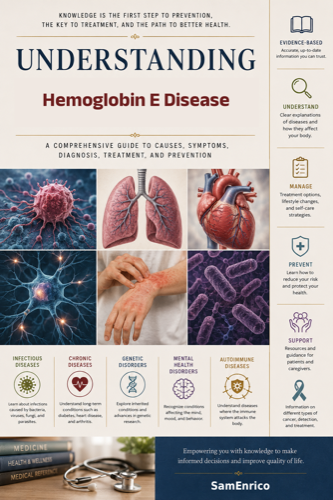
Understanding Hemoglobin E Disease eBook
This disease publication, published by SamEnrico,
by Oneil Sage
This disease publication, published by SamEnrico, covers Understanding Hemoglobin E Disease
Formats
Free sample
Chapter 1: The Third Hemoglobin--–- In the summer of 1954, a thirty-seven-year-old researcher named Virginia Minnich stared at a series of cellulose acetate electrophoresis strips hanging vertically in a small, stuffy laboratory at the Washington University School of Medicine in St. Louis. The strips—each no wider than a human thumb—had been soaked in buffer solution, loaded with hemolysates from blood samples, and subjected to an electrical current. Under normal circumstances, hemoglobin proteins migrate across the strip at predictable speeds, forming distinct bands that any trained hematologist could identify at a glance. Hemoglobin A, the adult form, travels farthest.
Hemoglobin A2, the minor adult fraction, lags behind. And in patients with sickle cell disease, hemoglobin S occupies a characteristic position midway between the two.But on this particular set of strips, Minnich saw something she could not explain.The samples had come from a family of Southeast Asian descent living in St. Louis. The father, the mother, and three of their four children all showed an extra band—a dense, dark smudge sitting exactly where no known hemoglobin variant was supposed to be. It was not hemoglobin A.
It was not hemoglobin A2. It was not hemoglobin S, C, D, or any of the other variants that had been catalogued since Linus Pauling first described sickle cell as a "molecular disease" just five years earlier. This was an entirely new protein, and it was abundant. In some family members, it accounted for nearly all of the hemoglobin in their red blood cells.Minnich did what any good scientist would do. She repeated the experiment.
She adjusted the p H of the buffer solution. She ran controls from healthy volunteers and from patients with known hemoglobin disorders. She consulted with her colleagues, including the renowned hematologist Carl Moore, who had seen more abnormal hemoglobins than almost anyone alive. The band persisted. It was real.
And it did not match any known pattern.What Minnich had discovered would eventually be named hemoglobin E. It would become recognized as the third most common hemoglobin variant on Earth, trailing only hemoglobin A (the normal protein) and hemoglobin S (the sickle variant). And it would challenge the fundamental way that hematologists thought about hemoglobin disorders, because hemoglobin E refused to fit neatly into either of the two existing categories. It was not purely a structural hemoglobinopathy like sickle cell, where the mutation creates a defective protein that polymerizes under low oxygen. Nor was it purely a thalassemia, where the mutation reduces the quantity of globin chains produced.
Hemoglobin E did both. It was a hybrid, a chimeric disorder that defied easy classification—and for that reason, it remained for decades the most misunderstood and underappreciated major hemoglobin variant in global medicine.The Woman Who Looked Closer Virginia Minnich did not set out to discover a new hemoglobin. She had trained as a botanist, earning her master's degree from the University of Minnesota in 1939, and she spent the early years of her career studying plant physiology. But World War II redirected countless scientific careers, and Minnich found herself working in a hematology laboratory, analyzing blood samples from patients with unexplained anemias. She proved to be exceptionally skilled at the meticulous, often tedious work of hemoglobin electrophoresis—a technique that separates proteins based on their electrical charge and molecular weight.In the early 1950s, electrophoresis was still a young technology.
The basic principle had been understood for decades, but its application to hemoglobin analysis had exploded after Pauling's 1949 landmark paper, "Sickle Cell Anemia, a Molecular Disease," which used electrophoresis to demonstrate that hemoglobin from sickle cell patients migrated differently from normal hemoglobin. Suddenly, hematologists around the world began running electrophoresis on every unusual blood sample they encountered. New variants proliferated: hemoglobin C was identified in 1950, hemoglobin D in 1951, hemoglobin E and hemoglobin G both in 1954.Minnich's contribution was not merely technical. She was a systematic thinker who understood that a single family study could reveal more than a hundred isolated case reports. When she encountered that extra band on the electrophoresis strips from the Southeast Asian family, she did not simply publish a case report and move on.
She tracked down the family's medical history. She collected blood samples from relatives. She built a pedigree that spanned three generations and demonstrated conclusively that the new hemoglobin was inherited as an autosomal dominant trait—meaning that a single copy of the altered gene was sufficient to produce detectable amounts of the abnormal protein.What made her discovery particularly significant was the family's clinical presentation. The parents and children with the new hemoglobin were not ill. They had no history of severe anemia, no painful crises, no gallstones, no leg ulcers, none of the hallmarks of sickle cell disease.
They were, by all appearances, completely healthy. And yet their red blood cells contained huge quantities of this abnormal hemoglobin—in some cases, up to ninety percent of their total hemoglobin.This was baffling. In sickle cell trait, where a person inherits one copy of the hemoglobin S gene and one normal copy, the abnormal hemoglobin typically accounts for about forty percent of the total. In sickle cell disease, with two copies of the hemoglobin S gene, the abnormal protein accounts for eighty to ninety percent. But the sickle cell trait carriers are essentially normal, while sickle cell disease patients are severely ill.
The new hemoglobin, by contrast, appeared to cause no symptoms even when present at levels that would be catastrophic in sickle cell disease.Minnich published her findings in 1954 in the Journal of Laboratory and Clinical Medicine, co-authored with Moore and several other colleagues. The paper was clear, methodical, and understated—a model of mid-century medical reporting. It described the electrophoretic characteristics of the new hemoglobin, the family pedigree, and the absence of clinical symptoms. It proposed the name "hemoglobin E" simply because the letter D had already been used for another variant discovered earlier that same year.The paper did not cause an immediate sensation. Hemoglobin E was one of several new variants reported in 1954, and it was not obvious at first that it would prove more common or more clinically important than the others.
But within a few years, reports began trickling in from Southeast Asia: hemoglobin E was not a rare curiosity confined to one family in St. Louis. It was extraordinarily common in Thailand, Laos, Cambodia, and parts of India and Bangladesh. In some villages in northeastern Thailand, more than half the population carried the gene. This was not a random mutation that had occurred in a single ancestor and spread by chance.
This was a genetic variant that had been actively selected for—presumably because it offered some protection against malaria, just as the sickle cell trait did in Africa.The Third Most Common Hemoglobin To understand why hemoglobin E matters, one must first understand the sheer scale of its global distribution. Approximately thirty million people worldwide carry at least one copy of the hemoglobin E gene. Of these, approximately one million have inherited two copies—one from each parent—and therefore have hemoglobin E disease (also called homozygous hemoglobin E). Another several million have inherited one copy of hemoglobin E and one copy of a beta-thalassemia…
This is the end of the free sample. Get the eBook to keep going. Buy now
About this book
Details
- Author
- Oneil Sage
- Publisher
- SamEnrico
- Language
- English
- Genre
- Non-Fiction, Informative, Educational
- Released
- 2026-06-02
- Pages (approx.)
- 160
- Available as
- eBook, Audiobook

Read better in the ZLOADR app
Your eBooks on your phone or tablet. Sign in with your SamEnrico account and start reading.
More by Oneil Sage
 Self Esteem And Partner CriticismOneil Sage$11.99
 Dreams After Narcissistic AbuseOneil Sage$11.99
 Purpose Journal WorkbookOneil Sage$11.99
 Video Game Addiction for ParentsOneil Sage$11.99
 The Spice Road to the Unknown: Dutch Explorers and the Secrets of Medieval AfricaOneil Sage$11.99
 The Last Wyvern of the Black Forest: A Beast’s LamentOneil Sage$11.99
 Cracking JEE Main And Advanced PrimerOneil Sage$12.99
 E-Commerce Returns Management OutlookOneil Sage$12.99
 Loss Prevention Agent City Place RackOneil Sage$11.99
 How to Become a Tax PreparerOneil Sage$11.99
You may also like
 Hong Kong Handover 1997Dunn Johnnie$11.99
 Zumba For Postnatal Recovery CourseNeal Christian$11.99
 Zumba for BeginnersLadner Nikia$11.99
 YouTube Comment Mining GuideHumes Pandora$12.99
 Worry Box MeditationCarlin Rudy$11.99
 Workplace Stress MeditationNguyen Lynn$11.99
 Workplace Stress and Sleep RepairHawley Ivory$11.99
 Workplace Perfectionism CureDelaney Jeffry$11.99
 Workplace Injustice Anger GuideWallen Isabelle$11.99
 Work Addiction and Burnout LinkGreenwood Ester$11.99
 Women in Yoga and WellnessBeattie Galina$11.99
 Women in Stand Up ComedyChun Evangeline$11.99