
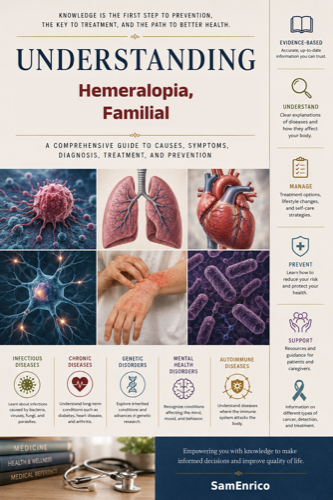
Understanding Hemeralopia, Familial
This disease publication, published by SamEnrico,
This disease publication, published by SamEnrico, covers Understanding Hemeralopia, Familial
Formats
About this book
Free sample
Chapter 1: Day’s Unexpected Enemy...--Imagine stepping outside on a bright, sunny morning. While everyone around you squints briefly and then adjusts, you experience something entirely different. The world does not become sharper or more vibrant. Instead, details vanish. Faces blur.
The white lines on the road seem to glow like neon tubes. You instinctively cover your eyes, not because the light is painfully bright in a typical sense, but because your vision simply... stops working correctly. This is the paradox of hemeralopia: you see better in the dark than in the light. For most people, darkness is the enemy of vision.
For you, daylight is.This chapter corrects a fundamental misunderstanding that has plagued the medical literature and patient communities for generations. Hemeralopia, derived from the Greek words hemera (day) and opsis (sight), is not the opposite of night blindness, nor is it simply "extreme sensitivity to light." It is a distinct, biologically rooted dysfunction of the cone photoreceptors—the cells responsible for daylight, color, and fine detail. Unlike those with typical photophobia, who experience pain or discomfort in bright light, individuals with familial hemeralopia experience a qualitative breakdown of the visual signal itself. The light does not hurt; it blinds functionally.To understand this condition, we must first dismantle a common assumption: that all vision problems worsen as light decreases. In fact, the human visual system contains two parallel pathways.
The rod-dominated scotopic system thrives in dim light, sacrificing color and detail for sensitivity. The cone-dominated photopic system requires bright light to activate but delivers sharpness, color, and rapid motion detection. In familial hemeralopia, the photopic system is defective from birth. The rods work perfectly. This means that as the sun rises, your visual acuity paradoxically falls.
A person who can read a book by candlelight may be unable to recognize a face across a table in a sunlit room.This chapter will define familial hemeralopia precisely, distinguish it from similar conditions, clarify the critical concept of photophobia as a behavioral adaptation rather than a sensory symptom, and establish the foundational distinction between stationary and progressive forms of cone…
This is the end of the free sample. Get the eBook to keep going. Buy now
Contents
- Chapter 1
- Chapter 2
- Chapter 3
- Chapter 4
- Chapter 5
- Chapter 6
- Chapter 7
- Chapter 8
- Chapter 9
- Chapter 10
- Chapter 11
- Chapter 12
Details
- Author
- Laughlin Santina
- Publisher
- SamEnrico
- Language
- English
- Genre
- Non-Fiction, Informative, Educational
- Released
- 2026-05-08
- Pages (approx.)
- 160
- Available as
- eBook, Audiobook

Read better in the ZLOADR app
Your eBooks on your phone or tablet. Sign in with your SamEnrico account and start reading.
More by Laughlin Santina
 The MBSR for Heart DiseaseLaughlin Santina$11.99
 Sex Addiction Sober Dating Boundaries WorkbookLaughlin Santina$11.99
 PMS Supplement Stack GuideLaughlin Santina$11.99
 Dreams in Bulimia Nervosa RecoveryLaughlin Santina$11.99
 The Balinese Healers: Ancient Wisdom and the Birth of Mindful MedicineLaughlin Santina$11.99
 Galahad's Last Lesson: The Knight Who Chose the GrailLaughlin Santina$11.99
 UK US Australia University HandbookLaughlin Santina$12.99
 Renewable Energy Development Permitting OutlookLaughlin Santina$12.99
 Growth EngineerLaughlin Santina$11.99
 How to Become a Kettle WorkerLaughlin Santina$11.99