

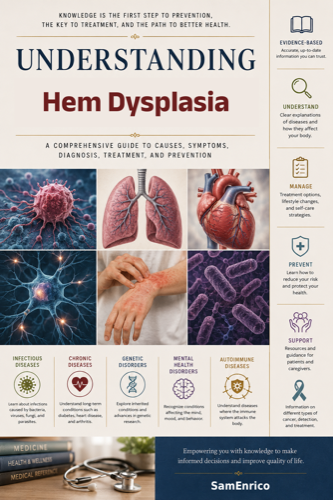
Non-FictionInformativeEducational
Understanding Hem Dysplasia
This disease publication, published by SamEnrico,
This disease publication, published by SamEnrico, covers Understanding Hem Dysplasia
Formats
About this book
Free sample
Chapter 1: The Moth-Eaten Bones...--–- In the autumn of 1986, a perinatal pathologist in Winnipeg, Canada, placed a set of fetal radiographs onto a viewing box and stepped back in disbelief. The images showed long bones that did not resemble any skeletal dysplasia she had seen in her fifteen years of practice. The femurs, rather than appearing as solid shafts of calcified cartilage, looked like they had been eaten away from within—fragmented into irregular islands of bone suspended in soft tissue, as if a colony of insects had tunneled through the developing skeleton. The skull was nearly absent of mineral, a ghostly outline where bone should have been. The spine consisted of scattered dots rather than continuous vertebrae.
And throughout the body, bizarre punctate calcifications appeared in places where bone had no business forming—in cartilage, in soft tissues, in the triradiate cartilage of the pelvis. This was not a variation of any known condition. This was something new.The pathologist, Dr. Cheryl Greenberg, faced a problem that no textbook could solve. Two siblings had been born to consanguineous parents—first cousins whose family tree had folded back on itself for generations.
Both fetuses had died before birth, both had shown similar patterns of hydrops (generalized fluid accumulation), similar ectopic calcifications, and similar moth-eaten skeletal destruction. The recurrence in siblings born to consanguineous parents screamed of an autosomal recessive condition, but nothing in the medical literature matched the constellation of findings. Greenberg did what scientists have done for centuries when faced with the unknown: she documented everything, preserved the tissues, photographed the radiographs, and began the slow, meticulous work of comparing her cases against every described skeletal dysplasia in the Western literature.What she found was a void. No condition combined hydrops, ectopic calcification, and moth-eaten bones. No known enzymatic defect produced this pattern of ossification failure.
No animal model existed. She had, in her laboratory, the only two known cases of what would eventually bear her name. But naming a disease is not the same as understanding it. The journey from observation to explanation would take three decades…
This is the end of the free sample. Get the eBook to keep going. Buy now
Contents
- Chapter 1
- Chapter 2
- Chapter 3
- Chapter 4
- Chapter 5
- Chapter 6
- Chapter 7
- Chapter 8
- Chapter 9
- Chapter 10
- Chapter 11
- Chapter 12
Details
- Author
- Higginbotham Ila
- Publisher
- SamEnrico
- Language
- English
- Genre
- Non-Fiction, Informative, Educational
- Released
- 2026-05-11
- Pages (approx.)
- 148
- Available as
- eBook, Audiobook

Read better in the ZLOADR app
Your eBooks on your phone or tablet. Sign in with your SamEnrico account and start reading.
More by Higginbotham Ila
 Sexual Addiction And Childhood Sexual Abuse GuideHigginbotham Ila$11.99
 Remote Tool Stack CommunicationHigginbotham Ila$11.99
 Luteal Phase Meal Prep GuideHigginbotham Ila$11.99
 Gestalt Dreamwork for TraumaHigginbotham Ila$11.99
 Dreams After Kidnapping TraumaHigginbotham Ila$11.99
 The Hollow Hill: Secrets of the Sidhe's Underground KingdomHigginbotham Ila$11.99
 The Cartographic Revolution: The House of Wisdom and the Atlantic Charts (1400s-1500s)Higginbotham Ila$11.99
 Student Visa Interview Success HandbookHigginbotham Ila$12.99
 Agrivoltaics Growth OutlookHigginbotham Ila$12.99
 How to Become a Keymodule-assembly-machine TenderHigginbotham Ila$11.99
 Ethical Hacking Advanced TechniquesHigginbotham Ila$11.99
You may also like
 Hong Kong Handover 1997Dunn Johnnie$11.99
 Zumba For Postnatal Recovery CourseNeal Christian$11.99
 Zumba for BeginnersLadner Nikia$11.99
 YouTube Comment Mining GuideHumes Pandora$12.99
 Worry Box MeditationCarlin Rudy$11.99
 Workplace Stress MeditationNguyen Lynn$11.99
 Workplace Stress and Sleep RepairHawley Ivory$11.99
 Workplace Perfectionism CureDelaney Jeffry$11.99
 Workplace Injustice Anger GuideWallen Isabelle$11.99
 Work Addiction and Burnout LinkGreenwood Ester$11.99
 Women in Yoga and WellnessBeattie Galina$11.99
 Women in Stand Up ComedyChun Evangeline$11.99