
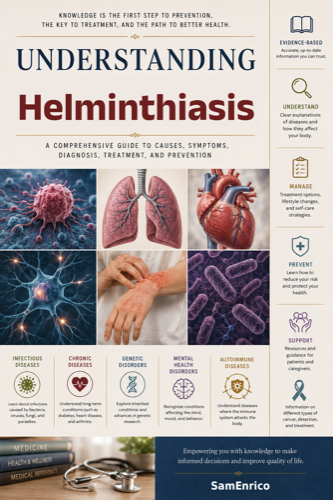
Non-FictionInformativeEducational
Understanding Helminthiasis eBook
This disease publication, published by SamEnrico,
by Wick Lottie
This disease publication, published by SamEnrico, covers Understanding Helminthiasis
Formats
Free sample
Chapter 1: The Worm That Ate My Thirties--–- The email arrived at 11:47 PM on a Tuesday. Sarah, a 34-year-old marketing director in Chicago, had just finished her third course of antibiotics for “presumed sinusitis” and was scrolling through her patient portal, looking for any clue that might explain why she’d spent eight years feeling like a stranger in her own body. The fatigue had started gradually—first, needing an extra cup of coffee in the afternoon, then canceling dinner plans because she couldn’t keep her eyes open, then calling in sick twice a month because the exhaustion felt like wet cement in her veins. Her gastroenterologist had diagnosed irritable bowel syndrome after a clean colonoscopy. Her rheumatologist had ruled out lupus and rheumatoid arthritis.
Her psychiatrist had prescribed antidepressants for “somatic symptom disorder.” Her primary care doctor had gently suggested she consider a less stressful job.But the email wasn’t from any of them. It was from a travel medicine clinic she’d visited six months earlier, on a whim, after a friend mentioned that unexplained eosinophilia—a finding on Sarah’s routine blood work that every previous doctor had dismissed as “probably allergies”—could be a sign of parasitic infection. The email contained three words that would change everything: Strongyloides serology positive.Eight years. Eight years of doctors, specialists, tests, and prescriptions. Eight years of being told it was all in her head.
And the cause was a worm—a nematode so small it could barely be seen with a microscope, but so cunning it could persist in the human body for decades, evading every immune defense her system could mount.Sarah’s story is not rare. It is not exceptional. And that is the most disturbing fact in this entire book.The Most Neglected of the Neglected If you asked a hundred doctors in New York, London, or Sydney to name the world’s most common infectious diseases, they would likely list influenza, tuberculosis, malaria, HIV, or perhaps COVID-19. They would be correct in terms of acute mortality and public health attention. But they would be overlooking a group of infections that collectively affect more than 1.5 billion people—nearly one in every five human beings on the planet.
That group is helminthiasis, the clinical term for infection with parasitic worms.The World Health Organization classifies the major helminth infections as Neglected Tropical Diseases (NTDs). The word “neglected” is carefully chosen. It does not mean these diseases are rare. It does not mean they are mild. It means they primarily affect populations with little political power, little economic leverage, and little voice in global health priorities.
The billion-plus people infected with soil-transmitted helminths (hookworm, Ascaris, whipworm) live overwhelmingly in sub-Saharan Africa, Southeast Asia, Latin America, and parts of the Caribbean. They are children whose growth is stunted by chronic malnutrition compounded by parasitic blood loss. They are pregnant women whose anemia increases the risk of maternal mortality and low birth weight. They are farmers whose productivity is sapped by relentless fatigue. They are human beings whose suffering has been deemed, by the implicit calculus of global health funding, less urgent than diseases that kill faster.But the geography of helminthiasis is shifting.
International travel, immigration, climate change, and the global food supply chain are bringing parasites to places that once considered them medical curiosities. In the United States alone, an estimated 3 to 5 million people are infected with Strongyloides stercoralis, most of them undiagnosed. In Europe, cases of Schistosoma infection from freshwater swimming in Africa are increasingly recognized in travelers returning from endemic regions. In Japan and South Korea, the popularity of raw freshwater fish has led to a resurgence of Diphyllobothrium latum (fish tapeworm). In every developed nation, the combination of clinical ignorance—parasitology is no longer a core subject in most medical schools—and nonspecific symptoms has created a perfect storm of underdiagnosis.Sarah was not infected in a remote village without clean water.
She was infected during a backpacking trip through Thailand in her mid-twenties, likely by walking barefoot on soil contaminated with hookworm larvae, or by drinking untreated water containing Strongyloides. She returned to Chicago, finished her MBA, launched her career, got married, and slowly, imperceptibly, began to fall apart. No doctor asked about her travel history. No doctor ordered a stool ova and parasite test. No doctor thought of worms.What Exactly Is a Helminth?Before we go further, we need to be precise about what we’re discussing.
The word “helminth” comes from the Greek helmins, meaning worm. In medical parasitology, it refers to three distinct classes of macroscopic, multicellular parasites that infect humans: nematodes (roundworms), trematodes (flatworms or flukes), and cestodes (tapeworms). These are not microscopic single-celled organisms like bacteria or protozoa. Helminths are animals—complex, multicellular, with digestive systems, nervous systems, reproductive organs, and in some cases, the ability to grow to astonishing sizes. The giant roundworm Ascaris lumbricoides can reach 35 centimeters (nearly 14 inches) in length.
The beef tapeworm Taenia saginata can grow to 10 meters (over 30 feet) inside the human intestine.This size and complexity have profound implications for how helminth infections behave compared to bacterial or viral illnesses. First, helminths do not replicate inside the human host. A single hookworm infection results from a single larva penetrating the skin. That larva grows into an adult worm, but it does not divide or multiply within the body. This means the severity of infection is determined almost entirely by the number of infective larvae that initially establish themselves.
It also means that eliminating every adult worm—with effective treatment—can cure the infection completely. Second, because helminths are large and immunogenic (they provoke an immune response), they have evolved extraordinarily sophisticated mechanisms to evade, suppress, or redirect that response. Unlike bacteria, which often cause disease by replicating rapidly and releasing toxins, helminths cause disease through chronic, low-grade inflammation, mechanical obstruction of organs, nutrient theft, and immune-mediated tissue damage.The distinction between helminths and protozoa is particularly important for clinical thinking. Protozoa (such as Giardia, Entamoeba histolytica, and Plasmodium—the cause of malaria) are single-celled organisms that replicate inside the human host. A single Giardia cyst can become thousands of trophozoites in the small intestine.
This means that protozoal infections often have a shorter incubation period, more acute symptoms, and can be diagnosed by finding the organism itself. Helminth infections, by contrast, often take months or years to produce noticeable symptoms, are characterized by eosinophilia (elevated eosinophil count, a type of white blood cell that responds to parasitic infection—more on this in Chapter 7), and are diagnosed by finding eggs or larvae in stool, blood, or tissue, or by detecting antibodies against the parasite.The Billion-Person Problem: Epidemiology by the Numbers The global burden of helminthiasis is staggering, yet it remains largely invisible to the media and to most clinicians outside of tropical medicine. Let me give you the numbers as they stand based on the most recent WHO estimates.Soil-transmitted helminths (STH) are the most common: approximately 900 million people infected with Ascaris lumbricoides (the giant roundworm), 500 million with Trichuris trichiura (whipworm), and 400 million with hookworms (Necator americanus and Ancylostoma duodenale). These numbers overlap—many people harbor multiple species simultaneously. Schistosomiasis…
This is the end of the free sample. Get the eBook to keep going. Buy now
About this book
Details
- Author
- Wick Lottie
- Publisher
- SamEnrico
- Language
- English
- Genre
- Non-Fiction, Informative, Educational
- Released
- 2026-05-06
- Pages (approx.)
- 159
- Available as
- eBook, Audiobook

Read better in the ZLOADR app
Your eBooks on your phone or tablet. Sign in with your SamEnrico account and start reading.
More by Wick Lottie
 Menstrual Health Myths DebunkedWick Lottie$11.99
 Remote Communication Non NativeWick Lottie$11.99
 Prostitution Solicitation Addiction Recovery WorkbookWick Lottie$11.99
 Jungian Dreamwork for TraumaWick Lottie$11.99
 The MBSR for Veterans GuideWick Lottie$11.99
 The Spy of Olympus: Athena’s Shadow NetworkWick Lottie$11.99
 Hops & Heists: The Untold Story of the Great Beer Robbery of 1974Wick Lottie$11.99
 Green Hydrogen Derivatives OutlookWick Lottie$12.99
 Regional Australia PR After Study ManualWick Lottie$12.99
 How to Become a Needle PolisherWick Lottie$11.99
 Ecommerce AssociateWick Lottie$11.99
You may also like
 Hong Kong Handover 1997Dunn Johnnie$11.99
 Zumba For Postnatal Recovery CourseNeal Christian$11.99
 Zumba for BeginnersLadner Nikia$11.99
 YouTube Comment Mining GuideHumes Pandora$12.99
 Worry Box MeditationCarlin Rudy$11.99
 Workplace Stress MeditationNguyen Lynn$11.99
 Workplace Stress and Sleep RepairHawley Ivory$11.99
 Workplace Perfectionism CureDelaney Jeffry$11.99
 Workplace Injustice Anger GuideWallen Isabelle$11.99
 Work Addiction and Burnout LinkGreenwood Ester$11.99
 Women in Yoga and WellnessBeattie Galina$11.99
 Women in Stand Up ComedyChun Evangeline$11.99