
Non-FictionInformativeEducational
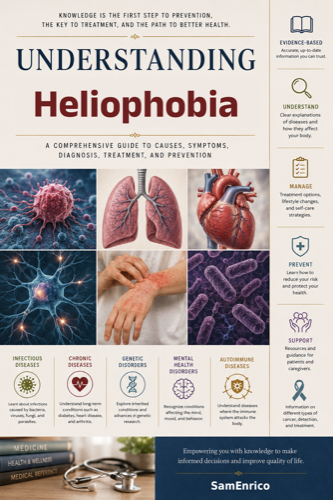
Understanding Heliophobia eBook
This disease publication, published by SamEnrico,
This disease publication, published by SamEnrico, covers Understanding Heliophobia
Formats
Free sample
Chapter 1: The Girl in the Darkroom--– In a small town in the Pacific Northwest, a seventeen-year-old girl named Maya had not felt sunlight on her skin in over four years. She woke at dusk, ate breakfast at midnight, and slept as dawn painted her blackout curtains a faint gray. Her bedroom walls were lined with aluminum foil—not for decoration, but because she had read somewhere that foil reflected every last photon of UV radiation. When emergency maintenance required entry during daylight hours, Maya hid in a windowless bathroom closet, pressing her palms against her eyes until the knocking stopped. Her mother described her as “sensitive to the sun.” Her teachers assumed she was homeschooled.
Her few online friends knew her only as “Nocturna,” a username that felt like a joke until you realized she had not seen a sunrise in 1,461 consecutive days.Maya is not a character from a horror novel. She is a composite of real individuals whose stories appear in the clinical literature on heliophobia—a condition so rarely discussed that most sufferers do not even know it has a name. They call themselves “vampires” or “night people” or simply “broken.” They fill online forums with questions like, “Is it normal to cry when the blinds are opened?” and “Has anyone else not left the house before 8pm in ten years?” And the answer, for a small but significant population, is yes. Heliophobia—from the Greek helios (sun) and phobos (fear)—is a specific phobia characterized by persistent, excessive, and unreasonable fear of sunlight. It is not a dislike of heat, not a preference for cool weather, not a practical adaptation to living in Arizona in July.
It is a clinical condition that destroys lives in ways both obvious and invisible, and it is almost entirely absent from public awareness.This book exists to change that. Understanding Heliophobia is written for three audiences: first, the person who hides from daylight and has spent years believing they are the only one; second, the family member, partner, or friend who watches someone they love retreat from the world and does not know how to help; and third, the mental health professional who has encountered a patient with sun avoidance and wants evidence-based guidance. By the end of this chapter, you will understand what heliophobia is, what it is not, and why distinguishing between the two matters more than you might think.What Heliophobia Is Not: Three Common Misconceptions Before defining heliophobia, we must clear away the debris of everyday language that obscures its clinical reality. Most people use the word “phobia” casually—I have a phobia of spiders, I am phobic about public speaking, heights are my phobia—without meeting the diagnostic criteria for a specific phobia disorder. This casual usage, while harmless in conversation, becomes dangerous when it prevents genuine sufferers from recognizing their condition or seeking treatment.First, heliophobia is not a mere dislike of heat.
Some people genuinely prefer cool weather. They sweat easily, feel uncomfortable when temperatures rise above 80 degrees, and avoid midday summer activities. This is a preference, not a phobia. The person with a preference may complain about the heat but will nonetheless attend an outdoor wedding, walk across a sunny parking lot, or sit near a window in a restaurant. The person with heliophobia cannot.
The distinction lies not in the presence of discomfort but in the presence of avoidance that produces life impairment. If you dislike heat but still function normally in daylight, you do not have heliophobia. If you rearrange your entire existence to avoid sunlight, you might.Second, heliophobia is not photophobia. Photophobia is a medical symptom—painful sensitivity to light—that typically originates in the eyes. People with photophobia squint, tear up, or experience sharp pain when exposed to bright light, often due to migraines, uveitis, corneal abrasions, or certain neurological conditions.
Photophobia is not a fear; it is a physical sensation. A person with photophobia can distinguish between “this light hurts my eyes” and “this light terrifies me.” Heliophobia involves fear, not pain. (Of course, one can have both conditions: a person with migraines who experiences photophobia may develop a secondary psychological fear of light because light predicts pain. This is a common comorbidity, discussed further in Chapter 4.)Third, heliophobia is not a rational adaptation to skin cancer risk. Skin cancer is real.
Melanoma kills. Sunscreen saves lives. These are facts, not opinions. The person who wears SPF 30, seeks shade during peak UV hours, and avoids tanning beds is practicing evidence-based skin protection. The person with heliophobia, by contrast, engages in catastrophic risk distortion—they believe that one minute of sun exposure will inevitably cause cancer, that any warmth on the skin means active burning, that UV radiation penetrates clothing and windows and clouds with equal intensity.
These beliefs are not only false; they are disproportionate to the actual risk. Evidence-based sun protection reduces risk. Heliophobia eliminates all sun exposure, which creates its own set of medical problems (vitamin D deficiency, osteoporosis, depression) that may ultimately be more dangerous than the avoided risk.The DSM-5 Definition: What Makes a Phobia Clinical The Diagnostic and Statistical Manual of Mental Disorders, Fifth Edition (DSM-5), the standard classification system used by mental health professionals in the United States, defines a specific phobia as an anxiety disorder meeting four criteria. Heliophobia fits squarely within this framework when sunlight is the feared object or situation.Criterion A: Marked fear or anxiety about a specific object or situation. For heliophobia, the feared stimulus is sunlight in any form: direct beams, indirect daylight through windows, reflected light from surfaces, or even the anticipation of future sun exposure.
The fear response is immediate, typically occurring within seconds of exposure or even upon imagining exposure. Physiologically, this involves activation of the sympathetic nervous system: increased heart rate, rapid breathing, sweating (paradoxically, often described as “cold sweat”), trembling, nausea, and a subjective sense of dread or impending doom.Criterion B: The phobic object or situation almost always provokes immediate fear or anxiety. This is the “almost always” clause. A person with heliophobia does not have good days and bad days with sunlight. Sunlight is a consistent, reliable trigger.
If a person feels fine in sunlight on cloudy days but panics in bright direct sun, that still qualifies—the threshold is about the stimulus, not its intensity. The key is consistency: the response is predictable and repeatable.Criterion C: The phobic object or situation is actively avoided or endured with intense fear or anxiety. This is the behavioral component, and it is where heliophobia becomes visible to outsiders. Avoidance can take many forms: staying indoors during daylight hours, installing blackout curtains or window films, wearing multiple layers of clothing even in summer, carrying an umbrella on sunny days, moving to a home with no windows facing the sun, working night shifts exclusively, or withdrawing from school or employment that requires daytime presence. For some individuals, avoidance is total—they simply never go outside when the sun is up.
For others, avoidance is partial but elaborate: they may go outside but only while holding an umbrella, wearing UV-rated gloves, and checking the UV index every ten minutes. The chapter…
This is the end of the free sample. Get the eBook to keep going. Buy now
About this book
Details
- Author
- Kingsley Rosalind
- Publisher
- SamEnrico
- Language
- English
- Genre
- Non-Fiction, Informative, Educational
- Released
- 2026-05-11
- Pages (approx.)
- 150
- Available as
- eBook, Audiobook

Read better in the ZLOADR app
Your eBooks on your phone or tablet. Sign in with your SamEnrico account and start reading.
More by Kingsley Rosalind
 Sex Addiction After Infidelity Discovery GuideKingsley Rosalind$11.99
 Remote Support Communication GuideKingsley Rosalind$11.99
 The MBSR Journal WorkbookKingsley Rosalind$11.99
 Period Poverty Solutions GuideKingsley Rosalind$11.99
 Dreams and Somatic Trauma ProcessingKingsley Rosalind$11.99
 The Thunderbird's Song: How a Native American Hero Tamed the SkiesKingsley Rosalind$11.99
 Echoes from the Desert: The Middle East's Secret Space RaceKingsley Rosalind$11.99
 Temporary Graduate Visa To PR WorkbookKingsley Rosalind$12.99
 Renewable Energy Insurance OutlookKingsley Rosalind$12.99
 How to Become a Needle GrinderKingsley Rosalind$11.99
 Design EngineerKingsley Rosalind$11.99
You may also like
 Hong Kong Handover 1997Dunn Johnnie$11.99
 Zumba For Postnatal Recovery CourseNeal Christian$11.99
 Zumba for BeginnersLadner Nikia$11.99
 YouTube Comment Mining GuideHumes Pandora$12.99
 Worry Box MeditationCarlin Rudy$11.99
 Workplace Stress MeditationNguyen Lynn$11.99
 Workplace Stress and Sleep RepairHawley Ivory$11.99
 Workplace Perfectionism CureDelaney Jeffry$11.99
 Workplace Injustice Anger GuideWallen Isabelle$11.99
 Work Addiction and Burnout LinkGreenwood Ester$11.99
 Women in Yoga and WellnessBeattie Galina$11.99
 Women in Stand Up ComedyChun Evangeline$11.99