
Non-FictionInformativeEducational
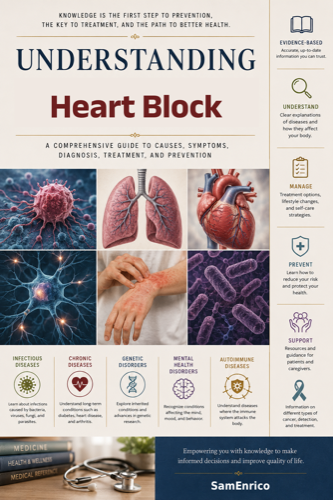
Understanding Heart Block eBook
This disease publication, published by SamEnrico,
This disease publication, published by SamEnrico, covers Understanding Heart Block
Formats
Free sample
Chapter 1: The Electrical Heart...–- On a Tuesday morning in March, a 42-year-old high school teacher named Sarah walked into her classroom, set down her coffee, and began writing algebra problems on the whiteboard. She had felt fine—slightly tired, perhaps, but she had three young children and a full teaching load. Tired was her baseline. At 9:47 AM, while explaining quadratic equations to thirty-five students, the world suddenly tilted. She later described it as someone slowly dimming a light switch.
Her knees buckled. She grabbed the chalkboard tray but missed. The next thing she remembered was the fluorescent ceiling lights of the emergency department, a strange tugging sensation on her chest, and a nurse saying, “Your heart stopped for eleven seconds.”Sarah did not have a heart attack. Her coronary arteries were clean, her cholesterol normal, her blood pressure excellent. What she had was an electrical problem—a complete heart block that had been brewing for years without a single warning sign until her heart decided, without notice, to stop talking to itself.This book is for Sarah.
It is also for her husband who watched the ambulance drive away, for her students who saw their teacher fall, and for the millions of people who will receive a diagnosis of “heart block” and have no idea what that actually means. The term itself is terrifying. “Heart block” sounds like a clogged pipe, a traffic jam of blood, a heart attack waiting to happen. None of those are true. Heart block is not a plumbing problem.
It is an electrical problem. And unlike many heart conditions, it is often completely treatable—sometimes reversible—and rarely limits a person’s lifespan once properly managed.But before we can understand what went wrong in Sarah’s heart, we need to understand what normally goes right. Every heartbeat is a carefully choreographed electrical event. Your heart beats approximately 100,000 times per day, 35 million times per year, and nearly three billion times over an average lifetime. That is not a pump working on its own.
That is an electrical system executing a perfect sequence, billions of times in a row, usually without you ever thinking about it. Until, one day, it doesn’t.The Heart’s Hidden Wiring Most people think of the heart as a muscular pump, and it is. But that muscle would sit motionless without electricity. The heart’s ability to contract depends entirely on an electrical signal that originates in a tiny cluster of cells no larger than a grain of rice. That cluster is called the sinus node, and it sits in the upper wall of the right atrium.
It is the heart’s natural pacemaker.The sinus node fires spontaneously, meaning it does not wait for a signal from the brain. It generates its own electrical impulse roughly once per second at rest, and faster when you exercise, stress, or even just think about something exciting. That impulse spreads first across the two upper chambers of the heart—the atria. As the atria contract, they push blood down into the lower chambers, the ventricles. So far, everything is working perfectly.But here is the crucial detail: the electrical signal cannot simply jump directly from the atria to the ventricles.
If it did, the ventricles would contract at the exact same time as the atria, and no blood would flow forward. The heart needs a brief delay. That delay happens at a second cluster of cells called the atrioventricular node, or AV node. Think of the AV node as a well-trained traffic controller. It receives the electrical signal from the atria, pauses for a fraction of a second (about one-tenth of a second), and then allows the signal to pass through to the ventricles.
That pause is what allows the atria to finish emptying their blood into the ventricles before the ventricles squeeze.After passing through the AV node, the electrical signal races down a pathway called the bundle of His, then splits into the left and right bundle branches, and finally spreads through the Purkinje fibers—a network that delivers the signal to every muscle cell in both ventricles simultaneously. The result is a coordinated, powerful squeeze that pushes blood out to the lungs and the rest of the body. Then the whole process repeats.On an electrocardiogram—the ECG or EKG that you have likely seen in medical dramas—this sequence appears as a series of waves. The first bump, the P wave, represents the atria contracting. The flat line after it, the PR interval, represents that crucial delay at the AV node.
Then the tall spike, the QRS complex, represents the ventricles contracting. Finally, the T wave represents the ventricles resetting electrically, ready for the next beat.When this system works perfectly, you never notice it. When it fails, the results range from an incidental finding on a routine physical to sudden collapse.What Actually Happened to Sarah When Sarah collapsed in her classroom, her sinus node was still firing perfectly. Her atria were still contracting. But the electrical signal never reached her ventricles.
Her AV node—that critical relay station—had stopped transmitting. For eleven seconds, her atria beat alone, uselessly, while her ventricles sat motionless. Without ventricular contraction, blood does not reach the brain. Without blood to the brain, consciousness vanishes. That is why she fell.But the human body has backups.
When the primary conduction system fails, other cells in the heart—normally quiet—can take over as a pacemaker. These are called escape rhythms. In Sarah’s case, cells lower down in her ventricles eventually fired, producing a slow, unreliable beat at about 35 beats per minute. That was enough to restore consciousness, but not enough to let her stand or think clearly. She was alive, but her heart was running on a backup generator meant for emergencies only.This is third-degree, or complete, heart block.
The name sounds catastrophic, and in the moment it is. But here is what Sarah learned later that day: complete heart block is one of the most treatable cardiac conditions in existence. A small electronic device called a pacemaker, implanted under her collarbone in a one-hour procedure, would completely restore her normal heart rhythm. She would leave the hospital in two days. Within a month, she would return to teaching.
Within a year, she would run a 5K. Her life expectancy would be the same as if she had never had heart block at all.That is the paradox of heart block. The symptoms can be terrifying. The diagnosis can feel like a sentence. But the treatment is often simple, safe, and extraordinarily effective.The Many Faces of Heart Block Sarah had the most severe form, but heart block exists on a spectrum.
Understanding that spectrum is the single most important step in moving from fear to control.First-degree heart block is the mildest form. In first-degree block, every electrical signal still reaches the ventricles, but it travels more slowly than normal through the AV node. On an ECG, this shows up as a prolonged PR interval—longer than 0.20 seconds. Most people with first-degree block have no symptoms at all. Many do not even know they have it.
It is often discovered incidentally during a routine physical or pre-surgery ECG. For the vast majority, it requires no treatment…
This is the end of the free sample. Get the eBook to keep going. Buy now
About this book
Details
- Author
- Abernathy Nadia
- Publisher
- SamEnrico
- Language
- English
- Genre
- Non-Fiction, Informative, Educational
- Released
- 2026-06-02
- Pages (approx.)
- 159
- Available as
- eBook, Audiobook

Read better in the ZLOADR app
Your eBooks on your phone or tablet. Sign in with your SamEnrico account and start reading.
More by Abernathy Nadia
 Sex Addiction 12 Step Program WorkbookAbernathy Nadia$11.99
 Menstrual Migraine Rescue GuideAbernathy Nadia$11.99
 Shah Persian Empire CelebrationsAbernathy Nadia$11.99
 Dreams After Bullying Trauma GuideAbernathy Nadia$11.99
 Therapist Dreamwork Training GuideAbernathy Nadia$11.99
 Darwin's Ghosts: The Genes That Rewrite Evolution in AfricaAbernathy Nadia$11.99
 Bubbles & Blood: The Untold Story of the Dutch Tulip ManiaAbernathy Nadia$11.99
 How to Start a Brush Wood Ware Business (Beginners Guide)Abernathy Nadia$11.99
 Client Services CoordinatorAbernathy Nadia$11.99
 Online Proctoring Success HandbookAbernathy Nadia$12.99
 Geothermal Energy Outlook 2030Abernathy Nadia$12.99
You may also like
 Hong Kong Handover 1997Dunn Johnnie$11.99
 Zumba For Postnatal Recovery CourseNeal Christian$11.99
 Zumba for BeginnersLadner Nikia$11.99
 YouTube Comment Mining GuideHumes Pandora$12.99
 Worry Box MeditationCarlin Rudy$11.99
 Workplace Stress MeditationNguyen Lynn$11.99
 Workplace Stress and Sleep RepairHawley Ivory$11.99
 Workplace Perfectionism CureDelaney Jeffry$11.99
 Workplace Injustice Anger GuideWallen Isabelle$11.99
 Work Addiction and Burnout LinkGreenwood Ester$11.99
 Women in Yoga and WellnessBeattie Galina$11.99
 Women in Stand Up ComedyChun Evangeline$11.99