

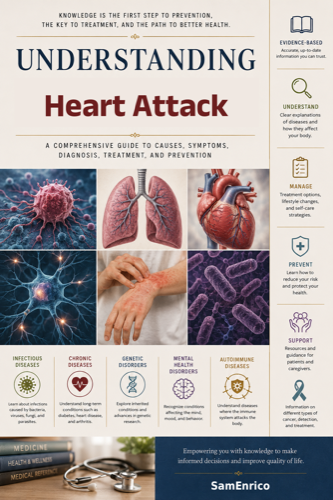
Non-FictionInformativeEducational
Understanding Heart Attack eBook
This disease publication, published by SamEnrico,
by Dorman Hiram
This disease publication, published by SamEnrico, covers Understanding Heart Attack
Formats
Free sample
Chapter 1: The Billion-Dollar Blind Spot--The majority of first-time heart attack victims had LDL cholesterol levels considered "normal" or even "optimal" by current medical guidelines. Let that sentence land. If you walked out of your doctor's office last week with a clean bill of health because your "bad cholesterol" was 110 mg/d L, you are not safe. You are simply undiagnosed.This is the billion-dollar blind spot of modern medicine. We spend enormous resources treating heart attacks once they happen—the stents, the bypass surgeries, the intensive care unit stays, the lifelong medication regimens.
But we spend almost nothing on finding the people who will have heart attacks before they have them. Worse, we give millions of people false reassurance based on incomplete data.I wrote this book because I got tired of telling families that their 48-year-old husband, father, or brother—the one who ran marathons, ate reasonably well, and had "normal" cholesterol—should not have died. But he did. And he died because the system failed him, not because his body failed him.Let me introduce you to someone I will call Mark. Mark was forty-three years old.
He was a triathlete. He had completed the Boston Marathon three times. He ate kale before kale was trendy. His resting heart rate was forty-eight beats per minute. His primary care physician had told him six months before his death that he was in "exemplary health." His LDL cholesterol was 112 mg/d L—well within the "near optimal" range of 100-129 mg/d L that the American Heart Association considers acceptable.One Saturday morning, Mark went for a twenty-mile training run.
He felt fine during the run—a little tired at mile eighteen, but that was normal for him. He finished, stretched, drank some water, and collapsed in his kitchen an hour later. His wife found him on the floor. The paramedics arrived within eight minutes. They never got his heart started again.The autopsy showed something that still haunts me.
Mark's coronary arteries had less than 50% narrowing by traditional measurement. By the standards of most cardiologists, he did not have "significant" coronary artery disease. But one of his plaques—a soft, inflamed, unstable plaque that was only 30% of the artery diameter—had ruptured. The rupture triggered a clot that completely occluded his left anterior descending artery, the so-called "widow-maker." Mark died of a heart attack caused by a blockage that no stress test would have caught and that no cholesterol panel would have predicted.Mark's story is not a rare outlier. It is the rule.The Paradox of Modern Cardiology Here is the central paradox of heart disease prevention today: the majority of first-time heart attack victims have LDL cholesterol levels that fall into the "low-risk" or "intermediate-risk" categories.
Study after study has confirmed this uncomfortable fact. The INTERHEART study, which examined 15,000 heart attack victims across 52 countries, found that lipid abnormalities—by standard measurements—failed to identify a huge percentage of patients who later had events.Why? Because the way we measure risk is fundamentally backwards.Most doctors still use something called the Framingham Risk Score or its newer cousin, the ASCVD Risk Calculator. These tools take your age, gender, total cholesterol, HDL cholesterol, blood pressure, smoking status, and diabetes status, and spit out a number: your 10-year risk of having a heart attack or stroke.Here is what these calculators do well. They are excellent at identifying people over sixty-five with multiple risk factors.
If you are seventy-two years old, have high blood pressure, have diabetes, smoke cigarettes, and have an LDL of 160, the calculator will correctly tell you that you are at high risk. You will get a statin. You will probably benefit from it.Here is what these calculators do terribly. They fail to identify the vast majority of people under sixty who will have heart attacks. Because the calculators are heavily weighted toward age, a forty-three-year-old with hypertension, smoking, diabetes, and an LDL of 180 might still get a "low" 10-year risk score simply because he is young.
The calculator assumes that risk accumulates slowly over decades. That assumption is correct for stable, calcified plaque. But it is catastrophically wrong for the soft, vulnerable plaque that kills people like Mark.This is not a failure of individual doctors. Most primary care physicians are doing exactly what their guidelines tell them to do. The guidelines say: use the risk calculator.
The guidelines say: treat to target. The guidelines say: statins are indicated for anyone with a 10-year risk over 7.5%. The guidelines say: you do not need advanced lipid testing or coronary imaging for asymptomatic patients.The guidelines are wrong. Not slightly wrong. Not outdated.
Dangerous wrong.Relative Risk versus Absolute Risk: The Deception Hiding in Plain Sight Before we go further, we need to understand one of the most deceptive statistical tricks in all of medicine: the difference between relative risk reduction and absolute risk reduction. This is not academic hair-splitting. This is the difference between being told a drug cuts your risk in half versus being told it reduces your risk from 2% to 1%.Let me give you an example. A pharmaceutical company runs a study on a new cholesterol drug. In the placebo group, 2% of patients have a heart attack over five years.
In the drug group, 1% of patients have a heart attack over five years. The company issues a press release: "New drug cuts heart attack risk by 50%!"That is the relative risk reduction. The absolute risk reduction is 1% (2% minus 1%). Both numbers are true. But which one makes you want to take the drug?Now apply this to your own risk calculation.
If your 10-year absolute risk of a heart attack is 2%, and a statin reduces that by 30% relative risk, your new absolute risk is 1.4%. You have reduced your risk by 0.6 percentage points. That is a meaningful reduction if you are the one person in 167 who benefits. But it is not the dramatic protection that "30% risk reduction" suggests.Here is where the blind spot becomes deadly. The risk calculators used in most doctors' offices vastly underestimate absolute risk for people under sixty because they are calibrated on populations that include many low-risk individuals.
Your doctor looks at your 5% 10-year risk and says, "You're fine, no need for medication." What your doctor does not see is that your 5% risk is based on average data. If you have high Lp(a)—one of the genetic time bombs we will discuss in Chapter 4—your real risk might be 15% or 20%. But the calculator does not ask about Lp(a). The calculator does not know what it does not measure.This is the billion-dollar blind spot. We spend billions on treating heart attacks, stents, bypass surgeries, and intensive care stays.
We spend almost nothing on finding the people with high Lp(a), high Apo B, high hs-CRP, or vulnerable plaque before they rupture. We have the technology to find these people. We have the medications to protect them. We just are not using the technology systematically.The Marathon Runner Who Should Have Been Fine Let me tell you another story, because Mark's story was not an isolated tragedy. I have seen variations of it dozens of times.A fifty-one-year-old woman I will call Sarah…
This is the end of the free sample. Get the eBook to keep going. Buy now
About this book
Details
- Author
- Dorman Hiram
- Publisher
- SamEnrico
- Language
- English
- Genre
- Non-Fiction, Informative, Educational
- Released
- 2026-06-02
- Pages (approx.)
- 144
- Available as
- eBook, Audiobook

Read better in the ZLOADR app
Your eBooks on your phone or tablet. Sign in with your SamEnrico account and start reading.
More by Dorman Hiram
 Iranian Revolution Israel AngleDorman Hiram$11.99
 PCOS Period Regulation HandbookDorman Hiram$11.99
 Dreams After Domestic ViolenceDorman Hiram$11.99
 Dream Trauma in First RespondersDorman Hiram$11.99
 The Phantom of the Met: How a Forger Outwitted the Art WorldDorman Hiram$11.99
 Huldra's Lure: The Forest's Forgotten BrideDorman Hiram$11.99
 How to Start a Brushes of Rubber Business (Beginners Guide)Dorman Hiram$11.99
 Channel Sales ManagerDorman Hiram$11.99
 Renewable Energy Workforce OutlookDorman Hiram$12.99
 European Master's On A Budget HandbookDorman Hiram$12.99
You may also like
 Hong Kong Handover 1997Dunn Johnnie$11.99
 Zumba For Postnatal Recovery CourseNeal Christian$11.99
 Zumba for BeginnersLadner Nikia$11.99
 YouTube Comment Mining GuideHumes Pandora$12.99
 Worry Box MeditationCarlin Rudy$11.99
 Workplace Stress MeditationNguyen Lynn$11.99
 Workplace Stress and Sleep RepairHawley Ivory$11.99
 Workplace Perfectionism CureDelaney Jeffry$11.99
 Workplace Injustice Anger GuideWallen Isabelle$11.99
 Work Addiction and Burnout LinkGreenwood Ester$11.99
 Women in Yoga and WellnessBeattie Galina$11.99
 Women in Stand Up ComedyChun Evangeline$11.99