
Non-FictionInformativeEducational
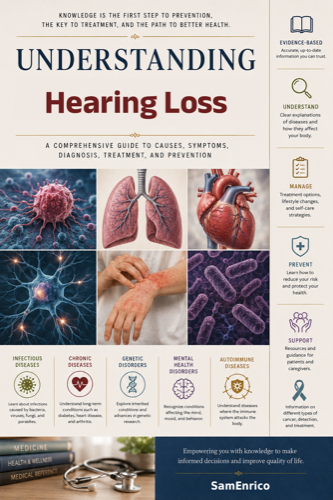
Understanding Hearing Loss eBook
This disease publication, published by SamEnrico,
This disease publication, published by SamEnrico, covers Understanding Hearing Loss
Formats
Free sample
Chapter 1: Cheers to Your Ears--–- Frank had been a rock drummer in the 1970s. Three tours, four albums, and a lifetime of ringing ears later, he sat in my office at age sixty-eight, his wife Margaret gripping the armrest of the chair beside him. "I'm not deaf," he said, for the third time. Margaret closed her eyes. "Frank, you haven't heard the doorbell in five years.
You thought our grandson's name was 'Matt' until we spelled it out. It's 'Max.' His name is Max."Frank shrugged. "Everyone mumbles these days."This scene has played out hundreds of thousands of times across every audiology clinic, ENT office, and kitchen table in America. The person with hearing loss genuinely believes the problem is external—everyone else speaks too softly, too quickly, or too unclearly. Meanwhile, their spouse, children, and friends have been adapting for years: speaking louder, repeating themselves, positioning themselves in the light, giving up on conversations in restaurants, and slowly, imperceptibly, withdrawing from the full richness of shared life.The staggering truth is that Frank is not unusual.
He is, in fact, perfectly average. The average person waits seven to ten years between first noticing a problem with their hearing and actually doing something about it. Seven to ten years of missed jokes, strained relationships, unnecessary fatigue, and accelerated brain aging. And the most heartbreaking part? The vast majority of that suffering is entirely preventable.This chapter is not a medical lecture.
It is an invitation to understand what hearing loss really is, why it matters far more than most people realize, and why taking action early is one of the single most powerful things you can do for your long-term health, your relationships, and your brain. By the end of this chapter, you will see hearing loss not as an inevitable, harmless part of getting older, but as a modifiable risk factor—something you can actually do something about, starting today.The Silent Epidemic Nobody Talks About Let's start with numbers, because numbers have a way of cutting through denial. Approximately 48 million Americans have some degree of hearing loss. That is nearly one in five adults. Among people over sixty-five, the prevalence jumps to one in three.
Among those over eighty, it is two in three. If hearing loss were a disease, it would be the third most common chronic condition in older adults, trailing only arthritis and high blood pressure.But here is the number that should stop you cold: of those 48 million people who could benefit from hearing aids, only about 16 percent have ever tried them. Eighty-four percent of people with treatable hearing loss are walking around untreated, struggling every day, exhausting themselves and their loved ones, for no good reason other than stigma, denial, and misinformation.The consequences of this mass avoidance are not trivial. They are not merely "inconvenient" or "annoying." They are, in many cases, life-altering and life-shortening. Untreated hearing loss is associated with a 30 to 40 percent faster rate of cognitive decline.
It doubles the risk of developing dementia. It triples the risk of falling. It increases the risk of depression by up to threefold, depending on severity. It is linked to higher rates of hospitalization, social isolation, and even earlier death.Let those numbers land. Doubles the risk of dementia.
Triples the risk of falls. Accelerates brain aging. This is not about missing punchlines or turning up the television. This is about fundamental brain health, physical safety, and the quality of every remaining year of your life.Why We Wait: The Psychology of Denial Understanding why people wait seven to ten years requires understanding how hearing loss tricks the brain. Unlike vision loss, which is immediately obvious—you cannot see the street sign, you cannot read the menu—hearing loss is insidious.
It creeps in so gradually that the brain compensates without conscious awareness.The brain is a prediction machine. It is constantly filling in gaps, making guesses, and constructing a coherent reality from incomplete sensory data. When you miss a few consonants in a sentence because you cannot hear high frequencies well, your brain automatically supplies the most likely missing sounds based on context. "Would you like some ___?" becomes "Would you like some tea?" even if the actual word was "coffee." Most of the time, the brain guesses correctly. You never notice the gap.This compensation happens automatically, unconsciously, and exhaustively.
The brain is working overtime to maintain the illusion of normal hearing. That is why people with hearing loss genuinely believe that everyone else has started mumbling. They have no direct experience of their own deficit because their brain has been covering for them, heroically but deceptively, for years.The cost of this compensation is fatigue. Real, physical, bone-deep exhaustion. By the end of a day of straining to hear, the brain of someone with untreated hearing loss has burned through significantly more cognitive energy than the brain of someone with normal hearing.
This leaves less energy available for memory, decision-making, emotional regulation, and all the other cognitive tasks of daily life. The person feels tired, irritable, and vaguely depleted—but they attribute it to aging, stress, or a bad night's sleep. They never connect it to their ears.The Wear and Tear of a Lifetime To understand why hearing loss happens, you need to understand the inner ear's tiny, irreplaceable machinery. Deep inside your skull, coiled like a snail shell, is the cochlea. Lining the cochlea are approximately fifteen thousand microscopic hair cells per ear.
These are not actual hairs like on your head. They are sensory cells with tiny bristle-like projections that bend in response to sound vibrations.When sound enters your ear, it creates waves in the fluid of the cochlea. Those waves bend the hair cells. Bent hair cells release chemical signals that trigger electrical impulses in the auditory nerve. Those electrical impulses travel to your brain, where they are interpreted as sound.
This entire process happens in milliseconds, thousands of times per second, without any conscious effort on your part.Here is the problem. Unlike the skin cells on your arm, which constantly regenerate and replace themselves, or the liver cells that can regrow after injury, the hair cells of the inner ear have almost no capacity for regeneration. When they are damaged or destroyed, they are gone for good. Evolution prioritized the exquisite sensitivity and speed of these cells over their ability to repair themselves. It was a design trade-off that made sense for our ancestors, who rarely lived long enough to experience significant age-related hearing loss.
But for modern humans living into our eighties and nineties, it is a design flaw with enormous consequences.What damages these irreplaceable hair cells? Three main culprits: aging, noise exposure, and genetics—often in combination.Aging alone, what doctors call presbycusis, causes a predictable pattern of hearing loss. The hair cells that respond to high-frequency sounds—the consonants that give speech its clarity and meaning—are the most vulnerable. They sit at the base of the cochlea, where sound waves enter first, taking the brunt of a lifetime of acoustic energy. As these high-frequency hair cells die off, speech starts to sound muffled, even when volume remains adequate.…
This is the end of the free sample. Get the eBook to keep going. Buy now
About this book
Details
- Author
- Arellano Anamaria
- Publisher
- SamEnrico
- Language
- English
- Genre
- Non-Fiction, Informative, Educational
- Released
- 2026-06-02
- Pages (approx.)
- 149
- Available as
- eBook, Audiobook

Read better in the ZLOADR app
Your eBooks on your phone or tablet. Sign in with your SamEnrico account and start reading.
More by Arellano Anamaria
 Hostage Crisis AftermathArellano Anamaria$11.99
 Dreams After Racial Trauma GuideArellano Anamaria$11.99
 CSAT Therapy Approaches WorkbookArellano Anamaria$11.99
 Teen PMS School Survival GuideArellano Anamaria$11.99
 The Dragonmaster's Gambit: A Medieval Espionage TaleArellano Anamaria$11.99
 The Codebreakers' War: How Women Cracked the Nazi EnigmaArellano Anamaria$11.99
 How to Start a Brush Back Made of Wood Business (Beginners Guide)Arellano Anamaria$11.99
 Renewable Energy Investment ForecastArellano Anamaria$12.99
 Cheapest Master's Degrees In Europe PrimerArellano Anamaria$12.99
 Business Unit LeaderArellano Anamaria$11.99
You may also like
 Hong Kong Handover 1997Dunn Johnnie$11.99
 Zumba For Postnatal Recovery CourseNeal Christian$11.99
 Zumba for BeginnersLadner Nikia$11.99
 YouTube Comment Mining GuideHumes Pandora$12.99
 Worry Box MeditationCarlin Rudy$11.99
 Workplace Stress MeditationNguyen Lynn$11.99
 Workplace Stress and Sleep RepairHawley Ivory$11.99
 Workplace Perfectionism CureDelaney Jeffry$11.99
 Workplace Injustice Anger GuideWallen Isabelle$11.99
 Work Addiction and Burnout LinkGreenwood Ester$11.99
 Women in Yoga and WellnessBeattie Galina$11.99
 Women in Stand Up ComedyChun Evangeline$11.99