
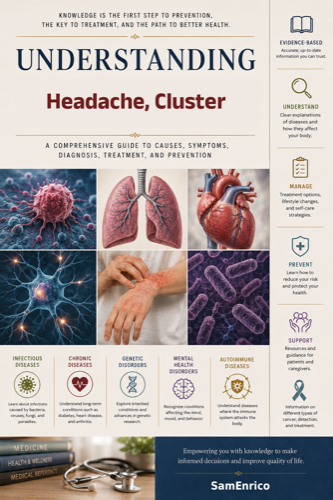
Non-FictionInformativeEducational
Understanding Headache, Cluster eBook
This disease publication, published by SamEnrico,
This disease publication, published by SamEnrico, covers Understanding Headache, Cluster
Formats
Free sample
Chapter 1: The Clockwork Devil...--The first time Mark felt it, he thought he was dying.It was 2:17 on a Tuesday morning in March. He had gone to bed at 11:00 PM, as always, after exactly two glasses of water and no alcohol—a routine he had followed for years without thinking much about it. The pain arrived like a railroad spike driven through his left eye socket. Not gradually. Not with warning.
One moment he was dreaming of something ordinary—a work meeting, a walk with his dog—and the next moment he was on his knees on the bedroom floor, his forehead pressed against the cold hardwood, making sounds he did not recognize as human.His wife, Elena, woke to the thumping. She found him rocking back and forth, his left eye streaming tears, his nostril on that side completely blocked, his eyelid drooping as if he had suffered a stroke. She called 911. The paramedics arrived nine minutes later. By then, the pain was gone.
Mark sat on the edge of the bed, confused, embarrassed, and exhausted. His left eye was still bloodshot. His face was wet. He had no explanation."Probably a sinus headache," the paramedic said. "Or a migraine variant.
Follow up with your primary care."That was the first of approximately four hundred attacks Mark would experience over the next seven years before someone finally told him the truth: he did not have sinus problems, dental issues, allergies, stress headaches, atypical migraines, or a brain tumor. He had cluster headache. And what he had just experienced—that railroad spike at 2:17 AM—was not the worst it would get. It was just the beginning.This book is for Mark. It is for Elena, who learned to keep a portable oxygen tank by the bed and to never, ever say "it's probably just a headache." It is for the neurologists who misdiagnosed him, not because they were bad doctors, but because cluster headache is one of the most poorly understood conditions in all of medicine.
And it is for the millions of people around the world who suffer in silence, believing they are alone in a pain so severe that suicide can seem like the only reliable abortive.Welcome to understanding the clockwork devil.The Most Painful Condition You Have Never Heard Of Let us begin with a simple statement that should shock you: cluster headache is widely considered by pain specialists to be the most severe pain condition known to medical science. Not migraine, which affects twelve percent of the population and has dominated headache research for decades. Not trigeminal neuralgia, the "suicide disease" of the face. Not complex regional pain syndrome, childbirth, kidney stones, or the pain of metastatic cancer to bone. Cluster headache.The evidence for this claim is not merely anecdotal, though the anecdotes are devastating.
In a 2016 survey published in the journal Cephalalgia, cluster headache patients rated their average attack pain at 9.7 out of 10 on a standard numerical rating scale, with 10 representing "the worst pain imaginable." For comparison, postpartum women rating their labor pain average 7.2. Kidney stone patients average 7.8. Migraine patients average 6.5. Cluster headache sits alone at the top of the pyramid, and when researchers have asked patients to compare cluster to other severe pain experiences they have personally endured—burns, fractures, surgery without adequate anesthesia—the answer is almost always the same: cluster is worse.But pain intensity alone does not capture the peculiar horror of this condition. Cluster headache is also distinguished by its rhythm, its reliability, and its relentless cruelty.
Unlike most pain conditions, cluster attacks do not come randomly. They arrive like a train on a schedule. Patients can tell you the exact time their first attack of the day will occur—2:17 AM, 1:45 PM, 9:30 PM—because it happens at that same time, day after day, week after week, until the cluster period ends. This predictability is not a mercy. It is a form of torture.
Imagine knowing that at 2:17 AM, you will experience the worst pain of your life, and that no matter what you do, you cannot stop it. That is the reality of living with cluster headache.The condition is also distinguished by its brevity. Migraine attacks can last three days. Cluster attacks last fifteen minutes to three hours, with most lasting forty-five to ninety minutes. On the surface, this sounds merciful—less total suffering per attack.
But patients will tell you the opposite is true. A three-day migraine is a long, grinding misery. A ninety-minute cluster attack is a detonation. The pain is so intense and so sudden that patients describe it as "explosive," "stabbing," "like a hot poker through the eye," "like someone is trying to scoop out my eyeball with a spoon." And because the attacks are brief, they can occur multiple times per day—up to eight times in a twenty-four-hour period during severe cluster bouts.The name "cluster" refers to the pattern in which these attacks occur. Patients experience periods of frequent attacks—"cluster bouts" or "cluster periods"—lasting weeks to months, followed by remission periods lasting months to years during which they are completely pain-free.
This cycling between agony and normalcy creates a unique psychological burden. During a cluster bout, patients live in terror of the next attack. During remission, they live in terror of the next bout. The sword of Damocles is never removed.The Hidden Epidemiology: Who Gets Cluster Headache and Why You Have Never Heard of It One of the most striking facts about cluster headache is that it is simultaneously common enough to affect millions of people worldwide and rare enough that most doctors will never diagnose a single case correctly.The prevalence is approximately 0.1 percent of the general population—one person in every thousand. In the United States, that translates to roughly 350,000 people.
Worldwide, approximately 3 million people live with cluster headache. These numbers place cluster headache in the category of "rare diseases" by medical definitions, but rare is a relative term. Three million people with cluster headache is three million people too many, and each of those people suffers an average of one to three attacks per day during cluster bouts. The total global burden of cluster headache pain is staggering.Historically, cluster headache was considered a condition that overwhelmingly affected middle-aged men. Early textbooks reported male-to-female ratios as high as 9:1.
This was not simply a biological reality—it was a diagnostic bias. Women with cluster headache were routinely misdiagnosed with migraine because doctors did not believe women could have "the male headache." As awareness has improved, the reported ratio has narrowed dramatically. Current estimates place the male-to-female ratio between 2:1 and 3:1, with some studies suggesting the true ratio may be even closer to 1.5:1. The condition is not a male disease. It is an underdiagnosed disease that has historically been ignored in women.Age of onset follows a predictable pattern.
The first attack most commonly occurs between the ages of twenty and forty, with a peak in the late twenties. However, cluster headache can begin in childhood (rare) and can first appear in the elderly (also rare). Once the condition establishes itself, it tends to follow a consistent pattern for each individual patient, though the pattern can change…
This is the end of the free sample. Get the eBook to keep going. Buy now
About this book
Details
- Author
- Provost Jaquelyn
- Publisher
- SamEnrico
- Language
- English
- Genre
- Non-Fiction, Informative, Educational
- Released
- 2026-06-03
- Pages (approx.)
- 160
- Available as
- eBook, Audiobook

Read better in the ZLOADR app
Your eBooks on your phone or tablet. Sign in with your SamEnrico account and start reading.
More by Provost Jaquelyn
 GAD Differential Diagnosis GuideProvost Jaquelyn$11.99
 PMS Breast Tenderness ReliefProvost Jaquelyn$11.99
 Iranian Revolution Women Mandatory VeilProvost Jaquelyn$11.99
 Refugee Trauma Dream GuideProvost Jaquelyn$11.99
 Dreams After Grief Trauma GuideProvost Jaquelyn$11.99
 The Monk and the X-Ray: A Medieval Mystery of Light and ShadowProvost Jaquelyn$11.99
 Anansi's Golden Web: The Spider's Grand DeceptionProvost Jaquelyn$11.99
 Bournonite MiningProvost Jaquelyn$11.99
 Wind Energy Growth ProjectionsProvost Jaquelyn$12.99
 Express Entry Provincial Nominee PrimerProvost Jaquelyn$12.99
 Ultimate Handbook Guide to West Yorkshire : (United Kingdom) Travel GuideProvost Jaquelyn$11.99
You may also like
 Hong Kong Handover 1997Dunn Johnnie$11.99
 Zumba For Postnatal Recovery CourseNeal Christian$11.99
 Zumba for BeginnersLadner Nikia$11.99
 YouTube Comment Mining GuideHumes Pandora$12.99
 Worry Box MeditationCarlin Rudy$11.99
 Workplace Stress MeditationNguyen Lynn$11.99
 Workplace Stress and Sleep RepairHawley Ivory$11.99
 Workplace Perfectionism CureDelaney Jeffry$11.99
 Workplace Injustice Anger GuideWallen Isabelle$11.99
 Work Addiction and Burnout LinkGreenwood Ester$11.99
 Women in Yoga and WellnessBeattie Galina$11.99
 Women in Stand Up ComedyChun Evangeline$11.99