
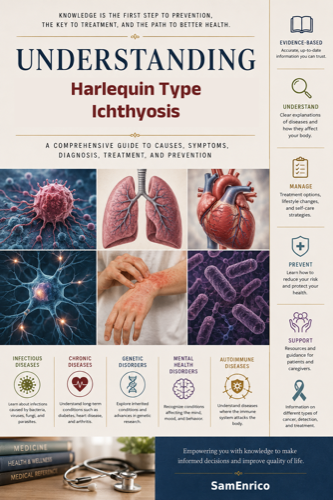
Non-FictionInformativeEducational
Understanding Harlequin Type Ichthyosis
This disease publication, published by SamEnrico,
by Durand Erwin
This disease publication, published by SamEnrico, covers Understanding Harlequin Type Ichthyosis
Formats
About this book
Free sample
Chapter 1: The 20 Square Feet--–- Your skin is the only organ you will ever see on another person. You will watch it flush with embarrassment, pale with fear, and shine with sweat after a run. You will touch it in greeting, in love, in the final moments of a life. And yet, for most of your waking hours, you will forget that it exists at all. Thirty thousand to forty thousand skin cells fall from your body every minute—a fine dust of dead material that collects on your keyboard, floats through your bedroom, and feeds the microscopic ecosystem of your home.
You do not notice this constant shedding because your skin, when it works, asks nothing of you. It seals your body against the outside world, regulates your temperature with unconscious precision, and repairs itself so seamlessly that you wake each morning without a single memory of yesterday's microscopic damages. This silent competence is the skin's greatest gift. It is also the reason that understanding skin—truly understanding what it does and what happens when it fails—requires looking at the cases where the gift is revoked.Harlequin Ichthyosis, known in medical literature as HI, is that revocation made visible. It is the rarest and most severe form of a family of genetic skin disorders called ichthyoses—a name derived from the Greek word ichthys, meaning fish, because the scaling pattern of milder forms resembles fish scales.
But the resemblance ends with the metaphor. In HI, the newborn emerges from the womb not with fish-like scales but with thick, plate-like armor that covers every surface of the body. These plates, which can measure up to a centimeter in thickness, are separated by deep, red fissures that crack and bleed with movement. The eyelids are pulled inside out (a condition called ectropion), exposing the delicate inner lining to air and debris. The lips are similarly pulled open (eclabium), leaving the mouth in a fixed oval that makes feeding nearly impossible.
The ears are flattened against the head, the fingers may be fused by scale, and the nose appears flattened or…
This is the end of the free sample. Get the eBook to keep going. Buy now
Contents
- Chapter 1
- Chapter 2
- Chapter 3
- Chapter 4
- Chapter 5
- Chapter 6
- Chapter 7
- Chapter 8
- Chapter 9
- Chapter 10
- Chapter 11
- Chapter 12
Details
- Author
- Durand Erwin
- Publisher
- SamEnrico
- Language
- English
- Genre
- Non-Fiction, Informative, Educational
- Released
- 2026-05-11
- Pages (approx.)
- 159
- Available as
- eBook, Audiobook

Read better in the ZLOADR app
Your eBooks on your phone or tablet. Sign in with your SamEnrico account and start reading.
More by Durand Erwin
 GAD Relapse Prevention PlanDurand Erwin$11.99
 Shapour Bakhtiar FailureDurand Erwin$11.99
 The MBSR for Chronic PainDurand Erwin$11.99
 PMS Insomnia Relief HandbookDurand Erwin$11.99
 Sexual Assault Nightmare RecoveryDurand Erwin$11.99
 The Velvet Heist: How a Socialite Outsmarted the MobDurand Erwin$11.99
 The Djinn's Lament: The Forgotten Songs of the Desert SpiritsDurand Erwin$11.99
 Remote Internship Guide For Global CompaniesDurand Erwin$12.99
 Artificial Intelligence Pricing OutlookDurand Erwin$12.99
 Anorthoclase MiningDurand Erwin$11.99
 How to Start a Hobby in PaintballingDurand Erwin$11.99
You may also like
 Hong Kong Handover 1997Dunn Johnnie$11.99
 Zumba For Postnatal Recovery CourseNeal Christian$11.99
 Zumba for BeginnersLadner Nikia$11.99
 YouTube Comment Mining GuideHumes Pandora$12.99
 Worry Box MeditationCarlin Rudy$11.99
 Workplace Stress MeditationNguyen Lynn$11.99
 Workplace Stress and Sleep RepairHawley Ivory$11.99
 Workplace Perfectionism CureDelaney Jeffry$11.99
 Workplace Injustice Anger GuideWallen Isabelle$11.99
 Work Addiction and Burnout LinkGreenwood Ester$11.99
 Women in Yoga and WellnessBeattie Galina$11.99
 Women in Stand Up ComedyChun Evangeline$11.99