
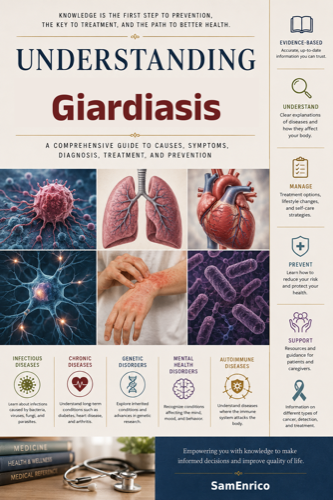
Non-FictionInformativeEducational
Understanding Giardiasis eBook
This disease publication, published by SamEnrico,
This disease publication, published by SamEnrico, covers Understanding Giardiasis
Formats
Free sample
Chapter 1: The Unseen Passenger--In 1681, a Dutch cloth merchant named Antonie van Leeuwenhoek did something no one had ever done before. He aimed his self-ground microscope at a drop of his own diarrheal stool and saw a world teeming with life. Among the swimming bacteria and swirling debris, he observed a peculiar creature—pear-shaped, with multiple flagella whipping like tiny oars, moving with a distinctive "falling leaf" motion. He called it a "little animalcule." He had no idea that he had just discovered one of the most common parasitic infections on Earth.Nearly three hundred years would pass before scientists would fully understand what Leeuwenhoek had seen. For most of that time, Giardia was considered a harmless commensal—an innocent passenger in the human gut, no more dangerous than the bacteria that ferment fiber in the colon.
Doctors dismissed it. Textbooks ignored it. Patients with chronic diarrhea were told it was "nerves" or "irritable bowel" or "just stress."They were wrong. Deadly wrong.Today, we know that Giardia lamblia—also known as G. duodenalis and G.
intestinalis—infects nearly 300 million people every year. It is the most commonly identified intestinal parasite in the developed world and one of the leading causes of diarrheal disease in children in resource-limited countries. It is not a harmless passenger. It is a pathogen. And it has been hiding in plain sight for centuries.This chapter is about the scale of that hidden epidemic.
It is about the history of a parasite that was ignored for too long, the populations most at risk, the staggering global burden of disease, and the socioeconomic forces that allow Giardia to thrive. It is the foundation upon which the rest of this book is built. Because before you can understand how to diagnose, treat, or prevent giardiasis, you must first understand the scope of the problem.The History of a Neglected Pathogen Leeuwenhoek's discovery in 1681 was remarkable, but it was also a dead end. Microscopy was in its infancy. The connection between microorganisms and disease had not yet been established.
For the next two centuries, Giardia remained a curiosity—a strange creature that appeared in the stool of some people with diarrhea and some people without. Without a clear causal link, the parasite was dismissed as an incidental finding.The first step toward understanding came in 1859, when Czech physician Vilem Lambl described the parasite in greater detail, giving it the name Cercomonas intestinalis. Later, the name was changed to Giardia lamblia, honoring both Lambl and French biologist Alfred Giard, who studied the parasite independently. But even with a name, the parasite's role in disease remained controversial.The great debate of the early 20th century: Some researchers argued that Giardia was a true pathogen, causing a distinct clinical syndrome of diarrhea, malabsorption, and weight loss. Others maintained that it was a harmless commensal that happened to be more common in people with diarrhea because diarrhea created a favorable environment for the parasite to multiply.
Without controlled studies, the debate could not be resolved.The turning point came in the 1970s and 1980s, with a series of outbreaks that forced the medical establishment to pay attention. The most famous was the 1978 outbreak in Aspen, Colorado, where 47% of the town's population developed giardiasis after the municipal water supply became contaminated with sewage from beavers. The Aspen outbreak was a wake-up call: Giardia was not just a problem in developing countries. It was in the water of wealthy ski towns. It was in the taps of American homes.
It was everywhere.The beaver connection: The Aspen outbreak also introduced the world to the concept of zoonotic transmission—the spread of disease from animals to humans. The beavers living in the watershed had become infected from human sewage, then shed cysts back into the water, creating a cycle of reinfection that the town's water treatment plant was not designed to break. This discovery fundamentally changed how public health officials thought about water safety. It was not enough to treat human sewage. The animals upstream mattered too.The Global Burden: Numbers That Demand Attention Giardiasis affects approximately 300 million people annually.
This number is not a guess. It is based on systematic reviews of prevalence studies from every region of the world, adjusted for underreporting and diagnostic limitations. But what does 300 million actually mean?In developed nations (North America, Western Europe, Australia, Japan), the prevalence of giardiasis is 2-8%. In the United States alone, the Centers for Disease Control and Prevention estimates approximately 15,000 confirmed cases per year, but this is almost certainly an underestimate. Many cases go undiagnosed.
Many diagnosed cases go unreported. The true number is likely five to ten times higher.In resource-limited countries (Sub-Saharan Africa, Southeast Asia, parts of South America and the Middle East), the prevalence soars to 20-30% and higher. In some communities, nearly every child has been infected by the age of five. In the poorest slums of Dhaka, Bangladesh, prevalence exceeds 50% in children under ten. These are not outbreaks.
They are endemic. The parasite is a constant presence, like the air they breathe or the water they drink.The asymptomatic iceberg: For every person with symptomatic giardiasis, there are several who carry the parasite without symptoms. These asymptomatic carriers shed cysts in their stool, contaminating the environment and infecting others, all while feeling perfectly fine. In some studies, asymptomatic carriers outnumber symptomatic cases by four to one. The iceberg is massive, and most of it is hidden beneath the surface.Who Is at Risk?
The Unequal Geography of Infection Giardiasis does not affect all people equally. It is a disease of inequity, driven by poverty, infrastructure, and circumstance. Understanding who is at risk is essential for prevention.Children Under Five Children are the most vulnerable population. Their immune systems are still developing. Their hygiene practices are poor—they put things in their mouths, they do not wash their hands reliably, they play in dirt.
And the consequences of infection are more severe for children than for adults.Stunting: Repeated giardiasis infections in early childhood are linked to stunted growth. Studies from Bangladesh, Peru, and Kenya have found that children with frequent Giardia infections are, on average, 2-4 centimeters shorter than their uninfected peers. This may not sound like much, but for a child in a resource-limited setting, those lost centimeters represent lost potential—reduced cognitive development, lower school performance, diminished lifetime earning capacity.Cognitive deficits: The link between Giardia and cognitive development is less well understood than the link with stunting, but the evidence is concerning. Several studies have found that children with a history of chronic giardiasis score lower on tests of memory, attention, and problem-solving. The mechanism is not clear—it may be the direct effect of the parasite on nutrient absorption, or it may be the indirect effect of chronic illness on school attendance and engagement.
Either way, the association is real.The Immunocompromised Patients with weakened immune systems are at risk for severe, protracted giardiasis that does not respond well to standard treatment. This includes:HIV/AIDS patients, especially those with CD4 counts below 150Organ transplant recipients on immunosuppressive medications (tacrolimus, mycophenolate, cyclosporine)Patients undergoing chemotherapy for cancer Individuals with primary immunodeficiency disorders, particularly Ig A deficiency In these populations…
This is the end of the free sample. Get the eBook to keep going. Buy now
About this book
Details
- Author
- Sikes Eusebio
- Publisher
- SamEnrico
- Language
- English
- Genre
- Non-Fiction, Informative, Educational
- Released
- 2026-06-02
- Pages (approx.)
- 121
- Available as
- eBook, Audiobook

Read better in the ZLOADR app
Your eBooks on your phone or tablet. Sign in with your SamEnrico account and start reading.
More by Sikes Eusebio
 The Eye Disease Genetic TestSikes Eusebio$11.99
 Pitching With Confidence CourseSikes Eusebio$11.99
 The Library Reading NookSikes Eusebio$11.99
 Japanese Railway Modernization GuideSikes Eusebio$11.99
 Anansi Weaves the Sky: The Spider’s Grandest DeceptionSikes Eusebio$11.99
 The Janus Effect: The Twin Who Outlived HistorySikes Eusebio$11.99
 Sam Walton Cash Turnover PrimerSikes Eusebio$12.99
 Certification Cost AnalysisSikes Eusebio$12.99
 Global Service Desk AnalystSikes Eusebio$11.99
 How to Start a Solid Waste Collection BusinessSikes Eusebio$11.99
You may also like
 Hong Kong Handover 1997Dunn Johnnie$11.99
 Zumba For Postnatal Recovery CourseNeal Christian$11.99
 Zumba for BeginnersLadner Nikia$11.99
 YouTube Comment Mining GuideHumes Pandora$12.99
 Worry Box MeditationCarlin Rudy$11.99
 Workplace Stress MeditationNguyen Lynn$11.99
 Workplace Stress and Sleep RepairHawley Ivory$11.99
 Workplace Perfectionism CureDelaney Jeffry$11.99
 Workplace Injustice Anger GuideWallen Isabelle$11.99
 Work Addiction and Burnout LinkGreenwood Ester$11.99
 Women in Yoga and WellnessBeattie Galina$11.99
 Women in Stand Up ComedyChun Evangeline$11.99