
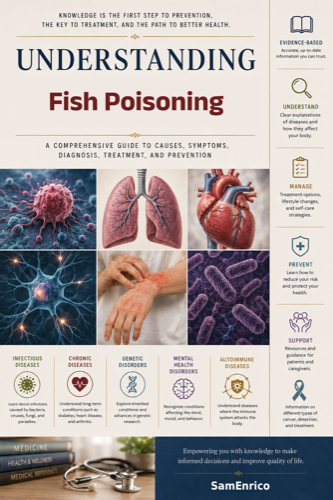
Non-FictionInformativeEducational
Understanding Fish Poisoning eBook
This disease publication, published by SamEnrico,
This disease publication, published by SamEnrico, covers Understanding Fish Poisoning
Formats
Free sample
Chapter 1: The Silent Invader...--– The first time Sarah felt something was wrong, she was holding a glass of white wine on a balcony overlooking the turquoise waters of the Bahamas. The sun was setting. She was on what was supposed to be the vacation of a lifetime. Two hours earlier, she had eaten a grilled grouper sandwich at a beachside bar that a local had recommended as "the best on the island." The fish was flaky, perfectly seasoned, and tasted like the ocean itself. She had no reason to suspect that this single meal would become the dividing line in her life—the "before" and the "after."The first symptom was subtle, almost dismissible.
A faint tingling in her fingertips, as if her hands had fallen asleep but were now waking up. She shook them out, assuming she had been leaning on the balcony railing for too long. Then came the nausea. Not the urgent, cramping kind that sends you running to the bathroom, but a deep, rolling queasiness that settled into her stomach like a stone. By the time she made it back to her hotel room, the vomiting had begun.
Violent. Relentless. By morning, she would be curled in a fetal position on the bathroom floor, the tile cold against her cheek, wondering if she was dying.She was not dying. But in many ways, the woman who checked into that hotel in the Bahamas never checked out. What returned home to Boston two weeks later was someone else entirely—someone who would spend the next eighteen months being told by doctors that her symptoms were "anxiety," "chronic fatigue syndrome," "fibromyalgia," "possibly multiple sclerosis," and finally, "there's nothing wrong with you; it's all in your head."The fish that did this to her was not rotten.
It was not undercooked. It did not smell strange or taste unusual. It was a perfectly healthy, perfectly beautiful grouper that had spent its life grazing on a coral reef. And because of that, because of where it had eaten and what it had eaten and who had eaten it, Sarah would spend years relearning how to live in her own body.This book is the map Sarah wishes she had.Beyond the Stomach Bug When most people hear the words "food poisoning," they think of a predictable sequence: eat something questionable, spend a miserable night vomiting or dealing with diarrhea, and wake up the next day feeling fragile but functional. They think of undercooked chicken at a barbecue, leftover rice that sat out too long, or a dodgy takeaway that tasted a little off.
They think of a few hours of discomfort and a valuable lesson about refrigeration.That is not what this book is about.The fish poisonings described in these pages belong to a different category entirely—a category for which the word "poisoning" is almost too gentle. These are not infections caused by bacteria that your immune system can fight off with a little rest and fluids. These are intoxications caused by some of the most potent natural toxins known to science. They are tasteless, odorless, colorless, and completely resistant to cooking, freezing, smoking, pickling, or any other food preservation method humanity has devised in the past ten thousand years.Consider this comparison: the lethal dose of tetrodotoxin, the poison found in pufferfish, is approximately 1 milligram for an adult human. That is roughly equivalent to a single grain of table salt.
One milligram. By weight, tetrodotoxin is more than one thousand times more toxic than cyanide. And yet every year, thousands of people around the world willingly eat pufferfish in Japanese restaurants, paying hundreds of dollars for the privilege of flirting with death. Most walk away fine. Some do not.Ciguatera poisoning, the most common non-bacterial fish poisoning on the planet, affects somewhere between 50,000 and 500,000 people annually, though the true number is almost certainly higher because most cases go undiagnosed or are misdiagnosed.
Victims experience vomiting and diarrhea within hours, followed by a bizarre neurological syndrome that includes the famous "hot-cold reversal"—where a cool breeze feels like a blowtorch and an ice cube feels like a branding iron. For the unlucky ten to twenty percent, these neurological symptoms never fully resolve. They live with them for years. Decades. Sometimes for the rest of their lives.These are not anecdotes.
These are the data points that global health agencies are only beginning to track systematically. And the data points are multiplying.Why This Book Exists The seafood industry is vast, globalized, and largely unregulated when it comes to natural toxins. A shipping container full of frozen grouper fillets caught in the Caribbean can arrive in a warehouse in Chicago within seventy-two hours. Those fillets might contain ciguatoxins at levels that would poison half the people who eat them. But because there is no routine testing, because the toxins cannot be seen or smelled or cooked away, because the symptoms mimic so many other conditions, those fillets will be sold.
People will eat them. Some will get sick. Most will never know why.The medical community, for its part, is not well prepared. Most emergency room physicians have never seen a case of Ciguatera. Many have never even heard of it, unless they trained in South Florida, the Caribbean, or certain parts of the Pacific.
As a result, patients who present with flushing and palpitations after eating tuna are diagnosed with anxiety or a panic attack—never mind that the tuna was served at a beachside restaurant in the middle of a sweltering summer day without adequate refrigeration. Patients with mysterious neurological symptoms that wax and wane are sent to neurologists who order MRIs, EMGs, and spinal taps, all of which come back normal, leading to the crushing diagnosis of "medically unexplained symptoms" or, worse, "conversion disorder"—the medical euphemism for "it's all in your head."Sarah, the woman from the opening of this chapter, was told by a neurologist at one of Boston's most prestigious teaching hospitals that her symptoms were "consistent with a somatization disorder." She was referred to a psychiatrist. The psychiatrist, to his credit, listened to her entire story—the fish sandwich, the vomiting, the tingling hands, the strange reversal of hot and cold that made showers unbearable and air conditioning feel like standing in a freezer. He asked her a simple question that no one else had thought to ask: "Have you ever heard of Ciguatera poisoning?"She had not. Neither had her primary care doctor, her gastroenterologist, or the first neurologist she saw.
But the psychiatrist had grown up in Puerto Rico, where Ciguatera was a familiar hazard of island life. He recognized the constellation of symptoms immediately. He referred her to a toxicologist at the Massachusetts Poison Control Center. Within a week, she had a diagnosis. Within a month, she had a treatment plan.
The relief of being believed, of having a name for the thing that had stolen two years of her life, was almost as powerful as the medications that finally began to turn her symptoms around.Sarah is one of the lucky ones.A Word About Terminology Before we go any further, we need to get precise about the words…
This is the end of the free sample. Get the eBook to keep going. Buy now
About this book
Details
- Author
- Chisolm Tarah
- Publisher
- SamEnrico
- Language
- English
- Genre
- Non-Fiction, Informative, Educational
- Released
- 2026-05-11
- Pages (approx.)
- 136
- Available as
- eBook, Audiobook

Read better in the ZLOADR app
Your eBooks on your phone or tablet. Sign in with your SamEnrico account and start reading.
More by Chisolm Tarah
 Menopause Skin Aging GuideChisolm Tarah$11.99
 The Caregiver Self Compassion GuideChisolm Tarah$11.99
 The Overland ArchaeologistChisolm Tarah$11.99
 Sleep Meditation for TherapistsChisolm Tarah$11.99
 Private Military Contractor StressChisolm Tarah$11.99
 The Great Balloon Race: How a Tiny Town Defied Gravity in 1852Chisolm Tarah$11.99
 Sir Ronald Cohen HandbookChisolm Tarah$12.99
 Mentor Review of Business CaseChisolm Tarah$12.99
 Tech Intermediate InstallChisolm Tarah$11.99
 A Beginners Guide to Call Bridge (Volume 1)Chisolm Tarah$11.99
You may also like
 Hong Kong Handover 1997Dunn Johnnie$11.99
 Zumba For Postnatal Recovery CourseNeal Christian$11.99
 Zumba for BeginnersLadner Nikia$11.99
 YouTube Comment Mining GuideHumes Pandora$12.99
 Worry Box MeditationCarlin Rudy$11.99
 Workplace Stress MeditationNguyen Lynn$11.99
 Workplace Stress and Sleep RepairHawley Ivory$11.99
 Workplace Perfectionism CureDelaney Jeffry$11.99
 Workplace Injustice Anger GuideWallen Isabelle$11.99
 Work Addiction and Burnout LinkGreenwood Ester$11.99
 Women in Yoga and WellnessBeattie Galina$11.99
 Women in Stand Up ComedyChun Evangeline$11.99