
Non-FictionInformativeEducational
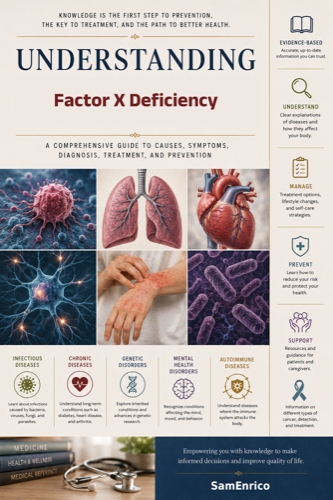
Understanding Factor X Deficiency eBook
This disease publication, published by SamEnrico,
This disease publication, published by SamEnrico, covers Understanding Factor X Deficiency
Formats
Free sample
Chapter 1: The Missing Switch...-- Every time a child falls off a bicycle, a grandmother bumps her hip against a kitchen counter, or a teenager takes a punch during a hockey game, the same microscopic miracle unfolds inside their bodies. Within seconds, a cascade of proteins—some floating quietly in the blood, others clinging to the walls of damaged blood vessels—snap into action like a series of dominoes falling in perfect sequence. The bleeding stops. The bruise fades. Life continues.
But for a person with Factor X deficiency, that domino chain has a missing piece. The cascade stalls. The bleeding does not stop. And the question that echoes through every emergency room, every hematology consult, and every exhausted parent's mind is simple: Why?This chapter answers that question. It is not a dry recitation of medical facts.
It is the story of a protein you have never heard of—Factor X—that holds the power to stop your bleeding or, when missing, to unravel the fabric of ordinary life. By the end of this chapter, you will understand what Factor X is, where it comes from, how it works, and why a deficiency in this single protein produces such a bewildering range of symptoms. More importantly, you will understand that you are not alone in this journey and that knowledge itself is the first and most powerful form of treatment.The Discovery of Factor X: A Medical Detective Story In the early 1950s, the field of blood coagulation was a chaotic frontier. Researchers had identified several clotting factors—fibrinogen, prothrombin, Factor V, Factor VII, Factor VIII, and Factor IX—but the cascade model was incomplete. Patients with unexplained bleeding disorders continued to baffle hematologists.
Their blood tests did not fit neatly into the categories of hemophilia A (Factor VIII deficiency) or hemophilia B (Factor IX deficiency). Something else was missing.Two researchers working independently—Rufus Stuart in the United States and John Prower in the United Kingdom—identified the same missing factor within months of each other. They named it the Stuart-Prower factor, later standardized as Factor X. The discovery was not glamorous. There were no press conferences or Nobel Prizes.
Instead, there were carefully labeled test tubes, frustrated patients who had been misdiagnosed for years, and the quiet satisfaction of solving a biological puzzle.What Stuart and Prower discovered was a serine protease enzyme—a type of protein that cuts other proteins to activate them. Factor X sits at the precise midpoint of the coagulation cascade, the critical junction where the two pathways of clotting (the intrinsic pathway and the extrinsic pathway) converge into a single common pathway. In simpler terms, Factor X is the on switch. Without it, the entire clotting process grinds to a halt.The Coagulation Cascade: Understanding the Domino Chain To understand Factor X deficiency, you must first understand the coagulation cascade. Do not let the name intimidate you.
A cascade is simply a sequence of events where each step triggers the next. Think of a line of dominoes standing on end. The first domino falls and knocks over the second, which knocks over the third, and so on until the final domino—the formation of a stable blood clot—falls into place.The coagulation cascade has three phases. The first phase, called the intrinsic pathway, is triggered when blood comes into contact with damaged blood vessel walls. It involves factors XII, XI, IX, and VIII.
The second phase, called the extrinsic pathway, is triggered by trauma to the tissues surrounding a blood vessel. It involves factor VII. These two pathways are like two rivers flowing toward the same lake. They converge at a single point: the activation of Factor X.Factor X sits at the confluence. When Factor X is activated—converted from its inactive form (Factor X) to its active form (Factor Xa)—it becomes a molecular switch.
It cleaves prothrombin (Factor II) into thrombin (Factor IIa). Thrombin then cleaves fibrinogen into fibrin, which forms a mesh-like net that traps platelets and red blood cells, creating a stable clot.This is the third phase: the common pathway. It involves Factor X, Factor V, prothrombin, and fibrinogen. If Factor X is missing or dysfunctional, the common pathway fails. The dominoes stop falling.
The clot does not form.The Analogy of the Factory Imagine a factory that produces a critical product—say, a fire extinguisher. The factory has multiple assembly lines that feed into a final packaging line. One assembly line produces the metal canister (intrinsic pathway). Another produces the pressurized gas (extrinsic pathway). Both send their components to a central workstation where a worker—let us call him X—attaches the valve that allows the gas to release.
Without the valve, the canister is useless. The gas cannot escape. The fire extinguisher fails.Factor X is that valve. You can have perfect canisters and perfect gas, but if the valve is missing, the extinguisher does not work. Similarly, you can have all the other clotting factors functioning perfectly, but if Factor X is deficient or dysfunctional, the clot does not form.This analogy explains why Factor X deficiency is so dangerous.
It is not a problem with a single assembly line. It is a problem with the final common pathway. Bleeding can occur anywhere, at any time, from any injury, because the entire system collapses.Inherited Factor X Deficiency: The Genetics of a Rare Disease Factor X deficiency is most commonly inherited as an autosomal recessive disorder. Those two words—autosomal and recessive—carry the weight of genetics. Let us break them down.Autosomal means that the gene responsible for Factor X production is located on one of the autosomes (chromosomes 1 through 22), not on the sex chromosomes (X and Y).
This is crucial because it means the disorder affects males and females equally. Many people mistakenly assume that all bleeding disorders are like hemophilia—carried on the X chromosome and affecting almost exclusively males. Factor X deficiency does not follow that pattern. A daughter is just as likely as a son to inherit the disorder.The specific gene is called the F10 gene, and it lives on chromosome 13. This gene contains the instructions for building the Factor X protein.
When the F10 gene is mutated, the instructions are garbled, and the resulting protein may be missing, shortened, misshapen, or completely absent.Recessive means that a person must inherit two copies of the mutated gene—one from each parent—to develop the deficiency. A person who inherits only one mutated copy is called a carrier. Carriers typically have no symptoms because their single working copy of the F10 gene produces enough Factor X (usually 50-70% of normal activity) to support normal clotting.This creates a pattern that surprises many families. Two healthy parents who are both carriers have a 25% chance with each pregnancy of having a child with Factor X deficiency. They have a 50% chance of having a child who is a carrier (like themselves) and a 25% chance of having a child with two normal copies who is completely unaffected.The parents themselves may have no idea they are carriers.
There is no family history of bleeding disorders. The first indication may be a newborn who bleeds excessively from the…
This is the end of the free sample. Get the eBook to keep going. Buy now
About this book
Details
- Author
- Kimball Sheron
- Publisher
- SamEnrico
- Language
- English
- Genre
- Non-Fiction, Informative, Educational
- Released
- 2026-06-02
- Pages (approx.)
- 144
- Available as
- eBook, Audiobook

Read better in the ZLOADR app
Your eBooks on your phone or tablet. Sign in with your SamEnrico account and start reading.
More by Kimball Sheron
 Costochondritis MindfulnessKimball Sheron$11.99
 Hypnotic Focus For ArcheryKimball Sheron$11.99
 Emotional Eating AffirmationsKimball Sheron$11.99
 Intensive Care Doctor BurnoutKimball Sheron$11.99
 The Name Memory SystemKimball Sheron$11.99
 Neon Mirage: The Synthetic Dreamers of 1980s TokyoKimball Sheron$11.99
 Procurement in AgricultureKimball Sheron$12.99
 Data Visualization Formula That WorksKimball Sheron$12.99
 Pharmacy Compliance AuditorKimball Sheron$11.99
 How to Start a Cycles Fitted With An Auxiliary Engine Business (Beginners Guide)Kimball Sheron$11.99
You may also like
 Hong Kong Handover 1997Dunn Johnnie$11.99
 Zumba For Postnatal Recovery CourseNeal Christian$11.99
 Zumba for BeginnersLadner Nikia$11.99
 YouTube Comment Mining GuideHumes Pandora$12.99
 Worry Box MeditationCarlin Rudy$11.99
 Workplace Stress MeditationNguyen Lynn$11.99
 Workplace Stress and Sleep RepairHawley Ivory$11.99
 Workplace Perfectionism CureDelaney Jeffry$11.99
 Workplace Injustice Anger GuideWallen Isabelle$11.99
 Work Addiction and Burnout LinkGreenwood Ester$11.99
 Women in Yoga and WellnessBeattie Galina$11.99
 Women in Stand Up ComedyChun Evangeline$11.99