
Non-FictionInformativeEducational
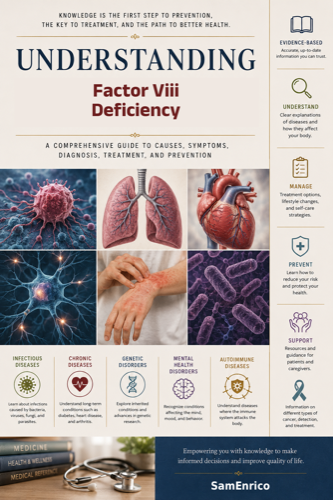
Understanding Factor Viii Deficiency eBook
This disease publication, published by SamEnrico,
This disease publication, published by SamEnrico, covers Understanding Factor Viii Deficiency
Formats
Free sample
Chapter 1: The Royal Curse...--– In the early morning hours of December 14, 1861, Prince Albert of Saxe-Coburg and Gotha lay dying at Windsor Castle. His wife, Queen Victoria—the most powerful monarch on earth—watched helplessly as her husband drifted in and out of consciousness. The official cause of death was listed as typhoid fever. But those who attended the royal family noticed something peculiar. Throughout his final illness, Prince Albert did not bleed.
He did not bruise. His joints did not swell with mysterious blood. And yet, his death would set in motion a chain of events that would eventually expose one of the most extraordinary genetic mysteries in human history—a secret hidden in the blood of nearly every major royal house in Europe.The truth was that Prince Albert was not the victim of the bleeding curse. His wife, Queen Victoria, was its silent carrier. And their children, grandchildren, and great-grandchildren would scatter this genetic time bomb across the thrones of Russia, Germany, Spain, and Prussia.
For more than a century, physicians would call it "The Royal Disease"—a mysterious affliction that caused young princes to bleed to death from the smallest injuries, that turned childhood tumbles into death sentences, that transformed the grandest palaces into houses of horror. They did not know what caused it. They could not treat it. And for generations, they watched in helpless fascination as the most privileged young men in the world died from a condition that seemed to spare their sisters entirely.This book is about that condition. But it is also about something far larger than the tragedies of long-dead princes.
It is about the remarkable journey of human understanding—from complete ignorance to molecular mastery, from fatal mystery to manageable chronic condition, from the terror of uncontrolled bleeding to the hope of genetic cure. This is the story of hemophilia A, also known as Factor VIII deficiency. And to understand where we stand today, we must first understand where we came from.The First Descriptions: Blood and Mystery The earliest known medical descriptions of what we now recognize as hemophilia A appear not in royal court records but in Jewish texts from the second century AD. The Talmud, a central text of Rabbinic Judaism, contains a remarkable passage discussing circumcision. It notes that if a mother has lost two sons to bleeding following circumcision, her subsequent sons should not be circumcised.
This is extraordinary not merely as a religious accommodation but as a clinical observation. Without understanding genetics, without knowing anything about the clotting cascade, without any concept of X-linked inheritance, these ancient scholars had identified the familial pattern of a bleeding disorder. They understood that the risk passed through mothers. They understood that it affected only sons. They had, in essence, described the inheritance pattern of hemophilia A more than seventeen centuries before anyone would explain why it happened.Jump forward to the tenth century.
Albucasis, an Arab physician working in Córdoba, Spain, wrote about families in which males died from uncontrolled bleeding after minor injuries. He described what we would now call hemarthrosis—bleeding into joints—though he lacked the vocabulary to name it. "I have seen men," he wrote, "who are wounded in the smallest way, and the blood does not stop flowing until they perish. And I have seen brothers of these men die in the same manner." Again, the pattern was clear: males afflicted, females spared, transmission through the maternal line.But these observations remained scattered and unsystematized. There was no name for the condition.
There was no understanding of its mechanism. There was no treatment beyond prayer, pressure, and hope.The Physician Who Named the Invisible The modern history of hemophilia begins in 1803 with a Philadelphia physician named Dr. John Conrad Otto. A graduate of the University of Pennsylvania, Otto was the first person to systematically study what he called "a hemorrhagic disposition existing in certain families." He traced affected families through multiple generations, noting that "the females are exempt but are capable of transmitting the affection to their sons." This was not yet a discovery of cause—Otto had no idea that blood plasma contained invisible proteins necessary for clotting—but it was a breakthrough in description. He had named the pattern.
He had given physicians something to look for.Fifty years later, in 1853, a British physician named Dr. Wickham Legg published what is widely considered the first definitive textbook description of hemophilia. Legg noted that affected males bled into their joints "with such frequency that the knees, ankles, and elbows become permanently stiffened and deformed." He described the psychological toll as well: "The patient lives in constant dread of the smallest injury, knowing that a cut finger may prove fatal and that a bump on the knee may lead to weeks of suffering." Legg also observed something that would later become critically important: affected males who survived into adulthood often experienced fewer joint bleeds than affected boys. This was the first hint that the severity of hemophilia might change with age—though again, the mechanism remained utterly mysterious.Then came the name itself. In 1854, a German physician named Dr.
Friedrich Hopff coined the term "hemophilia" from the Greek words haima (blood) and philia (affection or love). It was an odd choice—"affection for blood" or "love of bleeding"—but it stuck. Hopff and his colleague Dr. Adolph Schonlein were the first to distinguish hemophilia from other bleeding disorders, noting that patients with hemophilia did not bruise more easily than normal individuals (contradicting earlier assumptions) but rather bled for longer when injured. This distinction remains clinically useful today: the easy bruising of von Willebrand disease is different from the prolonged bleeding of Factor VIII deficiency.The Royal Disease: Hemophilia in the Courts of Europe But no medical description could capture the public imagination like the sufferance of royalty.
And no family would come to define this condition more than the descendants of Queen Victoria.The story begins with Victoria herself. Born in 1819, she was an apparently healthy child who grew into a robust young woman. She had no bleeding symptoms. She had no unusual bruising. By all external measures, she was completely unaffected by the condition she would unknowingly transmit to her descendants.
But Victoria's genetic code carried a mutation—a specific alteration in the gene that encodes Factor VIII, located on her X chromosome. We know this now. She could not have known it then. And that ignorance changed the course of European history.Victoria married her cousin, Prince Albert of Saxe-Coburg and Gotha, in 1840. Together, they had nine children: four sons and five daughters.
None of Victoria's sons had hemophilia. None of her daughters had bleeding symptoms. But two of her daughters—Princess Alice and Princess Beatrice—inherited the mutated X chromosome, making them carriers. And it was through these two women that the Royal Disease spread across Europe.The first tragedy struck the family that appeared, for a time, to have escaped. Victoria's son, Prince Leopold, Duke of Albany, was born in 1853.
Unlike his brothers, Leopold inherited his mother's mutated X chromosome. He had hemophilia. His childhood was a catalog of bleeding crises: a bumped elbow leading to…
This is the end of the free sample. Get the eBook to keep going. Buy now
About this book
Details
- Author
- Richard Danilo
- Publisher
- SamEnrico
- Language
- English
- Genre
- Non-Fiction, Informative, Educational
- Released
- 2026-05-11
- Pages (approx.)
- 160
- Available as
- eBook, Audiobook

Read better in the ZLOADR app
Your eBooks on your phone or tablet. Sign in with your SamEnrico account and start reading.
More by Richard Danilo
 The Pain Threshold ExpansionRichard Danilo$11.99
 Social Worker Secondary TraumaRichard Danilo$11.99
 Post Performance Recovery HypnosisRichard Danilo$11.99
 Housing Downgrade UpsideRichard Danilo$11.99
 Patagonia Environmental Business StoryRichard Danilo$11.99
 Red Dust Chronicles: The Forgotten Martian Colony of Ares-7Richard Danilo$11.99
 Guardians of the Abyss: The Deep-Sea Pioneers of the Indian OceanRichard Danilo$11.99
 Petroleum Service TechnicianRichard Danilo$11.99
 Procurement in AutomotiveRichard Danilo$12.99
 One-Page Data Presentation BlueprintRichard Danilo$12.99
 How to Start a Cyclic Alcohols Business (Beginners Guide)Richard Danilo$11.99
You may also like
 Hong Kong Handover 1997Dunn Johnnie$11.99
 Zumba For Postnatal Recovery CourseNeal Christian$11.99
 Zumba for BeginnersLadner Nikia$11.99
 YouTube Comment Mining GuideHumes Pandora$12.99
 Worry Box MeditationCarlin Rudy$11.99
 Workplace Stress MeditationNguyen Lynn$11.99
 Workplace Stress and Sleep RepairHawley Ivory$11.99
 Workplace Perfectionism CureDelaney Jeffry$11.99
 Workplace Injustice Anger GuideWallen Isabelle$11.99
 Work Addiction and Burnout LinkGreenwood Ester$11.99
 Women in Yoga and WellnessBeattie Galina$11.99
 Women in Stand Up ComedyChun Evangeline$11.99