
Non-FictionInformativeEducational
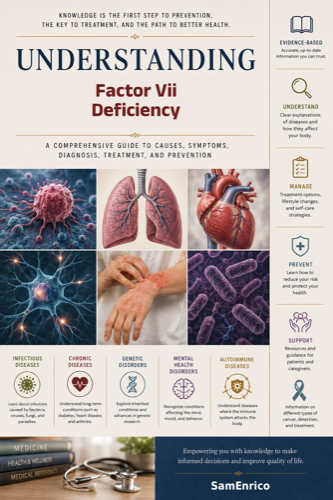
Understanding Factor Vii Deficiency eBook
This disease publication, published by SamEnrico,
by Bolt Rashad
This disease publication, published by SamEnrico, covers Understanding Factor Vii Deficiency
Formats
Free sample
Chapter 1: The Clotting Domino--–- Every human body carries a remarkable defense system that most people never think about until it fails. Hidden within the bloodstream, a carefully balanced team of twelve proteins—each called a clotting factor—stands ready to seal leaks, repair injuries, and prevent minor cuts from becoming life-threatening emergencies. Among these twelve, Factor VII occupies a uniquely important position: it is the trigger, the alarm bell, the first responder that launches the entire clotting cascade into action. When Factor VII works properly, you heal normally from surgery, survive car accidents without bleeding internally, and never wonder why that kitchen knife slip stopped bleeding within minutes. But when Factor VII is deficient—when the body produces too little of this critical protein—the entire domino chain topples, and the consequences can range from mysterious bruising to catastrophic brain bleeds.This book exists to shine a light on that shadow.
Factor VII deficiency is one of the most common among the rare bleeding disorders, yet it remains poorly understood even by many physicians. Patients often spend years being told they are “just clumsy” or that their nosebleeds are “normal” before finally receiving a correct diagnosis. Families struggle with decisions about treatment, pregnancy, sports, and surgery without clear guidance. And researchers continue to uncover new genetic mutations and treatment possibilities that could change lives. This chapter begins the journey by laying the foundation: what exactly Factor VII is, how the coagulation cascade works, how common (or rare) this deficiency truly is, and why every patient’s experience is uniquely their own.The Coagulation Cascade: A Delicate Balancing Act To understand Factor VII deficiency, one must first understand the astonishing complexity of normal blood clotting.
The human body maintains blood in a liquid state for most of its journey through vessels, heart, and capillaries. But when a blood vessel is damaged—whether by a paper cut, a surgical incision, or a blow to the head—the body must rapidly transform that liquid into a solid plug. This transformation is called hemostasis, and it involves three overlapping systems: the platelets (tiny cell fragments that form an initial plug), the blood vessel walls (which constrict to slow blood flow), and the coagulation cascade (a chain reaction of proteins that reinforces the plug with fibrin threads).The coagulation cascade is often divided into three pathways: the intrinsic pathway, the extrinsic pathway, and the common pathway. Think of them as two separate on-ramps that merge into the same highway. The intrinsic pathway (measured by a lab test called the activated Partial Thromboplastin Time, or a PTT) involves factors XII, XI, IX, and VIII.
The extrinsic pathway (measured by the Prothrombin Time, or PT) involves Factor VII working together with tissue factor—a protein normally hidden beneath the lining of blood vessels. When a blood vessel is injured, tissue factor becomes exposed to circulating blood. Factor VII binds to tissue factor, and this complex then activates Factor X, which begins the common pathway leading to the formation of thrombin and ultimately fibrin. In short, Factor VII is the match that lights the flame. Without enough Factor VII, the match sputters, and the flame may never catch.This elegant system typically works so seamlessly that we never notice it.
But in Factor VII deficiency, the extrinsic pathway is compromised while the intrinsic pathway remains intact. That is why a patient with FVII deficiency will have a prolonged PT test but a normal a PTT—a key diagnostic clue discussed in detail in Chapter 4. The body still has all the other factors, but it lacks sufficient quantity of the one protein that initiates the extrinsic pathway. The result is not necessarily a total inability to clot, but rather a delay and unreliability in clot formation. Some people with mild deficiency clot almost normally most of the time, only struggling after major trauma or surgery.
Others with severe deficiency may experience spontaneous bleeding into joints or the brain without any identifiable injury.A Brief History: From Confusion to Clarity The story of Factor VII deficiency is, in many ways, the story of modern hematology itself. Before the 1950s, physicians recognized a group of bleeding disorders that did not fit the classic pattern of hemophilia A (Factor VIII deficiency) or hemophilia B (Factor IX deficiency). These patients had prolonged bleeding times and family histories suggestive of a genetic problem, but their lab tests looked different from the hemophilias. Some were labeled simply “parahemophilia,” a catch-all term that caused more confusion than clarity.In 1951, a researcher named Alexander and his colleagues described a patient with a severe bleeding tendency whose plasma failed to correct a specific coagulation defect in a way that suggested an entirely new factor deficiency. Over the following years, Factor VII was isolated, characterized, and distinguished from other clotting factors.
The condition was initially referred to by various names, including “Alexander’s factor deficiency” in some early literature. However, it is critically important to note that Factor VII deficiency has never been called “Alexander’s disease”—that term belongs to an unrelated and devastating neurological condition affecting the brain’s white matter (a leukodystrophy). The similar-sounding names have caused confusion in online forums and patient groups, so this book sets the record straight: Factor VII deficiency has no eponymous disease name, and it should never be confused with Alexander’s disease.The modern understanding of FVII deficiency advanced significantly in the 1980s and 1990s with the cloning of the F7 gene and the development of recombinant Factor VIIa (r FVIIa, brand name Novo Seven) as a treatment. For the first time, patients with severe deficiency had a reliable, virus-free replacement therapy that could be administered at home. Registries were established to track outcomes, and genetic testing became available to identify specific mutations.
Today, Factor VII deficiency is recognized as the most common among the “rare bleeding disorders” (those affecting factors other than VIII or IX), though it remains far less common than hemophilia A or B.Epidemiology: How Rare Is “Rare”?The word “rare” in medicine carries a specific definition: in the United States, the Rare Diseases Act of 2002 defines a rare disease as one affecting fewer than 200,000 people. Factor VII deficiency comfortably meets this threshold, with an estimated prevalence of approximately 1 in 300,000 to 1 in 500,000 individuals in the general population. However, these numbers are estimates based on diagnosed cases, and many experts believe mild deficiency is significantly underdiagnosed. A person who bruises easily but never has a major bleed may never undergo the specific testing needed to identify FVII deficiency.The true frequency of FVII deficiency varies dramatically by geography and ethnic background due to the genetic inheritance pattern (explored fully in Chapter 2). In populations where consanguineous marriage—marriage between blood relatives—is common, the prevalence rises sharply.
For example, studies from Iran, parts of the Middle East, and Southern Europe (particularly Spain and Italy) have reported prevalence rates as high as 1 in 50,000 to 1 in 100,000. Israel’s Arab population has shown similarly elevated rates. This geographic clustering is not due to any environmental factor but rather to the simple mathematics of autosomal recessive inheritance: when parents share a recent common ancestor, they are more…
This is the end of the free sample. Get the eBook to keep going. Buy now
About this book
Details
- Author
- Bolt Rashad
- Publisher
- SamEnrico
- Language
- English
- Genre
- Non-Fiction, Informative, Educational
- Released
- 2026-06-02
- Pages (approx.)
- 159
- Available as
- eBook, Audiobook

Read better in the ZLOADR app
Your eBooks on your phone or tablet. Sign in with your SamEnrico account and start reading.
More by Bolt Rashad
 Emotional Eating and Diet CultureBolt Rashad$11.99
 Herniated Disc MeditationBolt Rashad$11.99
 Hypnotic Competition SimulationBolt Rashad$11.99
 The Active ListenerBolt Rashad$11.99
 Airline Pilot Stress ManagementBolt Rashad$11.99
 The Miracle on Ice: The Untold OvertimeBolt Rashad$11.99
 The Bridge That Time Forgot: The Mysterious Collapse of the Roman Pont du GardBolt Rashad$11.99
 Data Presentation Cheat Sheet for AnalystsBolt Rashad$12.99
 Procurement in PharmaceuticalsBolt Rashad$12.99
 How to Start a Cyclic Hydrocarbons (saturated and Unsaturated) Business (Beginners Guide)Bolt Rashad$11.99
 Pet Grooming (Basic Certification)Bolt Rashad$11.99
You may also like
 Hong Kong Handover 1997Dunn Johnnie$11.99
 Zumba For Postnatal Recovery CourseNeal Christian$11.99
 Zumba for BeginnersLadner Nikia$11.99
 YouTube Comment Mining GuideHumes Pandora$12.99
 Worry Box MeditationCarlin Rudy$11.99
 Workplace Stress MeditationNguyen Lynn$11.99
 Workplace Stress and Sleep RepairHawley Ivory$11.99
 Workplace Perfectionism CureDelaney Jeffry$11.99
 Workplace Injustice Anger GuideWallen Isabelle$11.99
 Work Addiction and Burnout LinkGreenwood Ester$11.99
 Women in Yoga and WellnessBeattie Galina$11.99
 Women in Stand Up ComedyChun Evangeline$11.99