
Non-FictionInformativeEducational
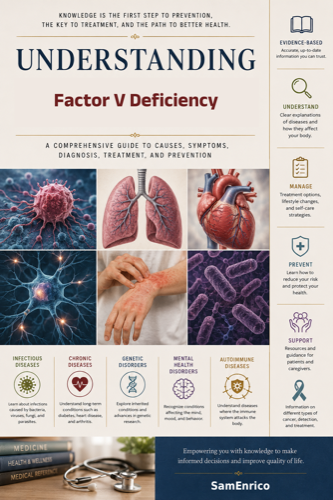
Understanding Factor V Deficiency eBook
This disease publication, published by SamEnrico,
by Aguiar Malia
This disease publication, published by SamEnrico, covers Understanding Factor V Deficiency
Formats
Free sample
Chapter 1: The Clotting Orchestra...--–- Imagine for a moment that your body is a symphony. Every instrument—the strings, the brass, the percussion—must play in perfect harmony to produce beautiful music. If one section falls silent, the entire piece falters. If the violins play too loudly while the cellos drop out, chaos ensues. Your circulatory system operates much the same way.
Blood, that remarkable crimson river, must remain fluid enough to travel through thousands of miles of vessels, yet ready to solidify into a protective plug the moment a vessel wall is breached. This delicate balance is called hemostasis—the body’s own emergency response system. And at the heart of this system, standing on the conductor’s podium, is a protein you have likely never heard of: Factor V.Without Factor V, the clotting symphony falls apart. Bleeding does not stop. A minor nick becomes a major event.
A routine surgery turns into a life-threatening crisis. This chapter is your invitation to understand not just what Factor V does, but why its absence—whether inherited or acquired—creates one of the rarest and most misunderstood bleeding disorders in medical literature. By the time you finish these pages, you will see your blood in a completely new light.The River and the Dam: Why Blood Must Clot To appreciate Factor V, you must first appreciate the problem that clotting solves. Your body contains approximately 1.5 gallons of blood, pumped with relentless efficiency by a heart that beats nearly 100,000 times per day. That blood travels through an astonishing network: if you laid all your arteries, veins, and capillaries end to end, they would circle the Earth more than twice.
This system is under constant low-grade assault. Every time you stand up, tiny vessels in your feet rupture and seal themselves without your knowledge. Every time you chew, microscopic tears in your gums are repaired before you taste metal. Every time your organs shift during digestion, small bleeds are quelled instantly.The body cannot afford to wait. A hemorrhage into a joint, a muscle, or—most terrifyingly—the brain can cause permanent damage in minutes.
So evolution crafted a rapid-response system that works in seconds. This system relies on a cascade, a chain reaction where one inactive protein activates the next, which activates the next, creating massive amplification from a tiny trigger. Think of it like dropping a single pebble into a still pond: the ripples expand outward, growing larger as they travel. In the coagulation cascade, one activated factor can activate dozens of the next factor, which activates hundreds of the next, culminating in billions of fibrin strands woven into a stable clot.But amplification requires precision. If the cascade triggers when it should not—if the orchestra plays the loudest note without a conductor’s cue—you develop thrombosis, a dangerous clot inside an uninjured vessel.
That clot can travel to your lungs (pulmonary embolism) or brain (stroke). If the cascade fails to trigger when it should—if the musicians sit silently while the building burns—you bleed uncontrollably. Factor V Deficiency belongs to the latter category: a failure of amplification, a conductor who has left the podium.The Roman Numerals of Clotting: A Brief Naming History When scientists first discovered the clotting factors in the mid-20th century, they named them not by function but by order of discovery. This has led to enduring confusion, even among medical students. Factor I is fibrinogen, the final protein that becomes the mesh of the clot.
Factor II is prothrombin, which becomes thrombin—the master enzyme that cleaves fibrinogen into fibrin. Factors VII, VIII, IX, X, XI, and XII each play specialized roles. But the most important number for our purposes is Factor V.Factor V was discovered in 1943 by a Norwegian physician named Dr. Paul Owren, whom you will meet properly in the introduction of this book. He identified a young woman with a severe bleeding disorder that did not match any known condition.
Her blood lacked something—something essential. Owren named the missing factor “Factor V,” with “V” standing for the fifth factor identified in the coagulation system. He also called it “labile factor” because it degraded quickly when blood was stored, and “proaccelerin” because it accelerated the conversion of prothrombin to thrombin.But the name is far less important than the job description. Factor V is not an enzyme. It does not cut other proteins.
Instead, Factor V is a cofactor—a helper molecule that binds to surfaces and dramatically increases the speed of an enzymatic reaction. Without Factor V, the enzyme that converts prothrombin to thrombin (called Factor Xa) works at a snail’s pace. With Factor V, that same enzyme works thousands of times faster. Factor V is the turbocharger on the engine of coagulation.The Two Lives of Factor V: Circulating and Platelet-Bound Here is where the story becomes both fascinating and clinically critical. Factor V exists in two distinct pools within your body.
The first pool, accounting for approximately 80% of all Factor V, circulates freely in your plasma (the liquid portion of blood). This plasma Factor V is inactive, waiting for the signal that an injury has occurred. The second pool, accounting for the remaining 20%, lives inside tiny blood cells called platelets.Platelets are the first responders of hemostasis. When a blood vessel tears, platelets rush to the site, change shape from smooth discs to spiky stars, and stick to one another, forming a temporary plug. This platelet plug is weak—it can stop oozing from a small cut but cannot withstand arterial pressure.
To become strong, the plug needs reinforcement: a mesh of fibrin woven through and around the platelets. And to create fibrin, the platelets need thrombin. To create thrombin efficiently, they need Factor V.But here is the critical nuance: the Factor V inside platelets is not identical to the Factor V in plasma. Platelet Factor V is partially pre-activated and stored in dense granules, ready for immediate release at the injury site. Think of plasma Factor V as firewood stacked in the yard, and platelet Factor V as kindling already in the fireplace.
When a bleed starts, platelet Factor V is released instantly, providing the initial burst of coagulant activity while plasma Factor V is recruited from the circulation. This two-pool system explains one of the great mysteries of Factor V Deficiency: why some patients with almost undetectable plasma Factor V levels bleed only mildly. Their platelet Factor V may be partially preserved, compensating for the missing plasma protein.The Molecular Structure: A Protein Built in Domains To truly understand how Factor V works—and what goes wrong in deficiency—you need a mental image of its structure. Factor V is a large protein, weighing in at approximately 330,000 daltons (for comparison, a single water molecule weighs 18 daltons). It is composed of three repeating structural units called A domains (A1, A2, and A3), two B domains (B1 and B2), and two C domains (C1 and C2).
The A domains are similar to a copper-binding protein called ceruloplasmin; the C domains resemble a fat-binding protein called discoidin. But the B domain is unique to Factor V and its close relative Factor VIII.The…
This is the end of the free sample. Get the eBook to keep going. Buy now
About this book
Details
- Author
- Aguiar Malia
- Publisher
- SamEnrico
- Language
- English
- Genre
- Non-Fiction, Informative, Educational
- Released
- 2026-05-09
- Pages (approx.)
- 160
- Available as
- eBook, Audiobook

Read better in the ZLOADR app
Your eBooks on your phone or tablet. Sign in with your SamEnrico account and start reading.
More by Aguiar Malia
 Flow State Self HypnosisAguiar Malia$11.99
 The Small Talk DeepenerAguiar Malia$11.99
 The Pain Reframing GuideAguiar Malia$11.99
 Estimate Your Downsize ProceedsAguiar Malia$11.99
 Military Combat Stress ManagementAguiar Malia$11.99
 The Velvet Throne: How a Princess Stole the CrownAguiar Malia$11.99
 The Salt of the Earth: Uncovering Jordan's Ancient SeasAguiar Malia$11.99
 How to Start a Cyclotron Business (Beginners Guide)Aguiar Malia$11.99
 Procurement in Oil and GasAguiar Malia$12.99
 Executive Summary Best Practices for Government ProposalsAguiar Malia$12.99
 Penalty Box AttendantAguiar Malia$11.99
You may also like
 Hong Kong Handover 1997Dunn Johnnie$11.99
 Zumba For Postnatal Recovery CourseNeal Christian$11.99
 Zumba for BeginnersLadner Nikia$11.99
 YouTube Comment Mining GuideHumes Pandora$12.99
 Worry Box MeditationCarlin Rudy$11.99
 Workplace Stress MeditationNguyen Lynn$11.99
 Workplace Stress and Sleep RepairHawley Ivory$11.99
 Workplace Perfectionism CureDelaney Jeffry$11.99
 Workplace Injustice Anger GuideWallen Isabelle$11.99
 Work Addiction and Burnout LinkGreenwood Ester$11.99
 Women in Yoga and WellnessBeattie Galina$11.99
 Women in Stand Up ComedyChun Evangeline$11.99