
Non-FictionInformativeEducational
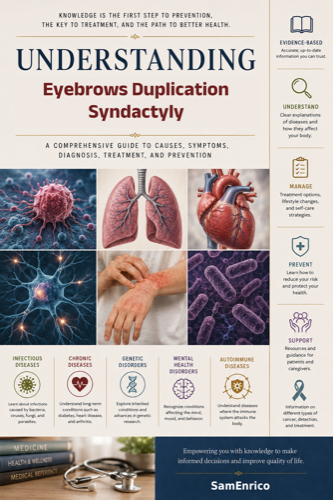
Understanding Eyebrows Duplication Syndactyly eBook
This disease publication, published by SamEnrico,
This disease publication, published by SamEnrico, covers Understanding Eyebrows Duplication Syndactyly
Formats
Free sample
Chapter 1: The Unseen Triad...--The child arrived on a Tuesday morning, carried in the arms of a mother who had stopped hoping for answers three years earlier. She sat in the plastic chair of the genetics clinic at Hadassah Medical Center in Jerusalem, her seven-year-old boy fidgeting beside her, his hands resting palms-up on his thighs. It was 1988, a time when the human genome was still largely unmapped, when the word "gene" still carried an air of abstraction for most physicians, and when a child with an undiagnosed condition was often labeled with the cruelest clinical term: unknown etiology – medical shorthand for "we do not know."Dr. Miriam Berkenstadt, a clinical geneticist with a reputation for solving puzzles that others had abandoned, noticed the boy's eyebrows first. They were not normal.
Each brow had not one tail arcing gracefully toward the temple but two – a main brow in the expected position and, lateral to it, a distinct secondary tuft of darker, coarser hair. It was as if someone had taken an eraser to the usual boundary line and drawn a second one further out. She had seen many eyebrow anomalies in her career: synophrys (the united eyebrows of Waardenburg syndrome), thinning (the sparse brows of ectodermal dysplasia), even complete absence. But duplication? She could not recall a single case.Then she looked at his hands.
The fingers of the right hand were webbed – digits two, three, and four bound together by soft, pliable skin that stretched like the webbing between a frog's toes. The left hand showed a milder version of the same finding. The toes, too, were involved: digits two and three on each foot connected by a cutaneous bridge. The webbing was complete but flexible, and when she gently pulled the fingers apart, the skin stretched without blanching or resistance. There was no bone involvement – no fused phalanges, no abnormal nail folds.
Just skin. Just an error in the body's decision to separate what should have been apart.The mother, a woman in her thirties who had the weary posture of someone who had repeated her story too many times, explained the family history in fragments. The boy's father was also her half-sibling. They shared one parent. The family was Jewish, of no particular geographic origin that she could name.
She had had a normal pregnancy, a normal delivery, and no exposure to medications or toxins. No one else in the family – not the grandparents, not the aunts or uncles, not the other children (there were none) – had anything like this. "Is he the only one in the world?" she asked.Dr. Berkenstadt did not answer immediately. She was already reaching for the small notebook she kept for unusual cases, the one with the black cover and the handwritten index that she never let her residents borrow.
She wrote: *Male, age 7. Eyebrows: bilateral lateral duplication. Hands: soft syndactyly digits 2-4. Feet: syndactyly digits 2-3. Skin: hyperelastic on face and chest, no fragility.
Eyelashes: markedly long (trichomegaly). Periorbital skin: excessive wrinkling when eyes closed. No dysmorphic facies. No cleft. No cardiac murmur.
Development: normal, attending regular school, age-appropriate academics. Family: half-sibling parents. No other affected.*She would later add: Joint hypermobility: none. Lip fibromas: none. Cognition: formally tested, normal IQ.What Dr.
Berkenstadt did not know, as she closed her notebook that Tuesday, was that an almost identical child was living thousands of miles away in a different context entirely. And that a few months later, a separate paper would appear in the American Journal of Medical Genetics describing not one but two related children – a brother and sister from a consanguineous Jewish North African family – with the same improbable combination of findings: duplicated eyebrows, webbed fingers and toes, stretchy skin, and long eyelashes. But those siblings also had features that Dr. Berkenstadt's patient lacked: congenital lip fibromas (small, benign growths on their lower lips) and joint hypermobility that allowed their fingers to bend backward beyond the normal range without pain.Three patients. Two families.
One pattern.And no name.The Problem of the Unnamed For a condition to enter the medical consciousness – to appear in textbooks, to earn an OMIM entry, to be searchable on Pub Med – it needs a name. But naming a newly discovered syndrome is a treacherous act. Name it after a person (Crouzon, Marfan, Apert) and you risk obscuring the phenotype behind a proper noun that means nothing to the uninitiated. Name it descriptively (oculocutaneous albinism, nail-patella syndrome) and you risk missing the cases that don't fit the exact description. Name it before you understand the genetics and you risk having to rename it later.The condition that Dr.
Berkenstadt observed had no name. In her 1989 paper, co-authored with seven colleagues and published in the Journal of Medical Genetics, she called it simply: A new syndrome of eyebrow duplication, syndactyly, and hyperelasticity in a child with half-sibling parents. That was not a name; it was a sentence. A few months later, Gross-Kieselstein and Har-Even published their two cases under the even less memorable title: Familial occurrence of eyebrow duplication, syndactyly and hyperelasticity. The descriptive similarity between the two papers was unmistakable, but no single author proposed a unifying term.This book proposes one: Eyebrows Duplication Syndactyly (EDS).
It is a functional name, descriptive without being cumbersome, and it captures the two most visible findings – the eyebrows and the fingers – without overpromising on the genetics. But the reader must understand: EDS is not a diagnosis that appears in any automated coding system. It is not in the ICD-11 (the international classification of diseases) as of this writing. It has no designated billing code. A clinician who searches for it on Up To Date will find nothing.
A parent who types the words into Google will encounter exactly three primary research papers, two of them from 1989, and a handful of secondary citations.This is the landscape of ultra-rare disease. And this chapter is the first attempt in over three decades to map it systematically.Defining the Core Triad Every syndrome needs a skeleton – a minimal set of features that must be present for the diagnosis to be considered. For EDS, that skeleton consists of three findings. They are:1. Lateral partial duplication of the eyebrows.
This is not a simple thickening of the brow, nor is it a stray hair or two growing outside the usual border. It is a discrete, anatomically distinct secondary tuft of terminal hair located lateral to the main brow body. In the three confirmed cases, the duplication was bilateral (both brows affected) and symmetric. The duplicated hair is typically coarser and darker than the surrounding vellus (fine) hair, and in some patients it extends toward the temporal region, creating the appearance of a brow that has been stretched laterally. No confirmed case of medial duplication (duplication toward the midline) exists in the literature.
The clinical significance of this finding – its visibility, its impact on social perception, its cosmetic management – is explored in Chapter 10. For diagnostic purposes, the clinician need only confirm that an extra lateral tuft exists.2. Cutaneous syndactyly of the fingers. Syndactyly means "webbed digits." It occurs when the normal process of interdigital apoptosis (programmed cell death) fails…
This is the end of the free sample. Get the eBook to keep going. Buy now
About this book
Details
- Author
- Hershberger Ramonita
- Publisher
- SamEnrico
- Language
- English
- Genre
- Non-Fiction, Informative, Educational
- Released
- 2026-05-09
- Pages (approx.)
- 157
- Available as
- eBook, Audiobook

Read better in the ZLOADR app
Your eBooks on your phone or tablet. Sign in with your SamEnrico account and start reading.
More by Hershberger Ramonita
 Emotional Eating AssessmentHershberger Ramonita$11.99
 Breath as Pain AnchorHershberger Ramonita$11.99
 The Real Estate NetworkHershberger Ramonita$11.99
 Body Image for Short Stature GuideHershberger Ramonita$11.99
 Self Esteem and Disability LoveHershberger Ramonita$11.99
 Whispers from the Black Forest: The Curse of the 12th CenturyHershberger Ramonita$11.99
 The Alchemist of the Gold Coast: Unlocking the Secrets of Life in 16th-Century AfricaHershberger Ramonita$11.99
 OTB (Off-Track Betting) ClerkHershberger Ramonita$11.99
 Executive Summary Sprint for Urgent DecisionsHershberger Ramonita$12.99
 Procurement Shared ServicesHershberger Ramonita$12.99
 How to Become a Molybdenum-steamer OperatorHershberger Ramonita$11.99
You may also like
 Hong Kong Handover 1997Dunn Johnnie$11.99
 Zumba For Postnatal Recovery CourseNeal Christian$11.99
 Zumba for BeginnersLadner Nikia$11.99
 YouTube Comment Mining GuideHumes Pandora$12.99
 Worry Box MeditationCarlin Rudy$11.99
 Workplace Stress MeditationNguyen Lynn$11.99
 Workplace Stress and Sleep RepairHawley Ivory$11.99
 Workplace Perfectionism CureDelaney Jeffry$11.99
 Workplace Injustice Anger GuideWallen Isabelle$11.99
 Work Addiction and Burnout LinkGreenwood Ester$11.99
 Women in Yoga and WellnessBeattie Galina$11.99
 Women in Stand Up ComedyChun Evangeline$11.99